An archive is not the experience
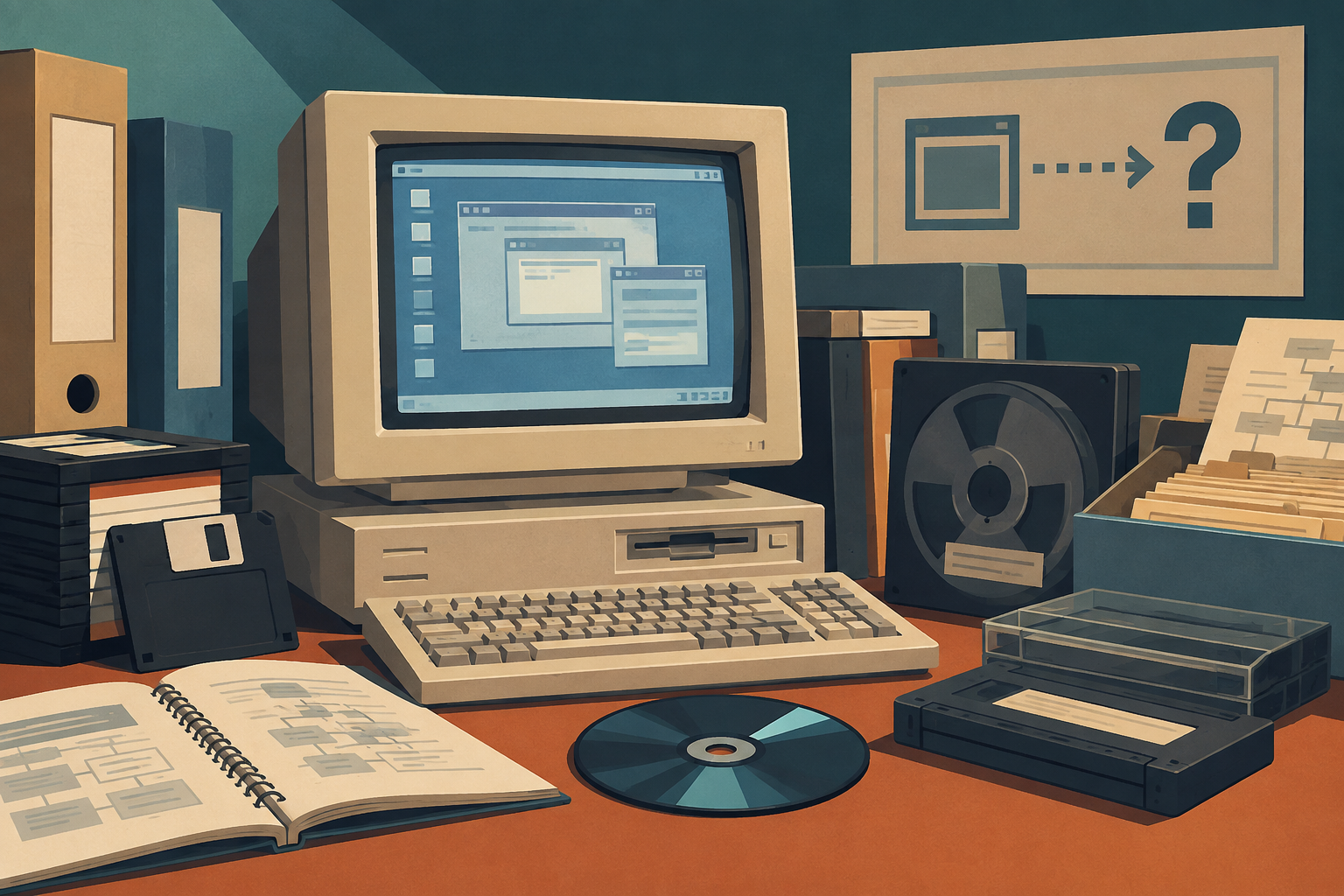
A program can survive as a file and still cease to be usable. This distinction—stated explicitly in RetroPause’s article about software museums—requires two separate questions: has a digital object been preserved, and can it be run again in conditions that help us understand how it worked? A positive answer to the first does not prove the second.
The distinction matters because software is not merely an image on a screen. Its use depends on a machine and system being able to interpret data and run the program. Yet the supplied evidence identifies no particular products, formats, platforms, or procedures. It therefore cannot support a technical how-to or a claim that a specific program can be recovered. The starting point here is the boundary between preserving information and preserving an operational experience.
What preservation means
The entry on digital preservation describes its goal as maintaining the integrity, authenticity, reliability, legibility, and functionality of information despite technological change. This is a broad formulation, but it is useful for thinking about software: keeping a copy addresses the continuity of content; maintaining the possibility of use introduces a different requirement.
That distinction should not be turned into a false opposition. A preserved copy can be valuable even if it cannot be run. It may document that a program existed or form part of a body of records. Conversely, getting something to open does not, by itself, prove that the file is intact, authentic, or representative of its original state. The available sources provide no technical case studies that would let us assess these conditions for a particular program.
The value of documentation
Institutional archives provide a framework for thinking about the work surrounding preserved objects. The National Archaeological Museum presents its historical archive as a resource for research by its departments and by external researchers. A discussion of museum archives lists tasks such as appraisal, acquisition, arrangement, description, preservation, and making records accessible. These are not software-specific instructions, but they support an important idea: preservation also means leaving information that helps people identify, understand, and consult what has been kept.
Applied cautiously to old software, this suggests documenting what was received, how it is identified, and what is—and is not—known about its use. A label reading “old program” is not enough. A useful description would distinguish verifiable facts from hypotheses and state whether the collection includes a file, a physical medium, related documentation, or a verifiable means of execution. The evidence assembled here does not describe a standard protocol for producing such a record, so it would be irresponsible to present a mandatory sequence of steps.
Execution as a question, not a promise
The ability to run a program may seem the most direct way to approach its operation, but the word “work” needs context. Does the file open? Does the program behave as expected? Has a documented condition of use been preserved? Without information about a product and its environment, these questions cannot be answered in the abstract.
An exhibition or article can therefore explain the distinction without staging a demonstration. It is reasonable to say that software raises questions of access and context; it is not reasonable to invent a user experience, a shared memory, or a specific compatibility claim. The title of RetroPause’s article about software museums captures the nuance: preservation is not the same as being able to run a program. Its supplied excerpt adds that software is not preserved in the same way as a console, magazine, or cartridge, and that copying a program is not the same as preserving its original medium. The available information does not support extending that comparison to particular formats or technologies.
What archives can and cannot prove
The sources on museum archives and institutional archives support the value of organizing records and making them available. They do not, by themselves, prove that a particular institution preserves old software or describe practices such as emulation, migration, or access. Likewise, a general definition of digital preservation does not prove that a particular program remains legible or authentic.
This caution does not weaken software history; it makes it more reliable. Research can identify its subject and distinguish material evidence from claims about operation. If the sources only document that a file is preserved, the conclusion should stop there. If they describe a program being run, that claim needs attribution and context. The evidence supplied here is not enough to reconstruct the history of a specific product or recommend technical procedures.
Preservation also means recognizing limits
Old software brings a question into focus that can hide behind the word “archive”: what do we want to keep available for the future? Documents, data, and the ability to run a program are not equivalent, even when they are related. The archival work described in the sources helps explain why identifying, describing, and providing access to records matter; the definition of digital preservation reminds us that the goal is more than storage.
The strongest conclusion is also the most measured: keeping a program is a beginning, not a guarantee that it will run again. Any stronger claim requires specific evidence about the object, its documentation, and its conditions of use. Until that evidence exists, acknowledging uncertainty is part of preserving it rigorously.
- Decade
- Contemporary
- Region
- Global
- Level
- Introduction
- Entities
- Museum, Museo Arqueológico Nacional
Sources and references
- Archivo histórico - | Ministerio de Culturawww.man.es · 2026-09-29
- Archivos de Museo: Funcionamientoevemuseografia.com · 2026-09-29
- Archivos de museos. Una oportunidad para liderar el ...edicionsedic.es · 2026-09-29
- Museos de software antiguo: conservar no es lo mismo que ...www.retropause.com · 2026-09-29
- Preservación digitales.wikipedia.org · 2026-09-29