The history of Sinclair Research’s computers brings together a drive to make electronics affordable, machines with conspicuous technical compromises, and users who learned to program, play and experiment on them. From the ZX80 to the QL, the story was not a straight line: audiences, priorities and the company’s fortunes all changed.
From miniaturisation to the first ZX computers
Clive Sinclair had explored miniaturisation well before home computers. Sinclair Radionics, founded in 1961, sold small radios and calculators such as the Executive. It should not be confused with the business that made the ZX machines: that company’s route ran through Science of Cambridge, then Sinclair Computers, before it became Sinclair Research in 1981.
The Executive calculator of 1972 and the Black Watch digital watch of 1975, with its LED display, show two sides of that strategy. Miniaturisation brought new functions to users, but the watch’s reliability problems and returns exposed the cost of taking a design to market before its weaknesses had been resolved.
The ZX80, brought to market in 1980, offered BASIC, 1 KB of RAM and a connection to a television. Its price and low component count helped bring computing into homes without requiring a dedicated monitor. The design imposed clear limits: a membrane keyboard, monochrome images and an architecture in which the processor also helped generate the display. Owners could write programs, but had to work within the pauses and restrictions of a machine designed to keep costs down.
The ZX81, launched in 1981, kept the low-cost approach while using more integrated electronics, 1 KB of RAM and a larger ROM. Its fast mode could blank the screen while a program ran; slow mode kept the image visible at the cost of speed. External memory expansions also became part of the experience. These were simple computers, but not merely appliances: they invited users to experiment with BASIC and learn what limited resources could—and could not—do.
The Spectrum: creativity within technical limits
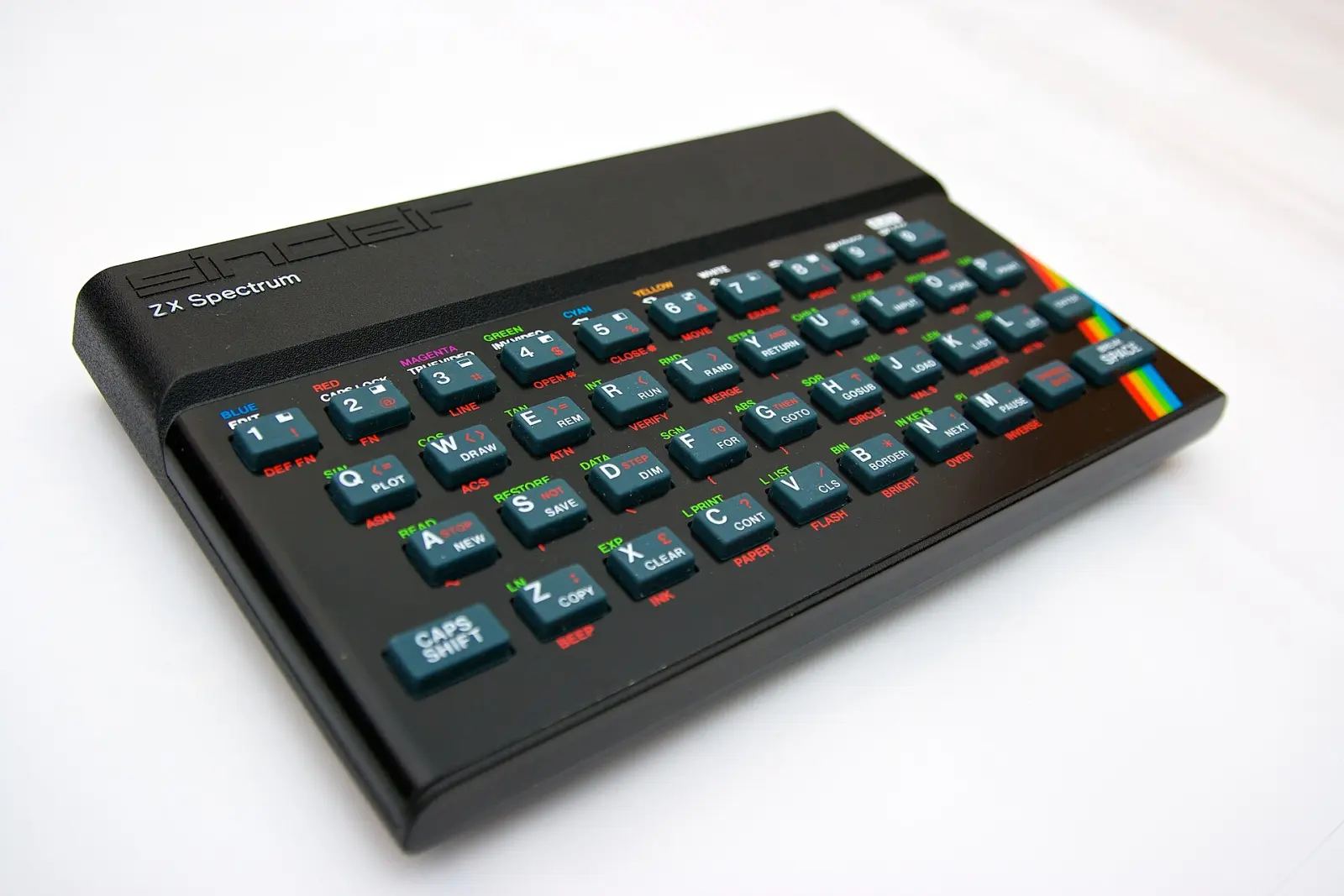
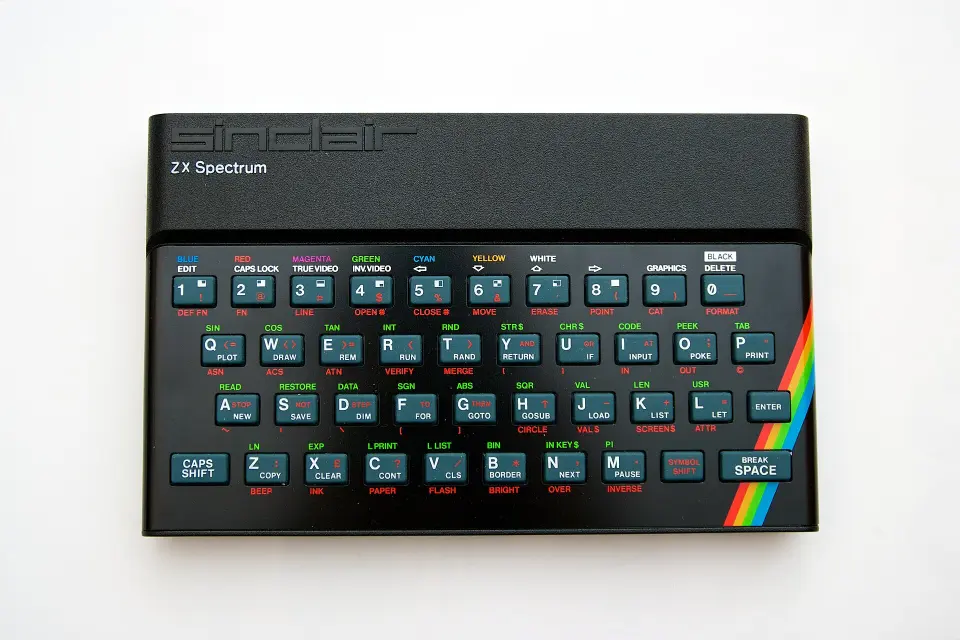
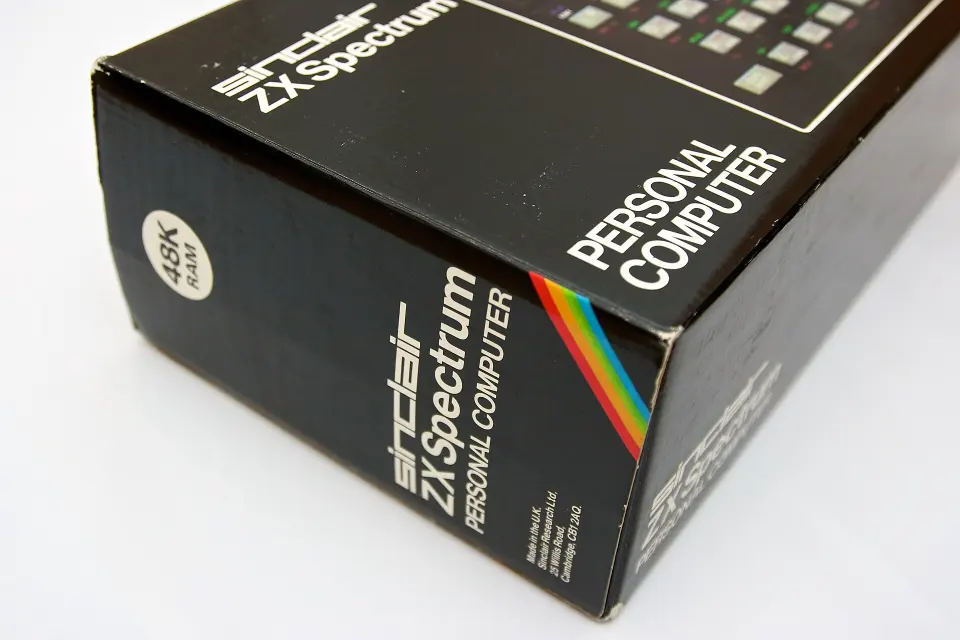
The ZX Spectrum, launched in 1982, widened the family’s reach. It was sold with 16 or 48 KB of RAM, a rubber keyboard, BASIC, television output, a simple internal speaker and external cassette storage. Its compact design and rainbow motif made it instantly recognisable, but its character also came from how it was programmed: keys and keyboard modes provided access to BASIC keywords, rather than requiring each command to be typed letter by letter.
The 256 × 192-pixel display produced colour while conserving memory, and that economy shaped the image. Ink, paper and brightness attributes were shared across 8 × 8-pixel cells. When different parts of an image needed incompatible colours within one cell, the familiar attribute clash appeared. For game programmers, this was not just an obstacle to work around; it influenced screen composition and the visual style associated with the Spectrum.
Programs loaded from cassette, bringing pauses and, at times, the need to adjust audio levels. The combination of computer, television and tape recorder made use of equipment many households already owned. The platform’s relatively low cost also helped support a market in games, utilities, peripherals and publications. The Spectrum became one of the UK’s most popular home computers and an introduction to computing for many people.
New cases, more memory and a change of owner
The Spectrum+, introduced in 1984, chiefly revised the case and keyboard of the 48K model; it did not introduce a new architecture. The larger memory arrived with the Spectrum 128, developed with the Spanish distributor Investrónica. It was presented in Spain in September 1985 and reached the UK in 1986. It added 128 KB of RAM, an AY-3-8912 three-channel sound chip, expanded ROM and additional connections; the Spanish model also came with an external numeric keypad.
In 1986, Amstrad bought Sinclair’s computer business and rights to its products, not the whole of Sinclair Research. Under Amstrad came the +2, with a built-in cassette deck, and the +3, with a 3-inch disk drive. They extended the Spectrum family, but hardware differences—and ROM variants—could affect software and peripheral compatibility.
The QL: professional ambitions and a troubled launch
The Sinclair QL, introduced in 1984, targeted a different audience. Its Motorola 68008 processor, 128 KB of RAM, QDOS operating system, SuperBASIC, Psion applications and twin Microdrives using tape cartridges placed it closer to a productivity computer than to the home use associated with the Spectrum. It was not a compatible successor to the Spectrum’s software library.
Its launch was marked by delays and technical problems. Planet Sinclair’s history of the QL says some customers waited months and received machines with faults; early units also shipped with the ROM on an external board because the software was not ready in time. The machine was ambitious, but early reliability problems and the challenge of competing in a business market turning towards IBM-compatible PCs constrained its prospects. The communities that kept the QL alive are part of its history, but they do not erase the launch difficulties or its more limited commercial reach compared with the ZX computers.
The C5, launched in 1985, belonged to Sinclair Vehicles, not the computer line. This electric three-wheeler with pedals faced concerns about road safety, exposure to the weather and practical usefulness. Its reception and Sinclair’s financial difficulties contributed to the wider context of the company’s crisis, but do not by themselves explain the course of the computer business.
Magazines, users and a shared culture
The Spectrum became more than a product. Software publishers, user groups, clubs and magazines grew around it, teaching programming and publishing listings. In Spain, MicroHobby, whose first issue appeared in November 1984, combined programs, reader questions, tips and technical material. Investrónica linked that market to the evolution of the Spectrum family, including development of the 128K.
The platform’s spread across Europe also produced related models, regional variants and compatible machines from other manufacturers. These should be distinguished from official Sinclair products: sharing some of the architecture did not make every computer identical or fully compatible.
Preserving the machines and their context
Preserving the Spectrum means keeping more than software: manuals, magazines, tape formats and technical documentation matter too. A program file, a cassette image and a memory snapshot do not preserve the same thing. Emulation makes it possible to study and run software on modern systems, but it does not replace the original machine or remove distribution rights.
ZXDB catalogues software, hardware, magazines and books related to the Spectrum and associated machines. The Fuse emulator supports several Sinclair models and many compatible computers, including Pentagon and Scorpion. That range matters: differences between machines can affect how a program behaves. Together with museum collections and period publications, these resources help reconstruct a history in which technical ingenuity coexisted with design compromises, business difficulties and a lively user culture.
Documentary gallery
- Decade
- 1980s
- Region
- Europe
- Level
- Enthusiast
- Entities
- Museum, Televisión
Sources and references
- The Centre for Computing History — Sinclair ZX80www.computinghistory.org.uk · 2026-11-11
- The Centre for Computing History — Sinclair ZX81www.computinghistory.org.uk · 2026-11-11
- The Centre for Computing History — Sinclair ZX Spectrum 48Kwww.computinghistory.org.uk · 2026-11-11
- The Centre for Computing History — Sinclair ZX Spectrum 128 and Investrónicawww.computinghistory.org.uk · 2026-11-11
- The Centre for Computing History — ZX Spectrum +3www.computinghistory.org.uk · 2026-11-11
- ZXDB — official preservation database documentationraw.githubusercontent.com · 2026-11-11
- Fuse — official Spectrum emulator documentationfuse-emulator.sourceforge.net · 2026-11-11
- World of Spectrum — Sinclair and Timex hardware referenceworldofspectrum.org · 2026-11-11
- World of Spectrum — 16K/48K technical referenceworldofspectrum.org · 2026-11-11
- Sinclair User, November 1985 — Spectrum 128 launch in Spainrk.nvg.ntnu.no · 2026-11-11
- Planet Sinclair — Sinclair QLrk.nvg.ntnu.no · 2026-11-11
- Planet Sinclair — Sinclair Micromatic radiork.nvg.ntnu.no · 2026-11-11
- MicroHobby Revisited — issue 1 archivemhr.speccy.org · 2026-11-11
- Planet Sinclair — Executive calculatorrk.nvg.ntnu.no · 2026-11-11
- Planet Sinclair — corporate history and company namesrk.nvg.ntnu.no · 2026-11-11
- Planet Sinclair — Black Watchrk.nvg.ntnu.no · 2026-11-11
- Planet Sinclair — C5 and Sinclair Vehiclesrk.nvg.ntnu.no · 2026-11-11
- World of Spectrum — preservation, emulation and permissionsworldofspectrum.org · 2026-11-11