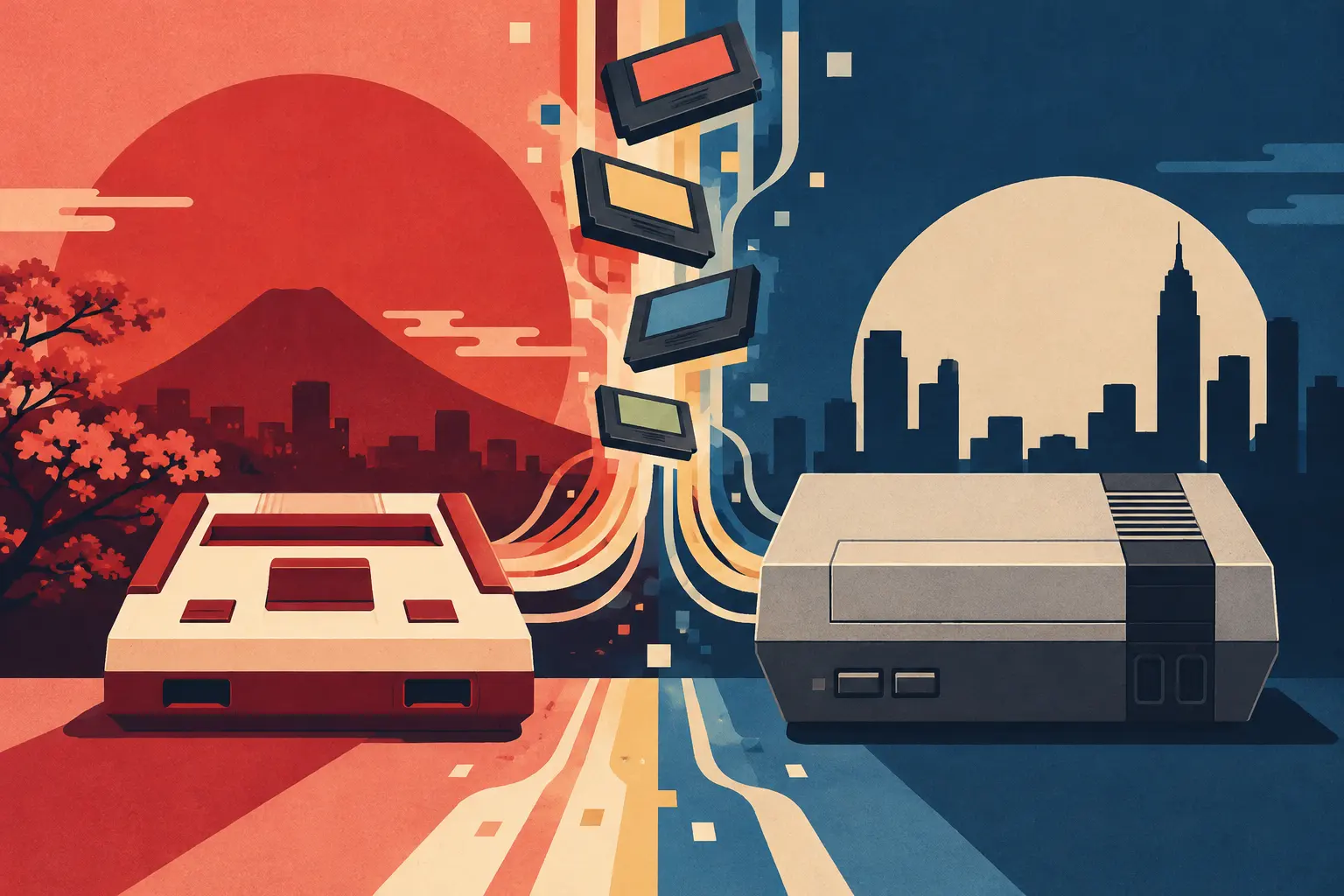
From the arcade to the living room
The Family Computer, commonly known as the Famicom, went on sale in Japan on 15 July 1983. Nintendo wanted an affordable, straightforward console that could bring some of the visual appeal of its arcade games into the home. Masayuki Uemura led its development at Nintendo R&D2. The aim was not to reproduce an arcade machine unchanged, but to adapt features such as sprites and screen scrolling to a cartridge-based home system.
Its architecture paired an 8-bit Ricoh processor based on the MOS 6502 with a dedicated graphics chip. That combination shaped both the machine’s capabilities and the possibilities available to game makers. The cartridge was not merely a replaceable medium; it also offered a way to extend what the console could do.
Design as part of the experience
The red-and-white casing made the Famicom instantly distinctive. Its two controllers were permanently attached and stored in recesses on the sides. The second had a microphone and volume control instead of Start and Select buttons, a configuration used by some Japanese games. The directional pad, developed from Nintendo’s work on Game & Watch, offered a compact alternative to the joystick common on many earlier consoles.
These choices also reflected priorities of cost and simplicity. Built-in controllers avoided connectors, but were harder to replace. Nintendo decided not to include a keyboard, modem or disk drive as standard, although expansion options had been considered. Instead, the console focused on cartridges, which let players change games without altering the machine.
The launch encountered a technical problem: some units could freeze during play. Nintendo recalled consoles and replaced their motherboards to address the fault. The revision helped stabilize the product and its relationship with retailers as the company opened a new chapter in the home market.
Cartridges and system expansion
Famicom cartridges used a 60-pin connector and did not physically fit NES cartridges. Over time, some cartridges incorporated additional circuitry to expand the system’s capabilities. Famicom’s expansion pins also allowed certain Japanese cartridges to add sound features that were not available in the same way on the Western NES.
The launch library included home versions of Donkey Kong, Donkey Kong Jr. and Popeye, making the link to Nintendo’s arcade catalogue explicit. Later participation by outside companies broadened the range and made the platform more than a means of bringing arcade hits home: the library also came to depend on third-party development and on the technical possibilities of individual cartridges.
Launched in Japan in 1986, the Famicom Disk System explored another way to extend the ecosystem. The add-on used rewritable disks and provided storage options useful, among other things, for saving games. It did not replace the base console or achieve comparable international distribution. Its significance lies in showing how the Famicom environment could grow through add-ons while remaining part of a shared platform.
Redesigning the machine for other markets
The NES retained the Famicom’s technical lineage but substantially changed its presentation and everyday use. Its front-loading casing, 72-pin cartridges and detachable controllers made for a different object: the controllers plugged into two ports on the front, and the second no longer had a microphone. The consoles shared a lineage, but their cartridges and accessories were not physically interchangeable without adaptation.
The redesign also responded to North American market conditions after the 1983 collapse of the US video game industry. Nintendo presented the machine as an “Entertainment System,” with a design closer to other household equipment, and promoted peripherals such as R.O.B. and the Zapper. The strategy aimed to frame the product differently for retailers and consumers; it does not by itself explain the system’s later reception, which also depended on distribution and software.
The history of the Famicom and NES is not that of two generations, but of one platform adapted for different markets. Regional variations affected connections, compatibility and functions, not just the colour or style of the casing. This combination of technical continuity and industrial change explains how closely related consoles could acquire such different identities.
A platform larger than the console
The Famicom is best understood by considering the machine, controllers, cartridges and add-ons together. The directional pad provided a compact form of control; fixed controllers embodied design and cost decisions; cartridges shaped a growing library; and accessories opened up different possibilities in different regions. The NES reframed several of these elements for an international presentation while retaining the shared technical foundation.
Their legacy is not limited to bringing arcade games to the television. The Famicom and NES show how industrial design, media and the organization of a software library influence one another. One platform could be presented with a different form, connections and commercial strategy while preserving the essential relationship between hardware and games.
- Decade
- 1980s
- Region
- Japan
- Level
- Enthusiast
- Entities
- Nintendo, Masayuki Uemura
Sources and references
- Family Computer - FamiWikifamiwiki.net · 2026-11-11
- Historia de Famicom / Nintendo Entertainment Systemwww.regionatlas.games · 2026-11-11
- Family Computer (Famicom) | RetroNESwww.retrones.net · 2026-11-11
- Nintendo Entertainment System - Wikipedia, la enciclopedia librees.wikipedia.org · 2026-11-11
- Consola: Family Computer Nintendo (Famicom) « Retroconsolawww.retroconsola.com · 2026-11-11