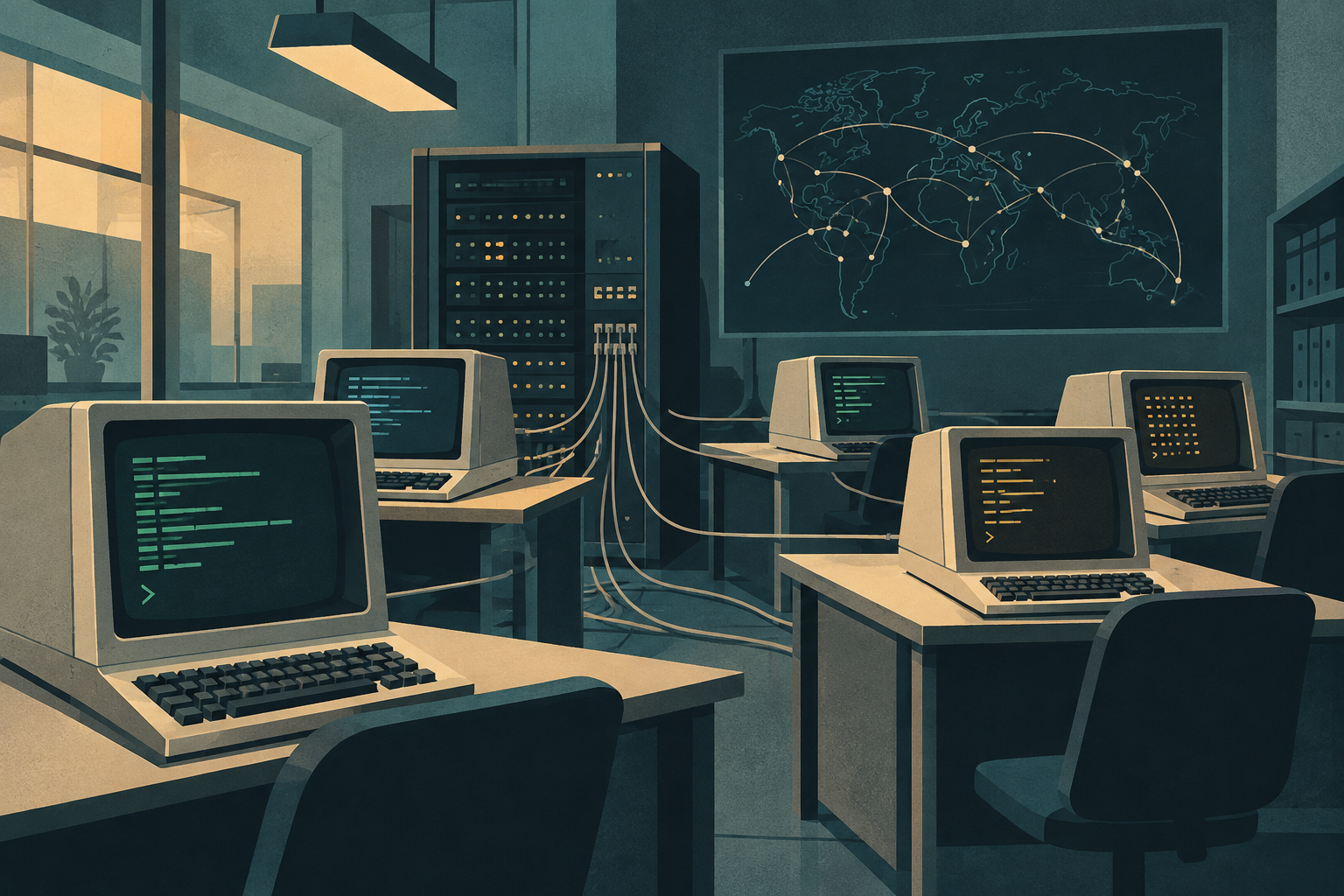
The image of the old Internet is often reduced to a slow web page open in a browser. But the history documented in the available sources is broader: long before the Web became the network’s most recognizable face, other ways to exchange messages, access computers and locate information already existed. It was not a staircase leading inevitably to today’s browser, but a set of networks, protocols and services that grew and overlapped.
A story that did not begin with a page
The Internet Society describes computers being added to ARPANET and the work on network protocols and software. It also notes that packet, satellite and radio-packet research networks brought groups together to coordinate their work through the means available. Email, file exchange and remote access appear in this account as significant uses, not merely as forgotten precursors to web browsing.
This perspective helps distinguish two ideas that are often conflated: the Internet as an infrastructure of interconnected networks, and the Web as one way of using it. The sources consulted support that general distinction, although they do not provide a complete technical chronology of every protocol or network involved in its development.
Messaging was a central function
In the Internet Society account, email stands out among early applications and is described as probably one of the most influential innovations of that period. The Internet history summary supplied by Wikipedia also mentions services such as email, remote access and file transfer, as well as online conversations and later forms of exchange.
There is no need to picture a modern inbox to understand the importance of this change. The evidence supports a more measured statement: the network was used to coordinate work and communicate before browsing pages became the experience people now most readily associate with the Internet. Email was not a decorative extra; it was one of the network’s notable applications.
Files and computers at a distance
File transfer and remote access also appear among the uses mentioned by the Internet Society. The Wikipedia history summary cites FTP and Telnet, among other services. These names point to actions different from visiting a web page: moving files or using the resources of another computer remotely.
The available evidence does not describe what each session looked like or let us reconstruct the experience of a particular user. It does, however, help correct a common simplification: before the Web, the Internet was not an empty space waiting for a browser. Tools with specific functions were already there, each associated with particular ways of accessing, communicating or sharing.
Discussion groups and distributed publishing
The same Wikipedia history summary says UUCPnet enabled text files to be published for others to read. It also reports that News software, developed by Steve Daniels and Tom Truscott in 1979, was used to distribute news messages and that this developed into discussion groups. Attribution and scope matter: these claims come from the supplied summary of an encyclopedic source, not from a direct examination of original technical documentation.
Even with that caution, the example shows that network culture included forms of publishing and conversation that did not depend on web pages. Reading, replying and participating could be organized through different systems. Nor should the history become uniform nostalgia: the sources do not establish that these tools were equally accessible to everyone or used in the same way in every region.
Finding information before web browsing
As the Internet grew during the 1980s and early 1990s, according to the supplied summary, the need to locate and organize files and information became more apparent. Gopher, WAIS and FTP archive lists are presented as projects that attempted to address that problem. It is important not to label them all “search engines” without qualification: the evidence describes different approaches to organization and access, not one tool or a shared solution.
This variety changes the retrospective picture of the network. The pre-Web experience was not simply a less polished version of today’s pages. Services had different purposes and modes of use; finding something could depend on knowing which system held the material. The cited sources do not detail every interface, so a precise visual reconstruction would require additional documentation.
An open chronology, not a straight line
CCCB Lab cautions that Internet history remains under construction and that timelines of familiar milestones leave gaps in research. Its observation is useful against accounts that reduce decades of collective work to a sequence of inventions and memorable dates. The Internet Society, meanwhile, presents development as collaboration among networks, working groups and applications.
Remembering the Internet before the Web therefore does not mean replacing one myth with another. The sources support a narrower, firmer conclusion: email, files, remote access, networked news and information-organizing systems belonged to an Internet history that did not begin with the browser. The Web transformed access to content, but it does not exhaust the network’s past. A fuller account would require more primary sources and historical documentation, especially about user experiences outside the best-known institutional narratives.
- Decade
- 1990s
- Region
- Global
- Level
- Introduction
- Entities
- No linked entities
Sources and references
- Historia de internetwww.fib.upc.edu · 2026-09-27
- Historia de Internet - Wikipedia, la enciclopedia librees.wikipedia.org · 2026-09-27
- Historia de Internet: ¿cómo nació y cuál ha sido su evolución? -www.telefonica.com · 2026-09-27
- Una breve historia de Internet - Internet Societywww.internetsociety.org · 2026-09-27
- Internet: una historia en construcción | CCCB Lab - CCCBlab.cccb.org · 2026-09-27
- Historia de Internet y de sus inicios en España | Archivo Digital UPMoa.upm.es · 2026-09-27
- Historia de Internet y de sus inicios en Españaforohistorico.coit.es · 2026-09-27