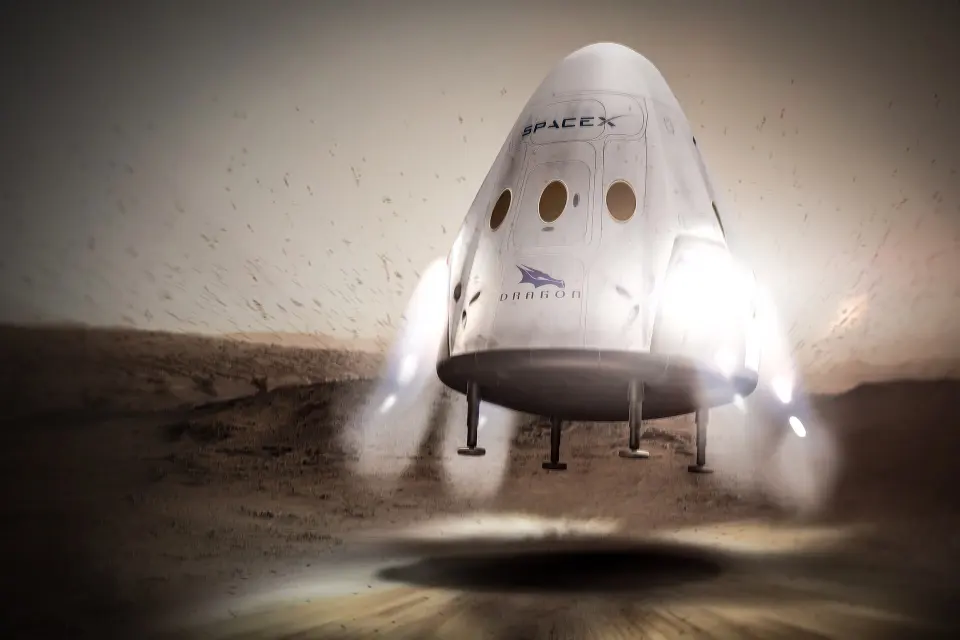
SpaceX’s Red Dragon project, introduced in 2011, was a modular orbital cargo vehicle that incorporated Super‑Draco engines for propulsion and precise maneuvers. Although never realized, it influenced the later Falcon Heavy design and laid conceptual foundations for rocket reuse.
Selected excerpts from our archive offer more context on this subject. Each reading links to the original article and its sources.
The origins of SpaceX Red Dragon and its place in private launch history
SpaceX's Red Dragon project was not a vehicle that was built and launched, but an idea that emerged in 2011 to redefine how the company approached orbital logistics. Its historical relevance does not lie in having flown, but in serving as a conceptual laboratory for the reuse technologies that would define the following decade. This article examines the technical roots of this concept and its impact on SpaceX's trajectory, based on available documentation and the context of the aerospace industry at the time.
Red Dragon emerged when SpaceX engineers identified that the Super-Draco engines, originally designed for the Dragon capsule's braking and attitude control system, generated enough delta-V to perform significant orbital maneuvers. This technical observation transformed a safety component into a propulsion tool. The idea was to use these engines to allow the capsule to adjust its orbit, perform precise docking, or even return to Earth without relying exclusively on main propulsion systems.
In 2011, SpaceX presented this concept to the public, describing it as an orbital cargo vehicle capable of operating with greater autonomy. The presentation was not just a product announcement, but a statement of intent regarding the versatility of the Falcon architecture. By showing that a cargo capsule could have its own maneuvering capabilities, SpaceX proposed a new standard for orbital flexibility. This moment marked an inflection point in the perception of the company, transitioning from being a launch provider to a developer of integrated space systems.
The Super-Draco engines were the technical heart of the Red Dragon proposal. Although their primary function was the safety of the crew and cargo, their ability to generate thrust in a vacuum made them ideal for orbital operations. The integration of these engines into the Red Dragon concept demonstrated SpaceX's philosophy of reusing proven components for new applications. This modular approach reduced development risks and accelerated the innovation cycle, a principle that would become central to the design of the Falcon Heavy and other subsequent missions.
KEY FACTS
- Type
- Device
- Year
- 2011
- Country or region
- USA
References
- La resurrección del Dragón Rojo de 1966translate.google.com
- Adiós a la Red Dragon de SpaceX - Eureka - Naukasdanielmarin.naukas.com
