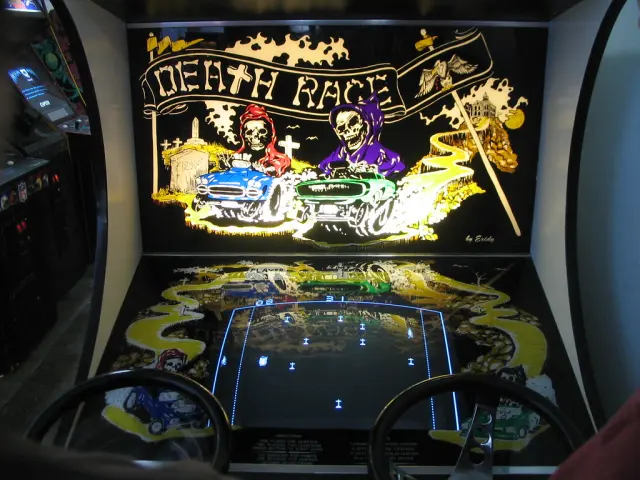
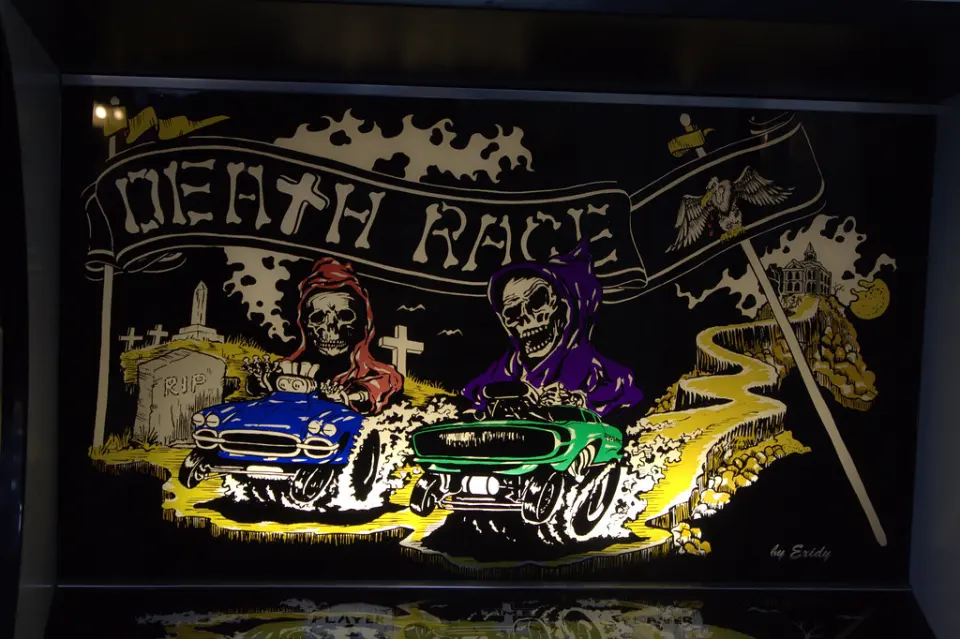
An arcade game developed and released by Exidy in the United States. Its first documented shipment to distributors was on April 1, 1976. The objective was to find figures called “gremlins”; the game supported one or two players controlling different cars and prompted public controversy in July 1976 over its depiction of killing humanoid figures.
Selected excerpts from our archive offer more context on this subject. Each reading links to the original article and its sources.
The Wheel and the Explosion: How Death Race Redefined Violence in 1976
In January 1976, arcades in the United States welcomed a cabinet that broke with the conventions of the time. Death Race, developed by Exidy, was not just a driving game; it was a machine designed for the player to experience destruction as the primary objective. Unlike previous titles, where violence was abstract or non-existent, here the collision with obstacles had immediate and explicit visual consequences. This paradigm shift did not go unnoticed and laid the foundations for what would be the first major public debate on the morality of interactive content.
The design of Death Race focused on the immediacy of action. The player controlled a vehicle using a steering wheel and pedals, an interface that sought to emulate the driving experience. However, the goal was not to reach the finish line, but to eliminate the obstacles that appeared on the screen. These included bombs, barriers, and other enemy vehicles. Upon impact, objects did not simply disappear; they exploded in a cloud of smoke and debris. This graphical representation of death and destruction was novel and, for many, disturbing.
To understand the magnitude of the reaction, it is necessary to situate the game in its context. In 1976, the video game industry was in its infancy. Most games were geometric abstractions or simple sports simulations. The idea that a game could represent violence so directly was unheard of. Death Race arrived four years after the first arcade games, at a time when society had not yet developed a framework for evaluating the impact of digital media on human behavior.
Indignation did not take long to arrive. Parents and school authorities began to point to the game as a negative influence on young people. The concern was not only about the violence itself, but about the possibility that interactivity would normalize aggression. Unlike a film or a book, where the viewer is passive, in Death Race the player was the active agent of destruction. This distinction was key in the public perception of the game.
KEY FACTS
- Type
- Arcade machine
- Year
- 1976
- Country or region
- United States
References
- Death Race (videojuego)es.wikipedia.org