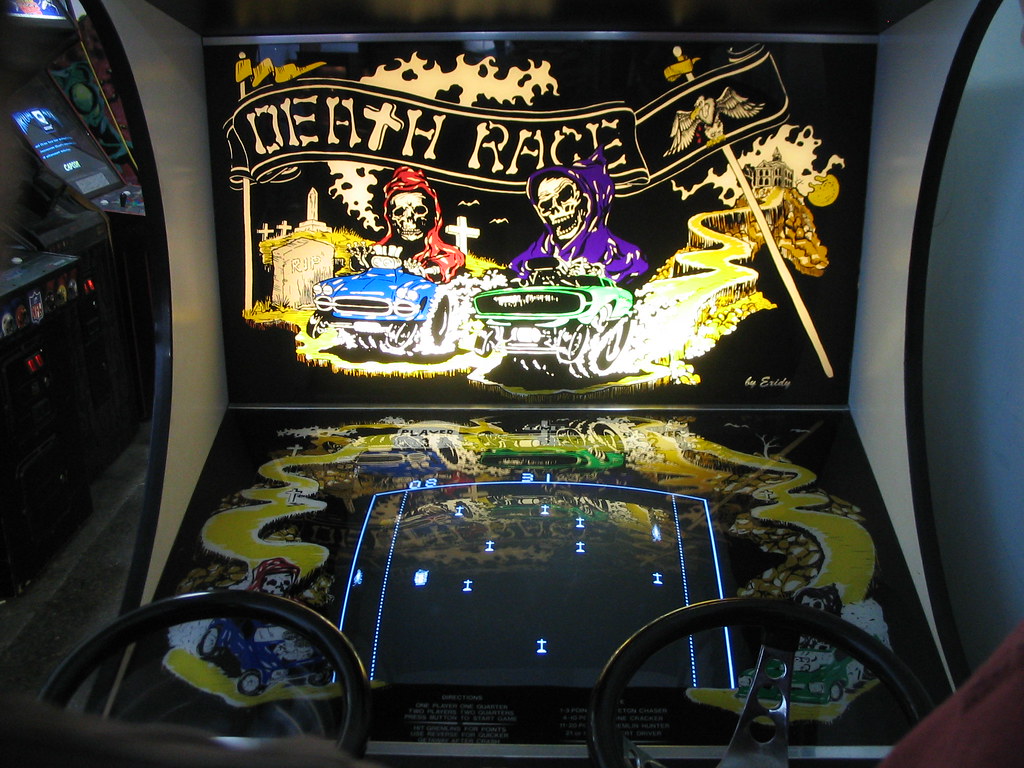
In January 1976, arcades in the United States welcomed a cabinet that broke with the conventions of the time. Death Race, developed by Exidy, was not just a driving game; it was a machine designed for the player to experience destruction as the primary objective. Unlike previous titles, where violence was abstract or non-existent, here the collision with obstacles had immediate and explicit visual consequences. This paradigm shift did not go unnoticed and laid the foundations for what would be the first major public debate on the morality of interactive content.
The Mechanics of Destruction
The design of Death Race focused on the immediacy of action. The player controlled a vehicle using a steering wheel and pedals, an interface that sought to emulate the driving experience. However, the goal was not to reach the finish line, but to eliminate the obstacles that appeared on the screen. These included bombs, barriers, and other enemy vehicles. Upon impact, objects did not simply disappear; they exploded in a cloud of smoke and debris. This graphical representation of death and destruction was novel and, for many, disturbing.
The Context of 1976
To understand the magnitude of the reaction, it is necessary to situate the game in its context. In 1976, the video game industry was in its infancy. Most games were geometric abstractions or simple sports simulations. The idea that a game could represent violence so directly was unheard of. Death Race arrived four years after the first arcade games, at a time when society had not yet developed a framework for evaluating the impact of digital media on human behavior.
Public Opinion Reaction
Indignation did not take long to arrive. Parents and school authorities began to point to the game as a negative influence on young people. The concern was not only about the violence itself, but about the possibility that interactivity would normalize aggression. Unlike a film or a book, where the viewer is passive, in Death Race the player was the active agent of destruction. This distinction was key in the public perception of the game.
Bans and Local Debates
In response to complaints, several U.S. states took measures to restrict access to the game. Its display was banned in schools and community centers, spaces where it was considered that minors had greater exposure. These bans were not uniform or permanent, but they established an important precedent: video game content could be subject to public regulation. This was the first documented case of an institutional reaction to violence in games.
The Regulatory Precedent
The Death Race case was not just an isolated incident, but the beginning of a conversation that has lasted decades. It established the idea that video games were not just innocuous entertainment, but a medium with the potential to influence behavior. This precedent laid the foundations for future discussions on age ratings, violent content, and developer responsibility. Although subsequent regulations have been more complex and nuanced, the origin of this debate dates back to the reaction to Death Race.
The Technology Behind the Scandal
Technically, Death Race used an architecture based on the Z80 microprocessor and simple rasterized graphics. It was not a technologically advanced game in terms of complexity, but its cultural impact was disproportionate to its technical capability. The simplicity of the graphics did not prevent the violence from being clear and direct. In fact, the crudeness of the representation, without artistic adornments, may have contributed to the perception of realism and, therefore, to public alarm.
Legacy and Preservation
Today, Death Race is considered a milestone in video game history. Original cabinets are preserved in museums and private collections, where they are studied as cultural artifacts. The game is remembered not only for its mechanics, but for the role it played in defining the ethical boundaries of the industry. Its legacy is a warning and a lesson: interactive content has a social impact that cannot be ignored. Death Race was not the last game to generate controversy, but it was the first to do so on a public scale, marking the beginning of an era of constant scrutiny on violence in digital media.
- Decade
- 1970s
- Region
- Global
- Level
- Introduction
- Entities
- Death Race, Cuatro
Sources and references
- video game ultra violento de la epoca: . Death Race fue ...www.facebook.com · 2026-10-19
- Historia de los videojuegos - Wikipedia, la enciclopedia librees.wikipedia.org · 2026-10-19
- Sonic el Erizo - Death Battle Fanon Wiki - Fandomtranslate.google.com · 2026-10-19
- ¡Nuevo programa especial! ¿Sabías que la primera ...www.instagram.com · 2026-10-19
- Miniserie High Score en Netflix; ¿la historia de los ...www.retromaniacmagazine.com · 2026-10-19