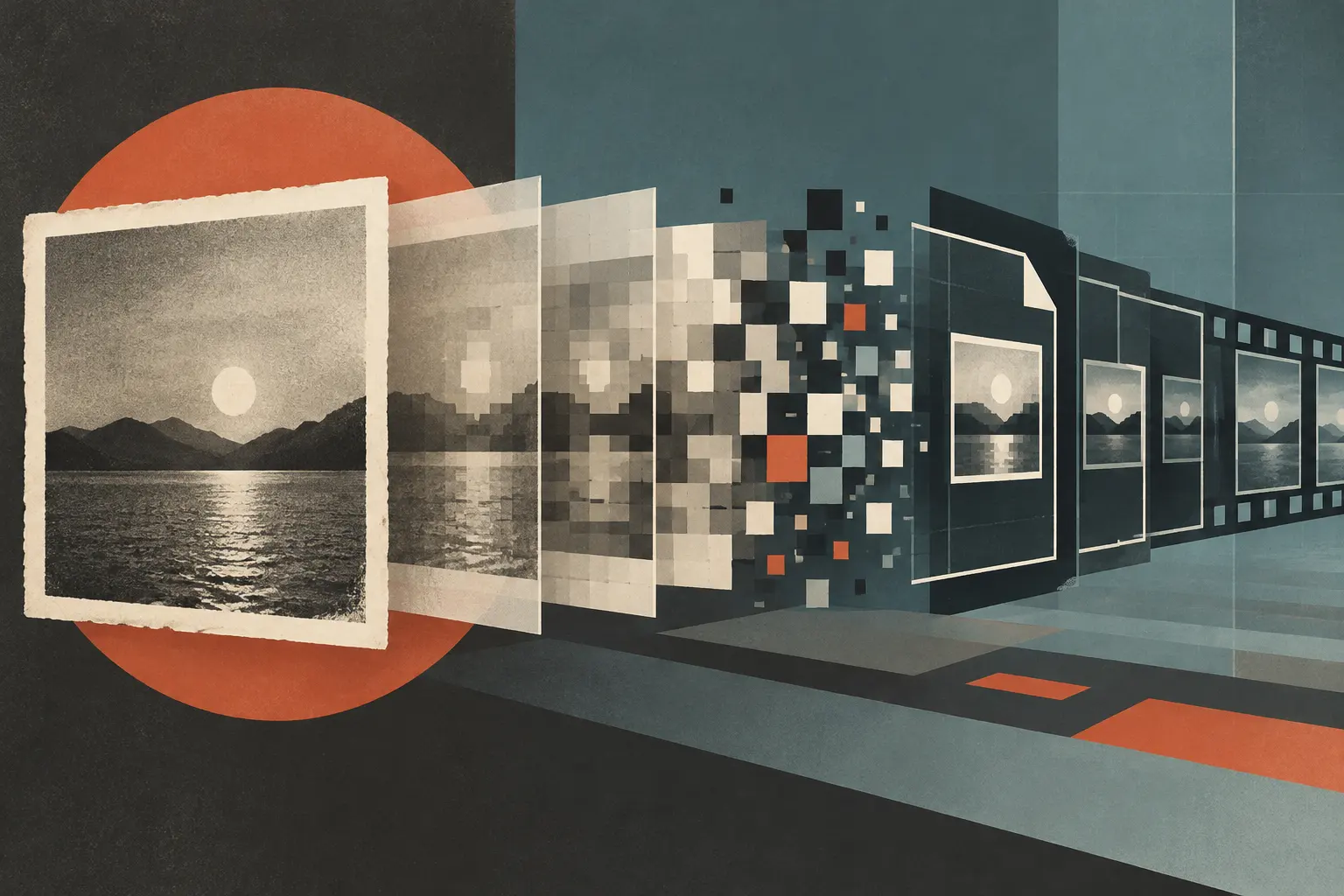
Digital photography changed more than the camera. Replacing the light-sensitive negative with data stored in a file altered the image’s support and the chain of work connecting it to what it depicts. It also changed the pace of production, made copying and distribution easier, and brought photography closer to audiovisual practices that share tools but organize time differently.
This shift does not make digital photography false by definition, or turn the negative into a guarantee of neutrality. It does make the history of each image more important: how it was captured, what processes it went through, which version is being shown, and the context in which it circulates.
From negative to data
In chemical photography, light changes a photosensitive emulsion and leaves a trace on film. Development makes the latent image visible; printing then produces a copy on paper or another support. Photography thus relies on a material sequence of decisions and operations: film, exposure, development, and printing. Negatives can be used to make copies, although each particular print requires further work in the darkroom.
In a digital process, a sensor records light and converts it into data stored as a file. The image can be reviewed on a screen and duplicated without making another negative or repeating a chemical printing process. It can also be processed with computer tools. This does not mean that analog images are untouched or transparent: framing, exposure, development, and selection shape them too. The difference lies in the available operations and in the material relationship between capture and the image we ultimately see.
Appearance alone cannot reconstruct a photograph’s history. A digital image can retain a connection to a real scene and still have been cropped, adjusted, or combined with other material. To assess what it documents, it helps to distinguish the capture from its processing and presentation—and not to equate the ease of manipulation with automatic falsity.
A more immediate workflow
Digital photography made it possible to review images soon after taking them, select quickly, and transfer files over computer networks. In a chemical workflow, taking a photograph and seeing a print are often separated by development and printing; a digital file shortens that gap. Photography became more readily integrated with screens, online publications, and forms of communication that rely on sharing images quickly.
The potential scale of circulation changed as well. Copying a file does not require repeating a printing process, and the same image can be distributed in many contexts. But easy circulation does not, by itself, explain what a photograph means. It matters who made it, for what purpose, how it was selected, what information accompanies it, and where it appears. Context does not remove an image’s ambiguity, but it helps clarify what it can support as a document.
Digital abundance also changes the experience of looking. When images are produced and shared in large quantities, each one arrives amid crops, captions, sequences, and publishing decisions. Reading a photograph means attending both to what is visible and to the way it is presented and related to other images.
Photography and video share tools, not the same sense of time
Cameras capable of recording both still images and video make clear that the difference between the media does not depend on the device alone. Photography and video share resources such as composition, lighting, shot planning, and color correction. Yet those resources are organized differently when an image unfolds over time.
In a photograph, composition fixes a relationship between elements at one instant. In an audiovisual shot, that relationship can change: subjects move, the camera moves, and the light can shift. The working unit also changes. Photography is often conceived as an individual image, even though a series or photobook can create a broader reading. In audiovisual work, shots are arranged as parts of sequences; their duration, order, and editing create rhythm.
Antoni Marín Amatller identifies the temporal factor as a central difference between photography and video. This does not mean that a still image has no relationship to time: it can suggest a before and after, and a series can guide the viewer through a duration. The distinction lies in how each medium organizes its elements. Video allows changes within a shot and a succession of edited shots; photography fixes an image, even when it belongs to a larger narrative whole.
A transition, not the disappearance of film
Digitization transformed the conditions of capture, editing, copying, and circulation, but it did not immediately erase film photography. The two processes coexist and produce objects with different material histories. Film’s persistence also reminds us that photographic technologies are not always replaced instantly or uniformly: their uses and meanings can continue as dominant practices change.
Understanding the digital shift does not require choosing between two simple claims—that analog photography is true or that digital photography is manipulable. It means examining how each image was made and what role it serves. With any photograph, we can ask what support recorded it, what operations separate the capture from the version we see, whether it stands alone or belongs to a sequence, and what context accompanies its circulation. The answer begins with the specific image and its history, not with a general assumption about the camera.
- Decade
- 1990s
- Region
- Global
- Level
- Introduction
- Entities
- Fotografía analógica, Imagen latente, Fotografía digital, La imagen latente
Sources and references 5
- El factor temporal y el ritmo como distintivo entre fotografía y vídeodoi.org · 2026-11-15
- Historia de la fotografía: Cada período, movimiento y ...translate.google.com · 2026-11-15
- Historia de la fotografía - Wikipedia, la enciclopedia librees.wikipedia.org · 2026-11-15
- Fotografía e historia en América Latinaissuu.com · 2026-11-15
- Fotografía: la historia del blanco y negro a la selfiwww.senalcolombia.tv · 2026-11-15