Format is more than packaging
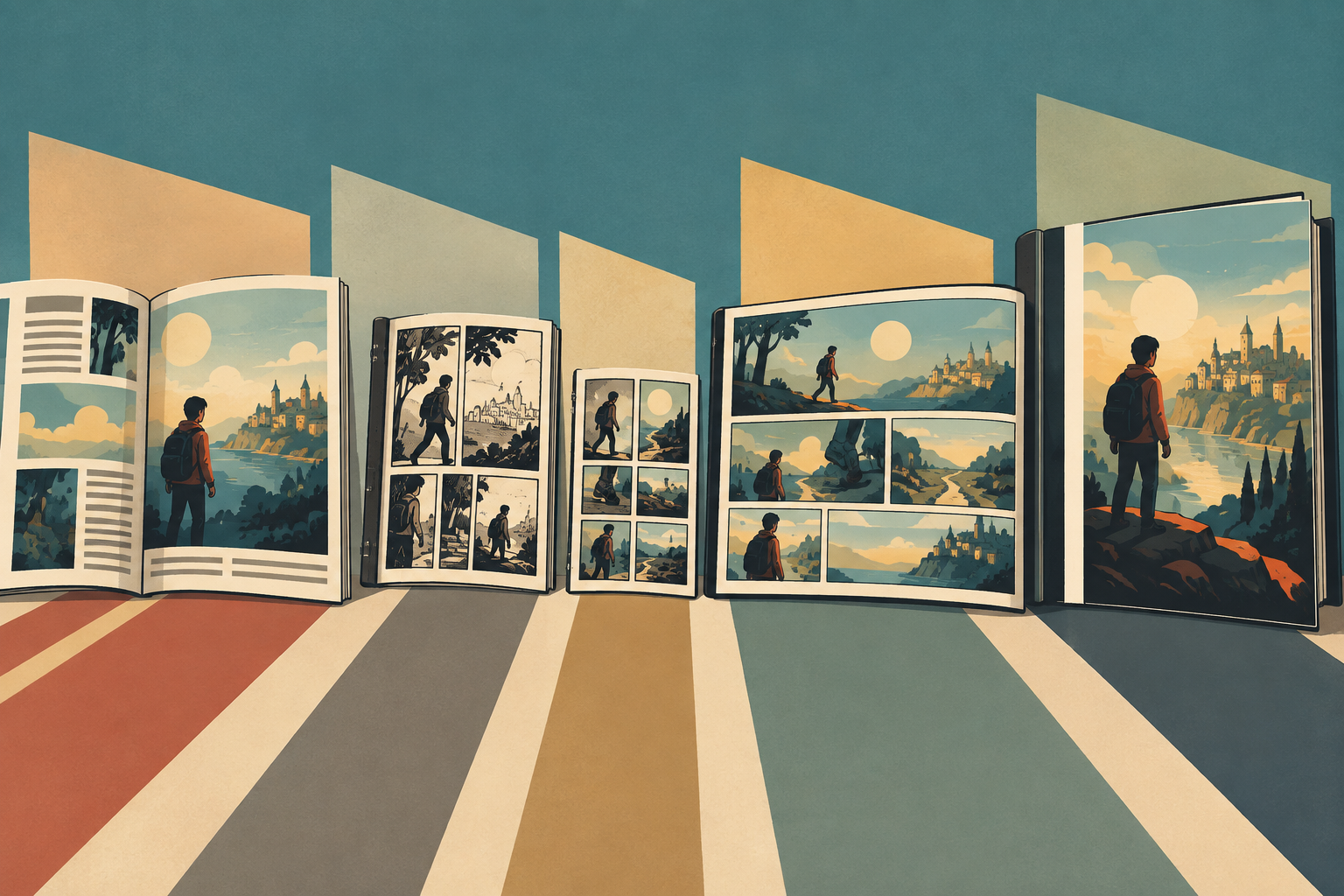
A story told in panels reaches its reader through a particular publishing form. The article by Rubén Varillas listed in the supplied evidence explicitly frames comics as a question of formats and names magazines, fanzines, mini-comics, albums and graphic novels. That list offers a useful starting point: before interpreting a work, we can describe how it is presented and circulated. The list alone does not prove that any category produces a particular narrative effect.
The distinction matters because storytelling through drawings also involves arranging pages and sequences. As a critical reading, one can ask whether a publication’s size, layout or material continuity changes the pace at which panels are read. Here, those questions are an analytical guide, not findings attributed to the cited study.
Five names, not a hierarchy of prestige
Magazine, fanzine, mini-comic, album and graphic novel appear together in the title of the academic paper. The available evidence does not provide their full definitions or establish universal boundaries between them. They should therefore not be treated as compulsory stages or ranked above one another. They are terms with which to investigate publishing differences, not labels from which to infer quality, audience or creative freedom automatically.
A careful comparison would begin with what can be observed: what unit is at hand—a periodical, a short instalment or a volume—how its pages are arranged, and what information the object itself provides. Analysis could then consider what kind of reading experience that presentation seems to encourage. “Seems” matters: format invites interpretation, but it does not replace examining the work or its publication details.
From the page to the conditions of circulation
Editorial history also depends on where material is kept and how access is provided. A RetroPause text among the sources addresses the transition from magazine to archive and connects comics with collection, museum and digital access. Its title identifies a clear issue: once a publication becomes part of a collection or archive, it may be consulted under conditions different from those of its initial circulation. The supplied material does not support details about particular cases, policies or consequences for specific readers.
Research on comic exhibitions offers another institutional perspective. The Cuadernos de Cómic article is described as a history and global context for such exhibitions, and the available excerpt points to a 1971 antecedent and later references. This supports the view that comic exhibitions have a history worth studying; it is not enough to reconstruct a comprehensive chronology here or claim that an exhibition changed the reading of a particular work.
What might change in the experience
As a reading hypothesis, format can shape how a work is encountered, its pages traversed and its contents revisited. A publication issued in instalments raises different questions from a volume considered as a whole. That difference is a line of inquiry, not a conclusion established by the available excerpts. Testing it would require comparisons of identified objects and editions, together with evidence about their production or reception.
The physical object should also be distinguished from digital access. Digitisation can make material available in another setting, but the supplied sources do not describe interfaces, resolution, specific collections or project outcomes. Claiming that a digital version necessarily preserves or changes reading pace would go beyond the record. What is verifiable here is that the relationship between collection, museum and digital access is an explicit subject of editorial research.
Making the limits visible
The evidence gathered includes the record of an academic article about formats, another about exhibitions, a study identified by its title as “Memory-history: comics as a dialogical space,” and a catalogue devoted to the history of Spain through comics. These titles and excerpts point to lines of inquiry—publishing form, exhibition, memory and history—but do not justify assigning arguments to those works that are absent from the supplied material. The Crossref record helps identify Varillas’s article; it is not, by itself, an independent source for that article’s conclusions.
The useful question, then, is not whether one format is better, but which publishing changes can be demonstrated and how they affect the reading of a particular work. Answering it requires comparable copies and verifiable publication data. Format makes the question possible; the object and its documentation must support the answer.
- Decade
- 2000s
- Region
- Global
- Level
- Enthusiast
- Entities
- Museum, Rubén Varillas
Sources and references
- El cómic, una cuestión de formatos (2): revistas de cómics, fanzines, mini-cómics, álbumes y novelas gráficasdoi.org · 2026-10-02
- Memoria-historia: el cómic como espacio dialógicoopenalex.org · 2026-10-02
- Cuando una revista pasa a ser archivo: el cómic entre colecciónwww.retropause.com · 2026-10-02
- Las exposiciones de cómics. Historia y contexto globalerevistas.publicaciones.uah.es · 2026-10-02
- Catálogo de la historia de España a través del cómic (1940 ...www.comares.com · 2026-10-02