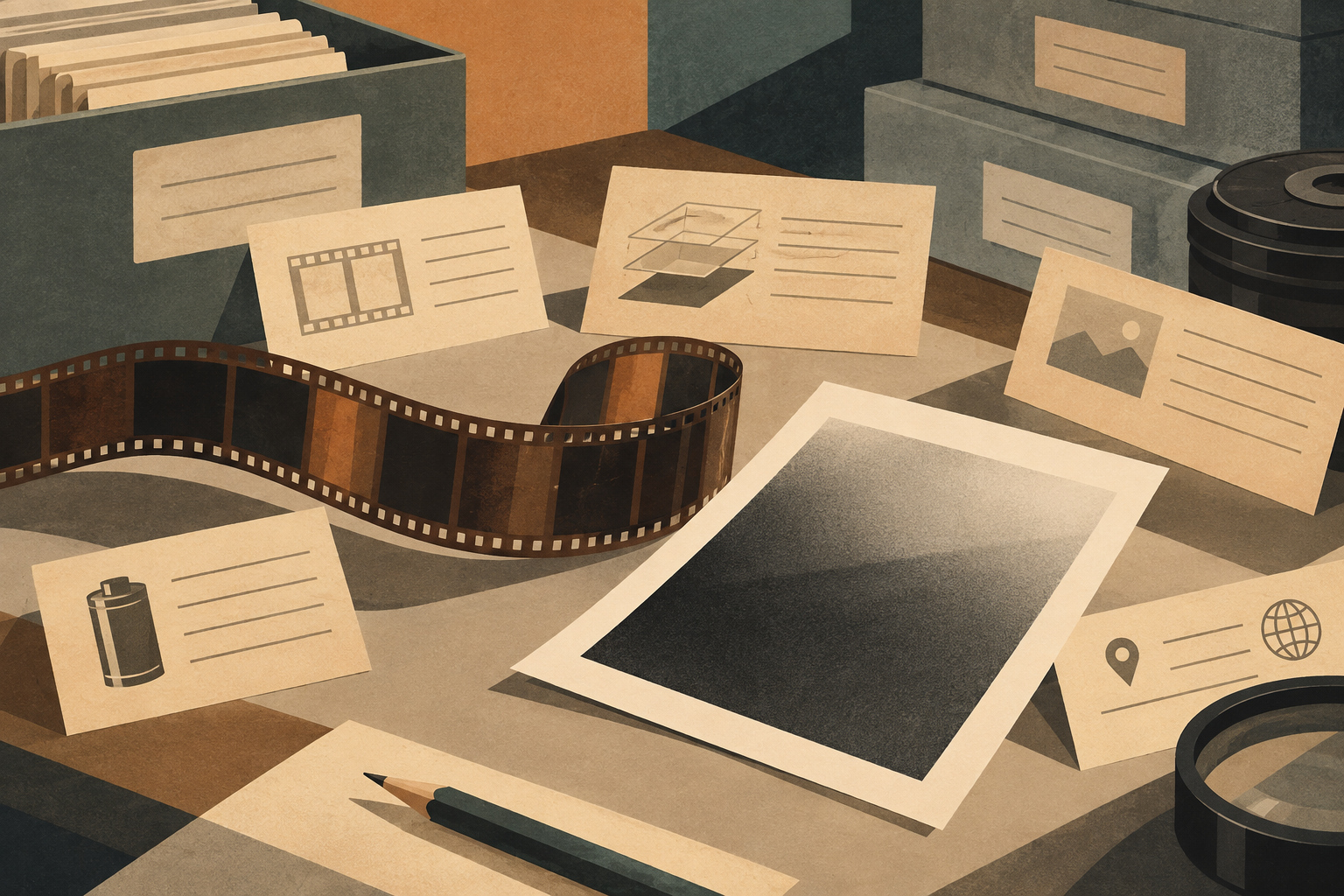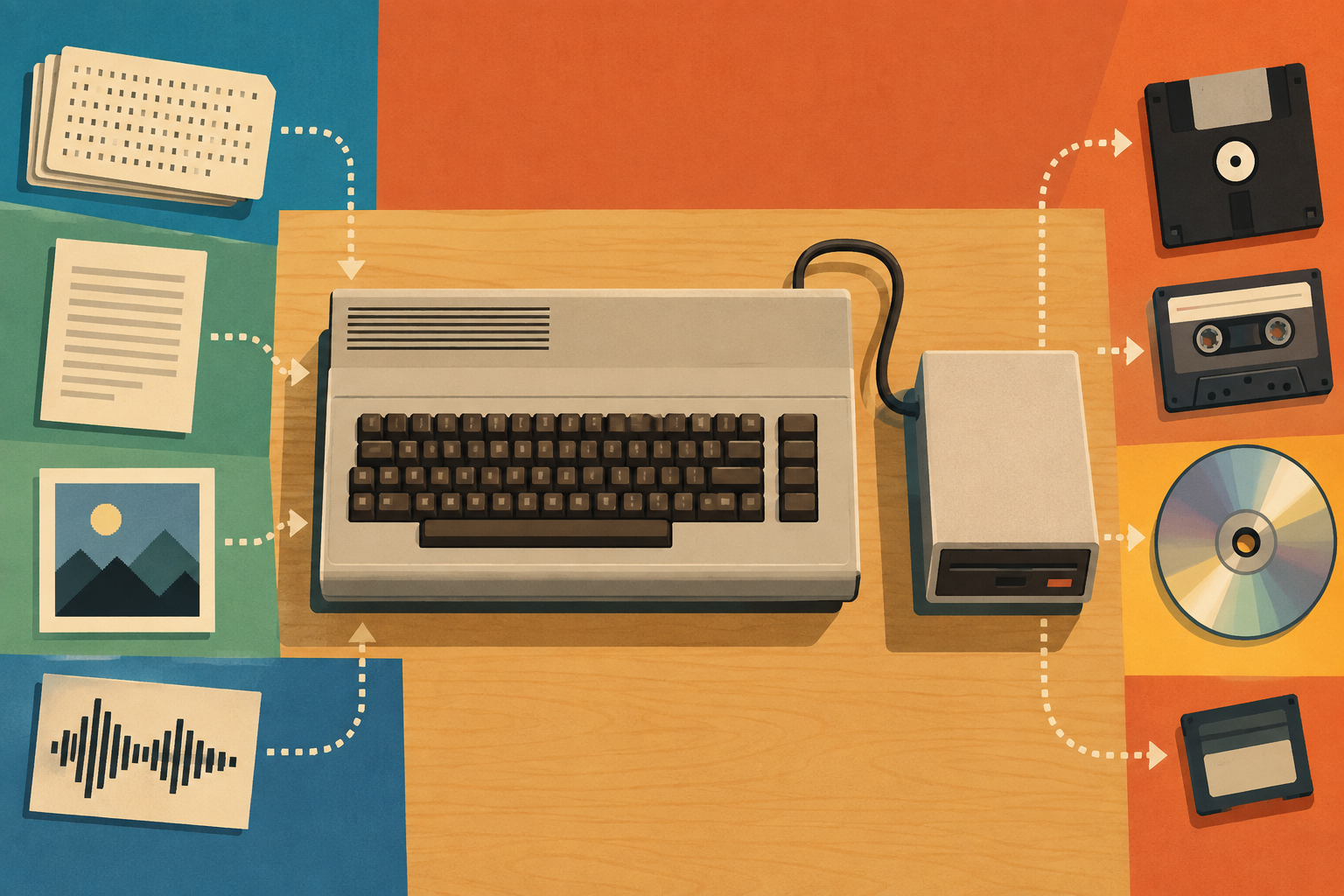
A home computer is often represented as a single unit: a case, a screen and, sometimes, a keyboard. But its use did not end at the case. Connections, drives and storage media made it possible to input, retain or move information. Reconstructing that experience without turning possibility into invented memory also means asking how those components were identified and what contextual details survive in their descriptions. The archival standards cited here are not guides to domestic use. Read cautiously, they show why physical media and their identification belong in the history of computing.
The machine is only one part of the set
A general description of a computer distinguishes hardware from software and includes cables, keyboards, mice, memory and input/output devices among its physical elements. This is a useful corrective to an overly narrow picture: the computer was not only its central unit. A functional definition, however, cannot tell us which peripherals accompanied a particular machine, who used them or how often. Those questions require evidence about a specific set of objects, not just a general definition.
The history of domestic use is better reconstructed by separating components and then establishing their relationships again. A drive may be documented alongside a computer, mentioned in a list or absent from the available record. Each situation means something different. An inventory that names a medium does not by itself prove that the corresponding machine could read it; its omission does not prove that it was never used.
A storage medium has a physical location
The Catalan Archival Description Standard makes a concrete recommendation: electronic documents should identify the physical unit in which they are stored. Its examples include CD-ROM, DVD, CD-Worm, DAT, floppy disk, hard disk and ZIP drive. This is neither a guide to choosing a technology nor a chronology of its popularity. Its value for material history lies in its attention to location: describing electronic information also means identifying where it is stored.
This principle encourages us to treat a medium as part of a documentary set, not as an isolated label. Naming the physical unit helps distinguish storage types; it does not automatically reveal how it was connected, which machine used it or whether its contents remain readable. Such conclusions require further documentation and, where appropriate, technical examination of the object.
Identification is not an explanation of use
A document on archives and historical memory lists several media—including floppy disk, microfilm, photography, video and cassette—and considers the software application when documentation is generated using software. The list reminds us that electronic archives coexist with very different media, but it does not in itself describe a domestic routine. A floppy disk appearing in a classification indicates a category of medium; it does not tell us who inserted it, what task they performed or how long that activity lasted.
The distinction matters in an exhibition or catalogue. An accurate description can record an object, its type and its storage unit without assigning it an unproven use history. By contrast, an image of a computer beside several media can suggest a plausible scene that never happened. Interpretation should distinguish what survives from what is imagined.
A document is more than its format
A study of historical databases mentions floppy disks and digital optical disks as electronic media, and also distinguishes published from unpublished documents according to their dissemination. This classification adds a useful nuance: physical medium and document circulation are separate aspects. A medium can store information without telling us how many copies existed, who received them or whether they were intended for one person alone.
Research into home computers should therefore keep separate questions that are often conflated: what object survives, what information is attributed to it, what equipment could read it, and what evidence explains its circulation. The medium can help raise these questions, but it cannot replace provenance records, inventories, manuals or documented testimony. The evidence available here does not support reconstructing an individual household case or assigning specific uses to a format.
Historical lists show change, not a uniform experience
An ANABAD information sheet summarises a transition in media used for data from older computers: from punched cards to magnetic tape reels, then to flexible floppy disks and finally to disk. The sequence offers evidence of technological change in the contexts addressed by that publication. It should not be applied automatically to every home, country or model, or mistaken for a complete chronology of domestic storage.
Classifications are tools for organising information; they do not replace local evidence. A general sequence can guide further questions about compatibility, preservation and data transfer. To find out how a particular peripheral was connected or what practices were common in a home, we would need specific sources not present here.
Reading what has survived with care
The documentation considered here supports a modest but significant point: telling the history of a computer requires more than describing the machine. Electronic media are recorded by type and by the physical unit in which they are stored; classifications distinguish document types and media; some sources summarise changes between storage formats. This helps build a fuller material history, but it does not license the reconstruction of scenes of use without evidence.
Looking at a home computer alongside its peripherals and storage media raises questions about connection, storage and documentation. The responsible response is not to fill gaps with nostalgia, but to preserve the distinctions between object, information and practice. Archival description can look like a technical note. It is also a clue to what we need to know before a machine can be more than a silhouette in a display case.
- Decade
- 2000s
- Region
- Spain
- Level
- Enthusiast
- Entities
- No linked entities
Sources and references
- LAS BASES DE DATOS HISTÓRICASagora.edu.es · 2026-10-02
- Los archivos, entre la memoria histórica y la sociedad del ...openaccess.uoc.edu · 2026-10-02
- 01 ARCHIVÍSTICA Y GESTIÓN DE DOCUMENTOSwww.cultura.gob.es · 2026-10-02
- Norma de Descripción Archivística de Cataluña (NODAC) ...cultura.gencat.cat · 2026-10-02
- Hoja Informativawww.anabad.org · 2026-10-02