A question about the medium
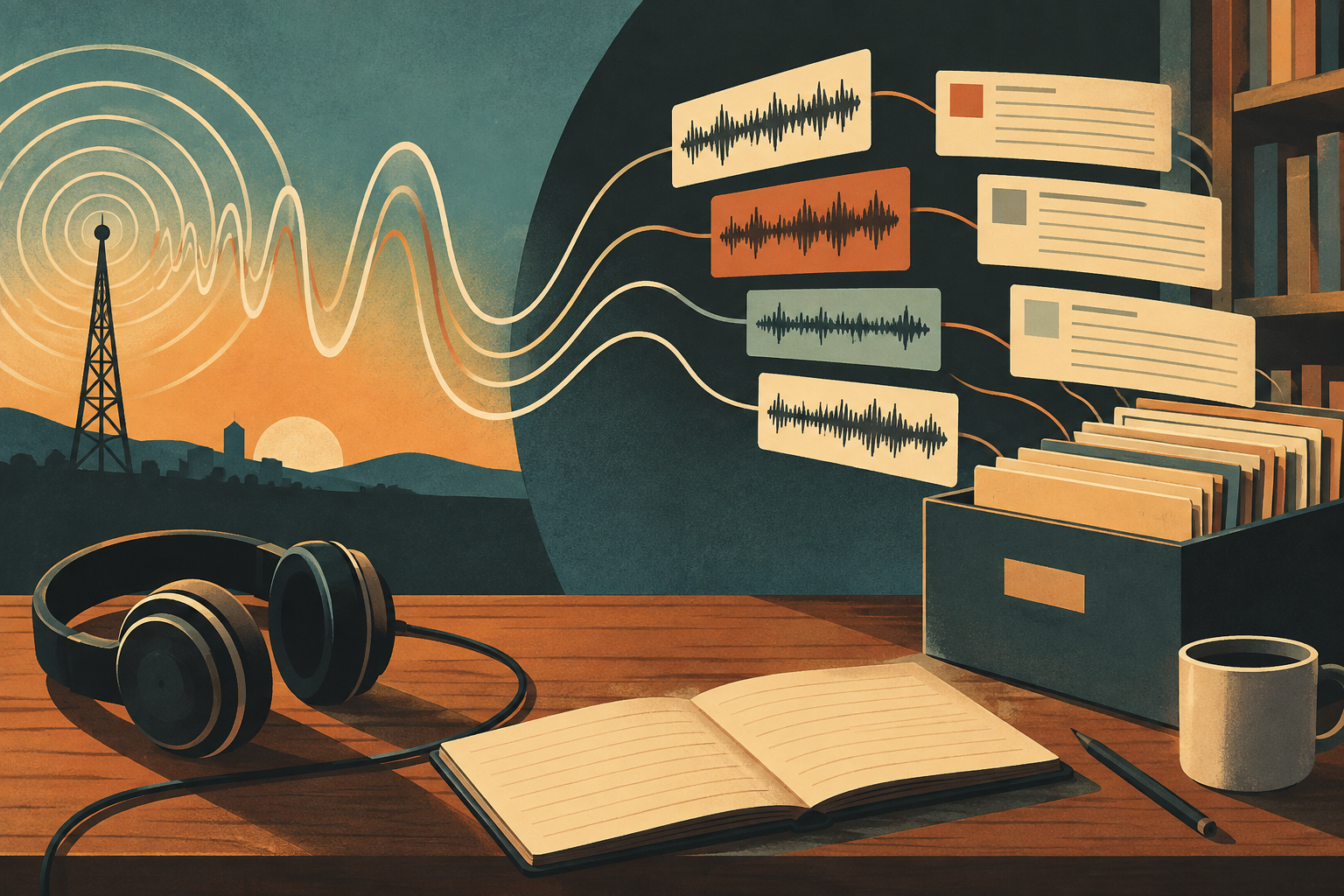
A song broadcast on the radio leaves more than one kind of trace. Researchers can study the musical recording, but also the documents that describe its preservation, organization or use in broadcasting. This distinction is a starting point for a more precise history: a work, an edition and a medium are not interchangeable, nor are a sound item and the record that describes it.
The evidence available for this article is limited. It includes studies of music documentation and sound archives, references to radio collections, and academic works whose titles identify radio drama or radio language as subjects. It does not provide detailed inventories, playable recordings or listener testimony. It therefore supports questions and research avenues, not a supposedly documented account of a particular listening experience.
The archive as a point of entry
A text on archival collections for music research names the Archivo y Museo de la Radio Valentín Letelier at the University of Valparaíso among the institutions considered. The reference places an institution and a preservation strategy within the landscape of research; the available extract does not describe its collections or establish which materials it holds.
Another article, on the appraisal of personal music archives through documentary analysis, offers a second line of inquiry: personal collections can themselves become objects of processing and study. Its title does not justify attributing specific methods that are not included here, but it does support a useful question: what changes when researchers consult the documents surrounding a musical practice as well as the recording itself?
Do not confuse a broadcast with its documentation
Music documentation in radio appears as a distinct professional topic in a conference organized by AEDOM with the RTVE Institute. The conference title—“Music Documentation in Radio: New Challenges and Management Alternatives”—shows that managing such documentation has been addressed as a professional concern. It does not establish which solutions were discussed or how they were put into practice.
The distinction between a broadcast and its documentation matters because different sources answer different questions. A recording may support study of its sound content if it is available and properly identified. A catalogue, file or other documentary record may provide information about its organization or provenance, but it does not replace listening. The supplied material contains no individual records that could demonstrate a specific connection between these kinds of source.
Radio as a subject of study
Paloma López Villafranca’s study of sound-fiction cases in Spanish public radio, RNE, and the Prisa Group’s podcast platform is a documented example of comparing radio and platform contexts. The available title and record identify its subject, publication year—2019—and author. Without the study’s text, its findings cannot be anticipated or turned into a general history of musical listening.
A work by Rafael Quintana Garzón, published in 2001, is also listed under the title “The Language of Radio and Its Educational Possibilities.” This record establishes academic interest in radio language, but it is not enough to summarize the author’s argument. Used cautiously, the two references show that radio can be studied through different questions: sound fiction, platforms and language. As presented here, neither describes particular musical listening habits.
What the evidence does not establish
The supplied records offer no broadcast dates for specific songs, audience figures, receiver models, listening testimony or adequate information for comparing technical conditions. Nor do they allow a work to be traced from its recording to a particular edition and an identifiable broadcast. These are not minor omissions: they prevent claims about how a medium shaped listening in a specific historical case.
It is therefore important to distinguish the editorial question from a historical conclusion. Asking how radio shaped the circulation or documentation of music is a legitimate line of research; answering it requires sources that connect works, broadcasts, media and contexts. A reference to an archive, an article or a professional conference cannot stand in for that evidence.
A history built from complementary sources
The available titles and records support a research path focused on the intersection of music documentation, sound archives and radio studies. The point is not to treat an archive as a transparent replay of the past, but to recognize that each kind of document can illuminate a different question. A recording and the record describing it do not tell the same story; if they can be linked, together they may provide a richer basis for research.
The conclusion must remain provisional: the evidence confirms work and initiatives devoted to music archives and radio, and identifies specific academic subjects. It cannot by itself reconstruct how a particular community listened or measure the effect of a medium. That limit is also a guide: moving from a history of documents to a history of listening requires identifiable items, provenance information and sources that can be compared.
- Decade
- Contemporary
- Region
- Global
- Level
- Enthusiast
- Entities
- No linked entities
Sources and references
- (PDF) La documentación musical: fuentes para su estudiowww.academia.edu · 2026-10-01
- Estudio de casos de la ficción sonora en la radio pública, RNE, y en la plataforma de podcast del Grupo Prisa en Españaopenalex.org · 2026-10-01
- El lenguaje de la radio y sus posibilidades educativasopenalex.org · 2026-10-01
- Acercamiento a los fondos de archivo y colecciones para el ...artes.uc.cl · 2026-10-01
- Valorización de archivos personales musicales mediante el ...revistas.ucm.es · 2026-10-01
- Jornadasaedom.org · 2026-10-01
- Los archivos sonoros en España: entre memoria, profesión y ...www.edicionsedic.es · 2026-10-01