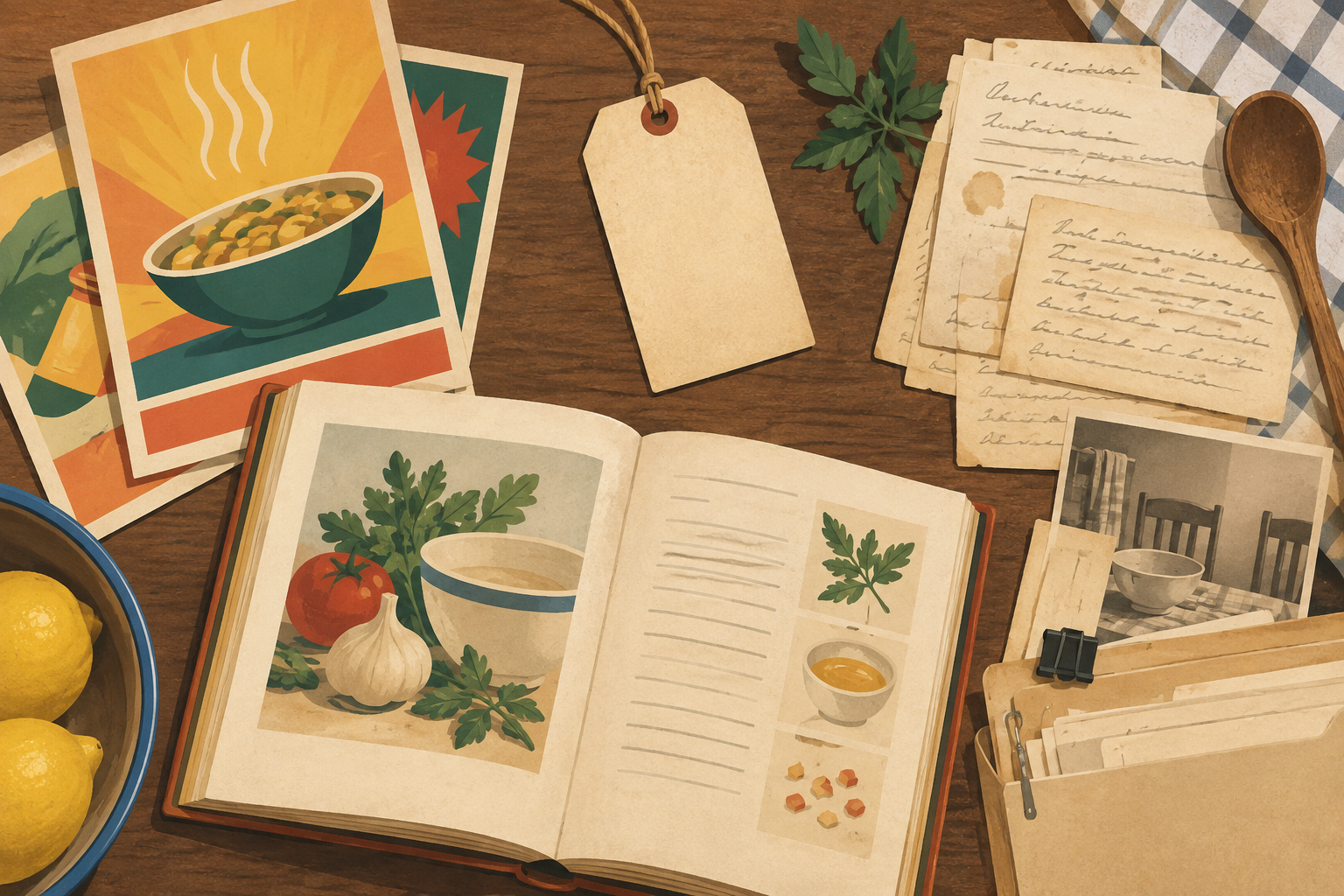
A surviving object is not a custom
A tin, label or cookbook may survive after the conversations, gestures and meals that accompanied it have left no record. That difference is the starting point for researching food without turning a museum object into a complete scene of domestic life. The description of the exhibition Patrimonio Comestible links the history of sweets with their women confectioners, while the CER.es listing records an entry associated with chocolate and food. These are signs that food culture can be studied through objects and collections; by themselves, they do not establish who consumed a product, how often, or on what occasion.
The useful first question is not “What did people eat?” but “What kind of source is this, and what can it demonstrate?” A cookbook documents published or collected instructions. Packaging allows examination of materials, presentation and visible messages. A collection catalogue tells us how an institution describes and classifies an item. Each document offers a different window, with different limits.
Advertising and domestic practice are different kinds of evidence
Advertising presents a commercial proposition: it seeks to make a product attractive, convey a promise or associate it with a desirable situation. Even if an image shows a family table, it does not prove that the product appeared on every table, or that the depicted scene was typical. Claims about actual consumption require additional, comparable sources—not just the sales message.
The supplied evidence supports making this distinction, but it cannot tell the story of a particular campaign or describe its results. No identified advertisements, sales statistics or household testimonies tied to a specific product are provided. A responsible analysis should therefore separate what an advertisement proposes from what other sources might show about purchase, preparation and consumption.
Everyday practice may also appear in cookbooks, family archives or testimony, but each has its own bias. A printed recipe documents a recorded preparation; it does not prove that anyone cooked it exactly as written. Nor does a cookbook preserved in a collection automatically represent a population. The available material says that cookbooks, tins, labels and archival documents can approach food as both tangible and intangible heritage. That statement opens a line of inquiry; it does not authorize claims about particular habits without specific evidence.
Reading packaging and labels without filling in the gaps
Packaging is a material object and a surface for communication. Its words, images, shape and materials can be studied when they are present in the item being examined. The CER.es description offers a concrete but limited clue: a result from the Muséu del Pueblu d’Asturies is associated with “Chocolates; Alimentos; Industria” and the entry “Calendario,” attributed to S. Subías. The fragment does not clearly identify the object as packaging or explain its context of use. It would therefore be wrong to present it as proof of a particular brand, recipe or campaign.
Care is equally important when discussing design. A label communicates visual and textual choices, but interpreting them requires seeing the original item or a reliable reproduction. Without that examination, colours, typefaces, ingredients and advertising claims cannot be described. A collection record can guide further research; it cannot replace access to the object.
Archives raise questions; they do not answer all of them
FoodCultura describes its archive as a bibliographic collection devoted to food culture, containing books, cookbooks, magazines, fanzines, CDs and memorabilia related to its history. This range suggests that research can compare formats and types of representation. A recipe book, a magazine and a keepsake do not perform the same documentary role, even when they share a subject.
Mercasa’s Alimentos con historia is presented as a popular work by Ismael Díaz Yubero containing extensive information about food. That description identifies a reference for consultation, but the supplied snippet does not verify any particular claim from the book. The Museo Arqueológico Nacional dossier on CONVIVIUM says that the exhibition examines the meaning of the Mediterranean diet as a practice recognized as intangible cultural heritage. This is an institutional framework for thinking about food, practice and heritage; it does not make every documented meal proof of a uniformly shared tradition.
There is also an academic reference on food museums: the Dialnet record identifies a 2021 article titled “Museos de la alimentación: sabores detrás del cristal.” Its available summary observes that food is presented in museums and raises questions about that representation. The listing offers a bibliographic starting point, not the full text or the study’s detailed arguments.
A more precise research question
To distinguish promotion from habits, ask focused questions: who produced the document, for what purpose, and for whom? Where does the object sit in a collection? What independent sources describe purchasing, preparation or consumption? Answers help calibrate claims. “The label promotes” may be demonstrable from the item; “families consumed it” requires a different kind of evidence.
Comparing sources can reveal differences, but only when the sources are identified and their contexts preserved. A cookbook might be compared with commercial or domestic records; a museum item with its catalogue entry and provenance. The evidence supplied here does not include series of advertisements, account books, surveys or linked testimonies. It therefore cannot reconstruct a particular historical diet or establish how widespread a habit was.
The value of acknowledging limits
A food archive is not a transparent window onto every kitchen. It preserves what someone produced, kept, collected or classified, and leaves many experiences out. Recognizing that selection does not diminish collections; it helps us use them rigorously. Cookbooks, packaging and exhibitions are sources for studying representation, materiality and memory. Claims about practice need an appropriate evidentiary basis as well.
The strongest conclusion these references support is methodological: food and table culture can be researched through diverse materials, but a commercial message, a surviving object and everyday behaviour must not be conflated. Keeping those categories distinct makes for a more precise history and leaves visible the questions that still require other sources.
- Decade
- Contemporary
- Region
- Spain
- Level
- Introduction
- Entities
- Museum, Museo Arqueológico Nacional
Sources and references
- Patrimonio Comestible: Una historia de dulces y de sus ...www.cultura.gob.es · 2026-10-01
- CER.es Colecciones en Red - Resultados de la búsquedaceres.mcu.es · 2026-10-01
- Alimentos con historiawww.mercasa.es · 2026-10-01
- Archivowww.foodcultura.org · 2026-10-01
- CONVIVIUMwww.man.es · 2026-10-01
- Museos de la alimentación: sabores detrás del cristal - Dialnetdialnet.unirioja.es · 2026-10-01