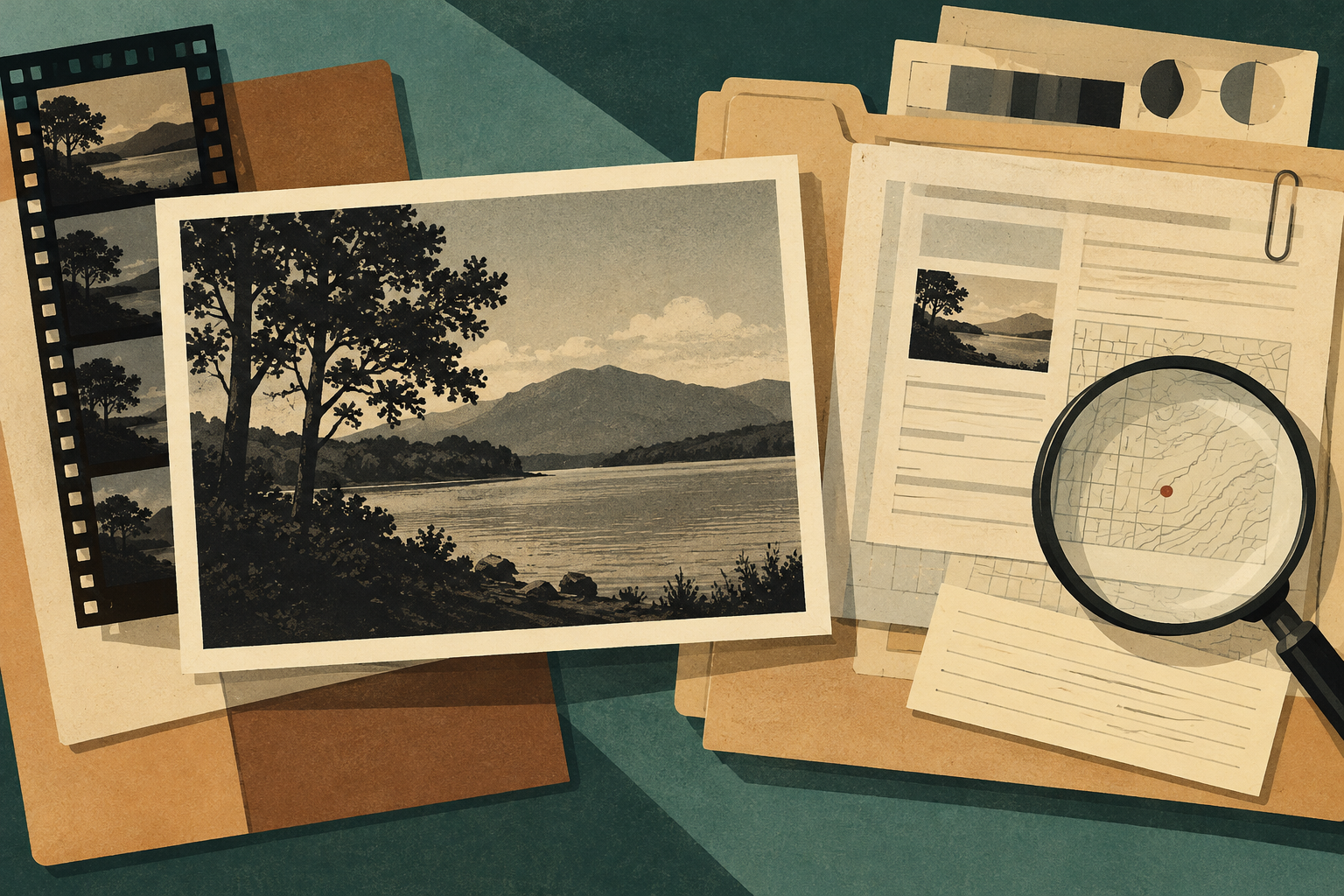
A photograph may show a scene, but it rarely explains by itself who made it, when, by what process, or for what purpose. Those questions require reading the image alongside the information that accompanies it. The distinction between what is visible and what can be documented allows us to treat a photograph not only as a representation, but also as an object and a record whose interpretation depends on a verifiable history.
This approach becomes tangible in museum work. The Met dates the beginning of its photography collection to 1928; the Münchner Stadtmuseum describes photography as part of connected activities that include collecting, research, conservation, exhibitions, and communication. These examples do not reconstruct the history of any particular image. They do show why preserving photographs involves more than keeping them visible: it also means organizing information and enabling study.
An image does not speak for itself
The first step in looking at a photograph is to describe what is actually visible. Visual reading may offer clues, but it does not automatically turn an interpretation into fact. A scene may suggest a place or an activity; without supporting documentation, that suggestion is not a demonstrated identification. The same caution applies to the circumstances of production and the original purpose.
This restraint does not diminish the image’s value. It helps distinguish observation from historical claim. A photograph preserves an appearance, but the relationship between that appearance and an event depends on specific questions: what is known about the object, what records exist, and how far those records can take us.
The object behind the representation
A photograph is also an object made through a process and on a support. Without examining a particular item, we cannot say which process produced it, what its support is, or what changes it may have undergone. The available evidence supports this general distinction but provides no material details about a specific photograph.
Recognizing the material dimension matters because an image does not exist apart from the conditions that produced it and kept it accessible. Conservation, listed among the activities of the Münchner Stadtmuseum’s Photography Department, is part of that institutional work. The information available, however, does not describe particular techniques or document an intervention on a specific object. The responsible conclusion is narrower: studying a photograph requires considering its status as an object, without guessing at its characteristics.
The archive as support for claims
Documentation can help establish authorship, date, provenance, or use. That does not mean all such information is always available, or that a record resolves every uncertainty. It means these claims should not be inferred solely from what is depicted. Identification becomes stronger when it can be connected to documented information; where records are missing or inconclusive, their limits should remain visible.
The scholarly article “Fotografía y archivo,” published in Fotocinema, offers a framework for considering the relationship between photography and the archive. The available reference confirms the publication and its author, but does not provide an abstract of its arguments. It would therefore be inappropriate to assign it a detailed thesis here. This article’s general framework rests on distinguishing image from documentation, not on an unverified reconstruction of the paper’s contents.
What a collection can tell us
Institutional history helps explain how context is built around a preserved photograph. The Met says it began collecting photographs in 1928 and connects that beginning with Alfred Stieglitz, described as an advocate for photography as fine art. This informs us about the history of that collection; it does not tell us when a particular photograph was made or when it entered the museum.
The Münchner Stadtmuseum, meanwhile, describes its Photography Department as involved in collection, research, conservation, exhibitions, and communication. Taken together, these functions suggest that museum work connects custody with knowledge-making: preservation makes research possible, while communication allows interpretations to be shared. This is an interpretation of the stated institutional activities, not proof of how every photograph has been managed.
Context, access, and limits
Other collection facilities illustrate the breadth of work involved in caring for visual materials. The Cultural Resources Center of the National Museum of the American Indian lists laboratories and workrooms for conservation, registration, photography, film and video, and collections management. This documents the facilities and functions of one center; it does not establish universal practices or provide a history of photography.
Together, these examples help frame the archive as an infrastructure for care, research, and access. But the supplied sources do not identify a specific image, provide its catalog record, or verify its maker, date, support, or provenance. Nor do they document particular audience experiences or social uses. Keeping those gaps explicit is part of rigor: institutional context can guide questions, but it cannot replace the records for an individual object.
Reading with precision
A preserved photograph can serve as evidence, even if it cannot answer every question it raises on its own. Its visual content, material form, and associated records are distinct layers that may complement one another but should not be conflated. The Met’s collection history, the activities described by the Münchner Stadtmuseum, and the facilities at the National Museum of the American Indian illustrate different aspects of this work without authorizing conclusions about an absent object.
The practical contribution of this approach is a rule for reading: first describe what is visible, then separate it from what is inferred, and seek documentation before presenting an identification as established. When records are missing, the answer is not to complete the story with conjecture but to state what remains unknown. The archive is therefore not a secondary add-on to the photograph; it is one condition for knowing what can responsibly be said about it.
- Decade
- 2000s
- Region
- Global
- Level
- Enthusiast
- Entities
- Museum
Sources and references
- Cultural Resources Center | National Museum of the American ...americanindian.si.edu · 2026-10-16
- Photographswww.metmuseum.org · 2026-10-16
- Photography Departmentwww.muenchner-stadtmuseum.de · 2026-10-16
- Fotografía y archivodoi.org · 2026-10-16
- Fondos de fotografía antigua sobre el arte aragonés en la Biblioteca Nacional y unas notas sobre el Museo del Prado y el Archivo Histórico Nacionaldoi.org · 2026-10-16
- Una mirada documental de la fotografía underground a través del fanzine Rockocó. Análisis del Archivo Miguel Trillo en el Museo Nacional Centro de Arte Reina Sofía (MNCARS)doi.org · 2026-10-16