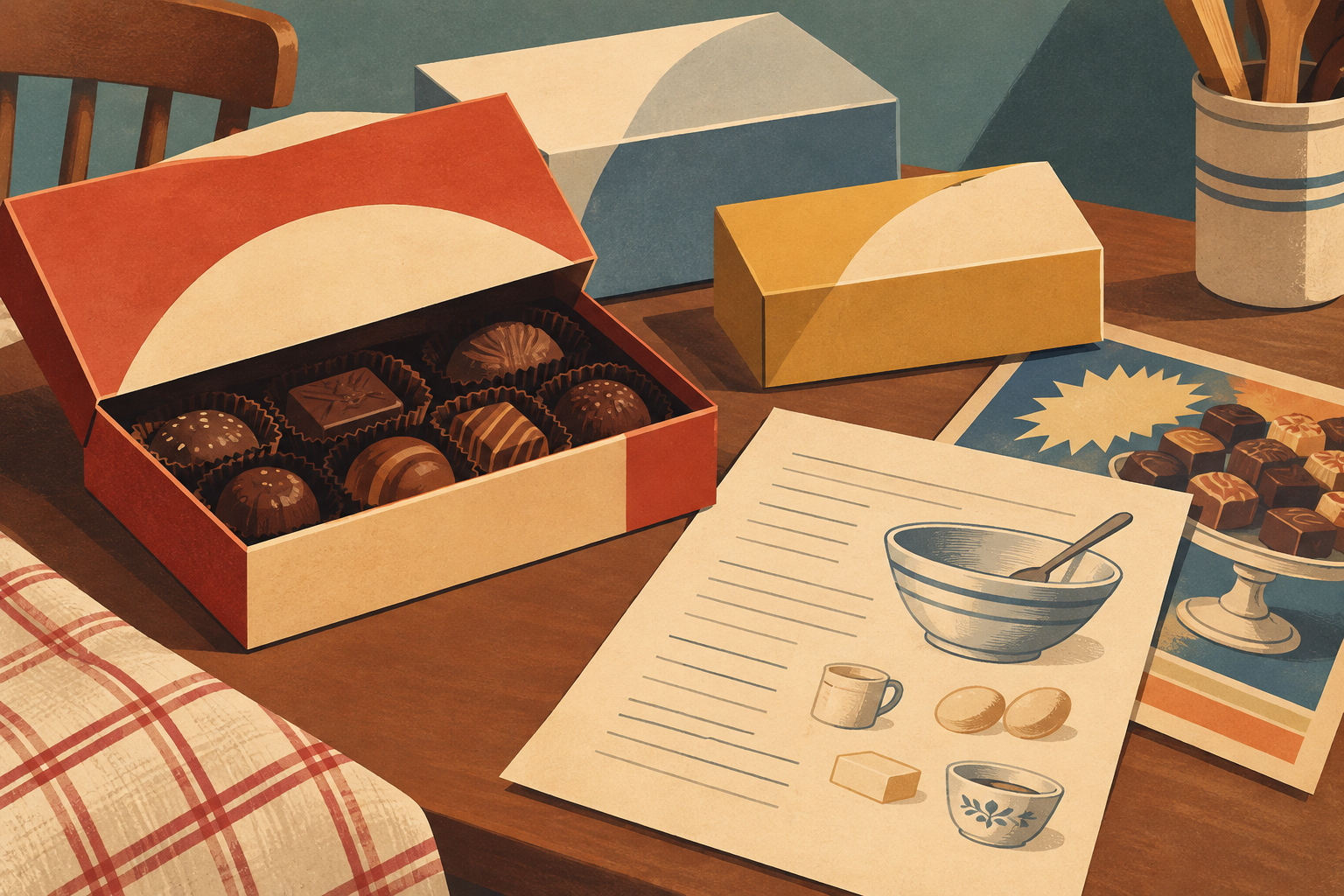
A biscuit box can preserve colours, images and clues to how a product was offered for sale. But on its own, it cannot show who bought it, how often it was eaten, or how it fitted into an everyday meal. That distinction—between commercial presentation and domestic practice—is the starting point for reading packaging carefully.
The Museum of the History of Madrid says its collection includes chromolithographed boxes used as packaging for selling biscuits, sweets and chocolate. This establishes that the objects had a commercial function and that their appearance is part of the evidence. It does not, by itself, establish a recipe, exact composition, sales volume or the experience of those who consumed the products.
Packaging documents an offer
Packaging is more than a container: it preserves a way of presenting food. A box connects a product to a visual identity and a sales context. Its surface can be studied as design and commercial communication; its materials and function may prompt questions about preservation, transport or display. But those questions should not be mistaken for answers when the available documentation does not provide them.
In this case, the museum identifies boxes associated with biscuits, sweets and chocolate, and explains their use as sales packaging. That description is the verifiable core. The supplied information does not identify brands, manufacturing dates, ingredients or buyers. An editorial account should keep that boundary visible: recognise the object’s value without filling its silences with a plausible but unproven story.
Advertising is not consumption
A product’s appearance may express an intention to attract attention or stand apart. Still, looking at a package is not the same as reading a complete advertisement, and neither proves how audiences responded. The survival of an object shows that it reached a collection, not that it represented every product available or the habits of an entire population.
Investigating the distance between supply and consumption requires sources of different kinds. An advertisement documents a promotional message; a cookbook records instructions and prescribed practices, though it cannot by itself prove that every household followed them. A box tells us about presentation and sale. Comparing them makes it possible to ask what was promised, what was prepared and what can be supported about everyday life, without treating those categories as interchangeable.
Social history widens the frame
María de los Ángeles Pérez Samper’s work on the history of food in Spain surveys foods and recipes across historical periods. Her research on food historiography, published in 2009 according to the supplied record, emphasises a social perspective and the question of how food was distributed. This approach moves the inquiry beyond an attractive object: who had access to food, how it circulated and which social relations help explain its presence.
Robert G. Weis’s “De panzas y prejuicios: la historia y la comida,” published in the Revista de Historia Iberoamericana, is another relevant historiographical reference for considering how food is studied in relation to history. The supplied evidence does not include the full article, so specific arguments should not be attributed to it. Its bibliographic record can be used as a research lead, not as proof of a particular claim about these boxes.
Cookbooks and archives have their own limits
A cookbook can provide access to instructions, vocabulary and models of preparation. The bibliography on food and gastronomy history compiled by the Universitat Autònoma de Barcelona lists books in Spanish and French published between 1980 and 2018. It offers a route to studies and materials; the record itself does not prove a particular practice or replace consulting each work.
Useful comparison does not mean forcing every source to say the same thing. It means asking what each source can answer. Packaging relates to presentation for sale; advertising to persuasion; cookbooks to instructions or culinary repertoires; historical research to documented interpretations of production, circulation and society. When sources differ, that difference may matter and should be preserved rather than erased by an overly certain narrative.
What can be said, and what remains open
The Madrid collection provides a specific foundation: chromolithographed boxes used to sell biscuits, sweets and chocolate. The supplied academic and institutional sources place these objects within a wider field of food history, recipes and social history. Together they support a method of interpretation, not a complete reconstruction of what households ate or how consumers reacted to each package.
Further work would require, among other things, detailed images and records for individual boxes, identifiable advertisements, relevant cookbooks and documentation that can date and contextualise the objects. Without such information, brands, ingredients and chronologies should not be invented. The soundest conclusion is also the most useful: packaging documents visual and commercial culture; turning it into a history of habits requires comparison with sources that record other aspects of food.
- Decade
- 2000s
- Region
- Spain
- Level
- Enthusiast
- Entities
- Museum, Robert G. Weis, María de los Ángeles Pérez Samper, Museo de Historia de Madrid
Sources and references
- De panzas y prejuicios: la historia y la comidadoi.org · 2026-10-07
- La colección de cajas de galletas, dulces y chocolates del ...www.madrid.es · 2026-10-07
- LA HistORiA de LA HistORiA de LA ALiMentAciÓndialnet.unirioja.es · 2026-10-07
- Historia de la comida en Españawww.march.es · 2026-10-07
- Bibliografía sobre historia de la alimentación y ...ddd.uab.cat · 2026-10-07
- Alimentos con historiawww.mercasa.es · 2026-10-07