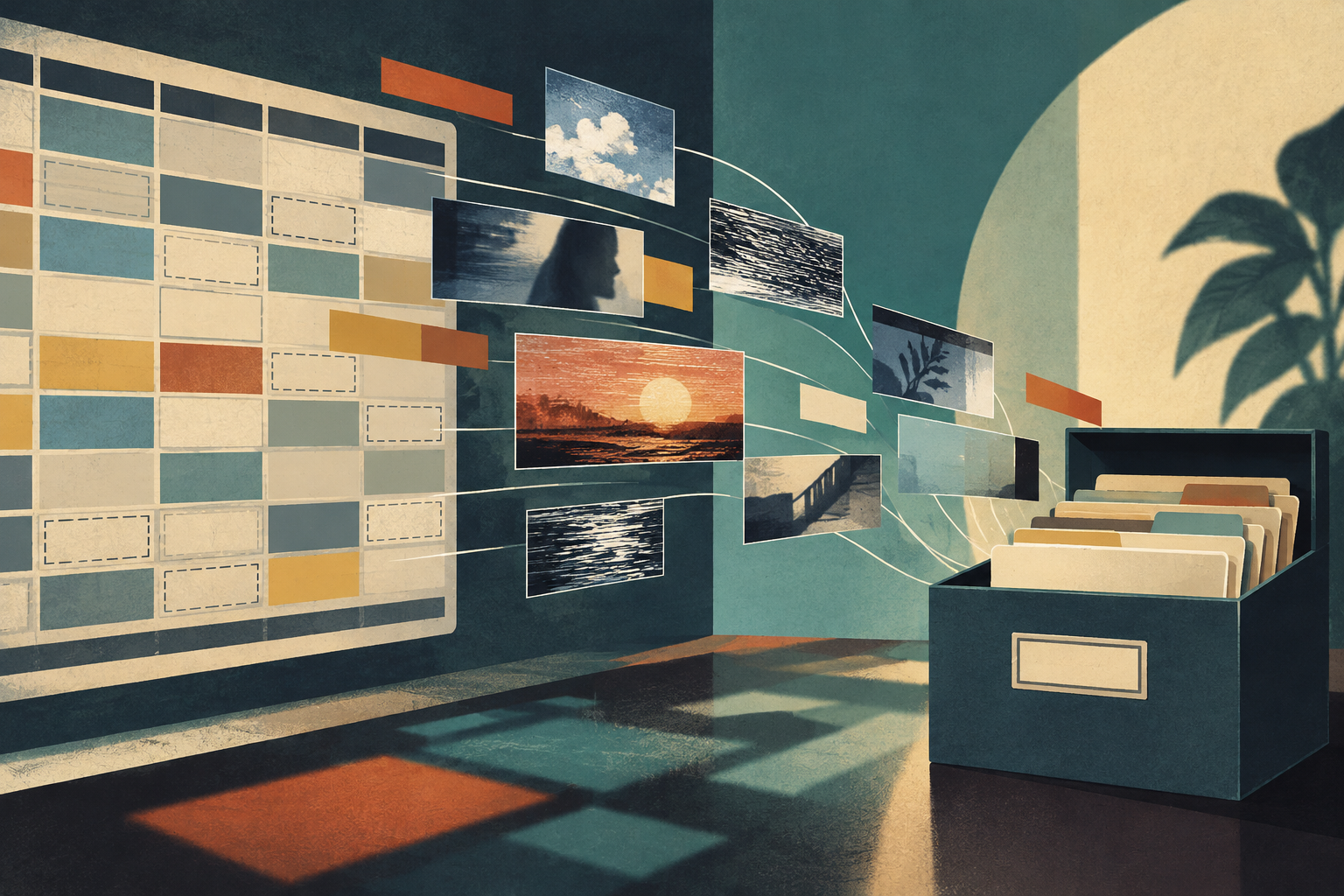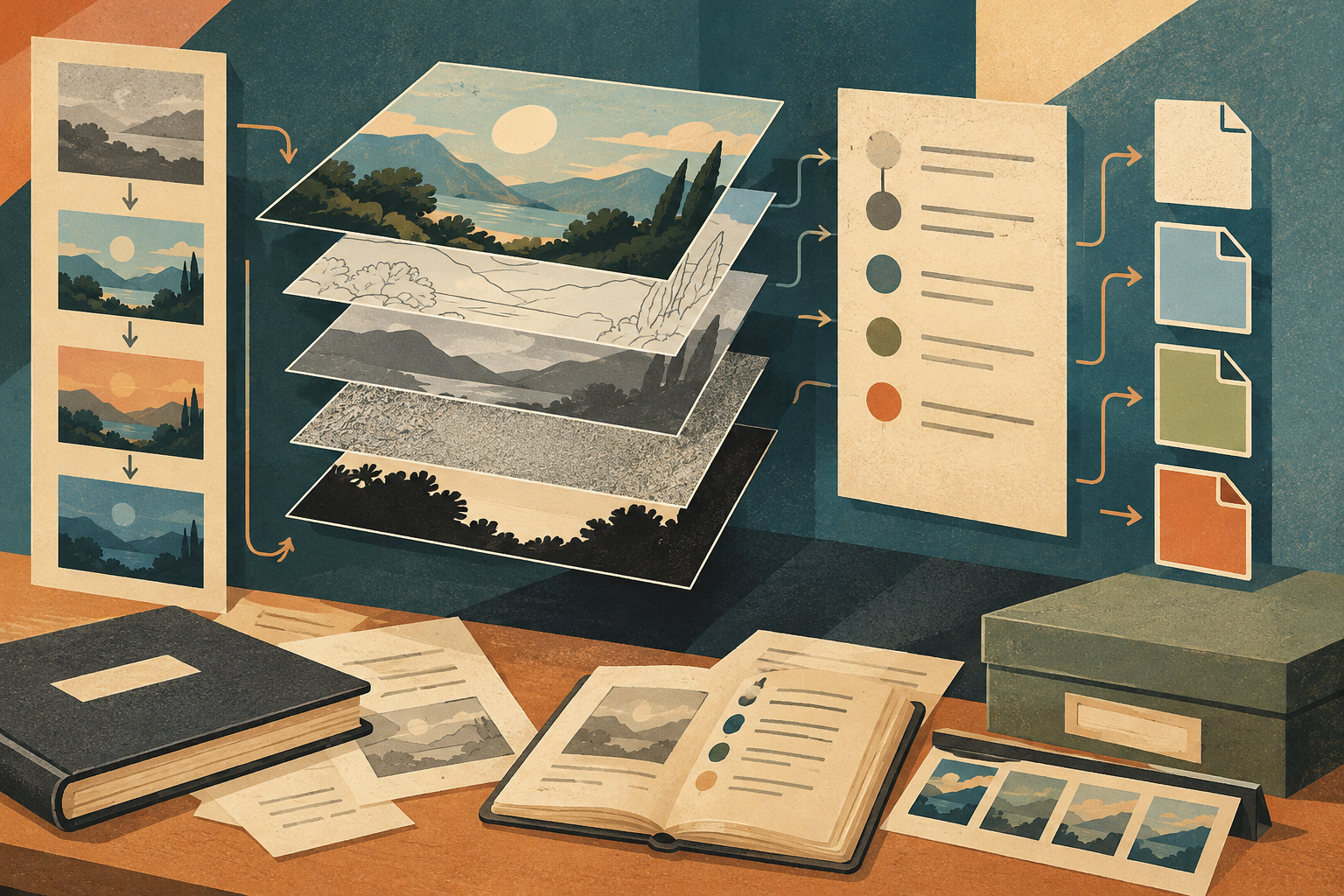
A digital image may preserve the result while losing the path that produced it. To tell the story of a program, a list of versions is not enough: we need documents that show what people did with it, in what context, and with what cautions. The materials available here do not reconstruct the full history of Photoshop or of domestic image editing. They do offer a more limited and useful view: how image-editing software appears in archival documents, digitization recommendations and work concerning documentary preservation.
Software appears within a task
A 2006 academic paper on institutional documentation initiatives lists Photoshop among the tools used for word processing, image editing and web design. The reference is not a history of the program and does not describe its interface; it records a role within a working process. That kind of evidence helps frame practical questions: what task was assigned to the program, what other steps formed the workflow, and what evidence survives of the result and the decisions behind it?
The historical importance of such a reference is limited, but real. It shifts attention from the product in isolation to documented use. It also warns us not to attribute capabilities or effects to the software that the source does not explain. The paper confirms that the program was included in a set of tools; it does not establish who used it, for how long, or with what configuration.
Editing can change the evidence
An archival document describing work carried out in 2008 mentions photographic retouching programs, including Adobe Photoshop, to adjust contrast and brightness in archival images. This is concrete evidence of an intervention. It is not a complete description of every image, nor does it show that all files received the same treatment.
The detail matters because editing is not merely an invisible stage before consultation. When visual values are changed, information about the process helps users distinguish the original document from a version prepared to make it easier to read. The cited source establishes that contrast and brightness were adjusted, but it does not say, on its own, how those changes were recorded, whether originals were retained, or what criteria guided each intervention. Those questions must remain open until documentation answers them.
Recommendations are documents of their time
Recommendations for digitization projects mention image-editing programs and related photographic tools, including Photoshop and Adobe Camera Raw. Their value for software history lies in showing that decisions about images belong to wider procedures: choosing tools, preparing materials and defining appropriate outcomes for a project.
They are not, however, user manuals for a particular version, nor proof that a specific institution adopted every tool mentioned. A recommendation describes options or proposed practices within its own framework. Treating it as evidence of universal use would go beyond what it documents.
Scanners and programs form a chain
A document about photographic archives in Madrid mentions an image editor, Photoshop, alongside three scanners. This combination shows the program appearing alongside other working resources. It also cautions against assigning the entire process to software: in this reference, digitization involves a relationship between capture and editing tools.
The source does not specify models, settings or the precise sequence of operations. It is therefore not possible to reconstruct a complete procedure from this mention. It can, however, serve as a lead for finding inventories, manuals, project records and output files that might complete the picture. In preservation work, an application name is a starting point for investigation, not a sufficient explanation.
Compatibility leaves traces too
A study of digital documentation and preservation notes that different Photoshop versions can present discrepancies and refers to parameters that may differ. The observation connects software history with a preservation problem: the ability to open a file does not, by itself, guarantee that it will be interpreted in the same way across environments or versions.
The reference does not identify every case, parameter or consequence. We should therefore avoid turning a general warning into a list of specific failures. Its value is to point to a documentation need: record the tools used, retain available information about files, and compare outputs when a current rendering appears different.
File formats are part of the story
OpenRaster is described as a proposed format for exchanging layered raster images, conceived as an alternative to older versions of the PSD format. The same reference says that the format was still under development and was supported by few programs at the time. Those limits matter as much as the goal of exchange: a format intended to make files portable does not guarantee that every program will interpret them alike or that adoption will be widespread.
The comparison helps explain why preserving an editable image involves more than saving a final view. A file and its layers may hold information about the work, but the supplied source does not detail which data survives in each case or guarantee full equivalence between formats. Collection documentation should describe precisely what is retained, without confusing a proposed exchange format with a universal solution.
What these traces can tell us
Taken together, the sources show Photoshop used in editing, digitization and documentary work; they also indicate that version differences and format interoperability deserve attention. They do not provide a complete chronology of interfaces, manuals or domestic learning. Nor do they support claims about how the program was used in every home or institution.
That limitation does not make the documents useless. It makes careful reading more important. A mention in an academic paper, an archival procedure, a technical recommendation and a format description answer different questions. Bringing them together can reconstruct partial practices and guide further research, provided we distinguish what is established from what remains undocumented. Software history becomes more than a list of versions when programs, files and tasks can be connected without asking sources to say more than they do.
- Decade
- 2000s
- Region
- Spain
- Level
- Enthusiast
- Entities
- No linked entities
Sources and references
- Historia y contexto actual de la documentación, restauración y ...riunet.upv.es · 2026-10-08
- Recomendaciones para proyectos de Digitalización de ...www.ccbiblio.es · 2026-10-08
- archivos fotográficos en madridxn--institutoestudiosmadrileos-4rc.es · 2026-10-08
- archivo y memoriawww.docutren.com · 2026-10-08
- INICIATIVAS INSTITUCIONALES DEe-archivo.uc3m.es · 2026-10-08
- FUENTES Y DOCUMENTOS PARA LA HISTORIA - rua@uarua.ua.es · 2026-10-08
- OpenRasteres.wikipedia.org · 2026-10-08