More than a line of objects
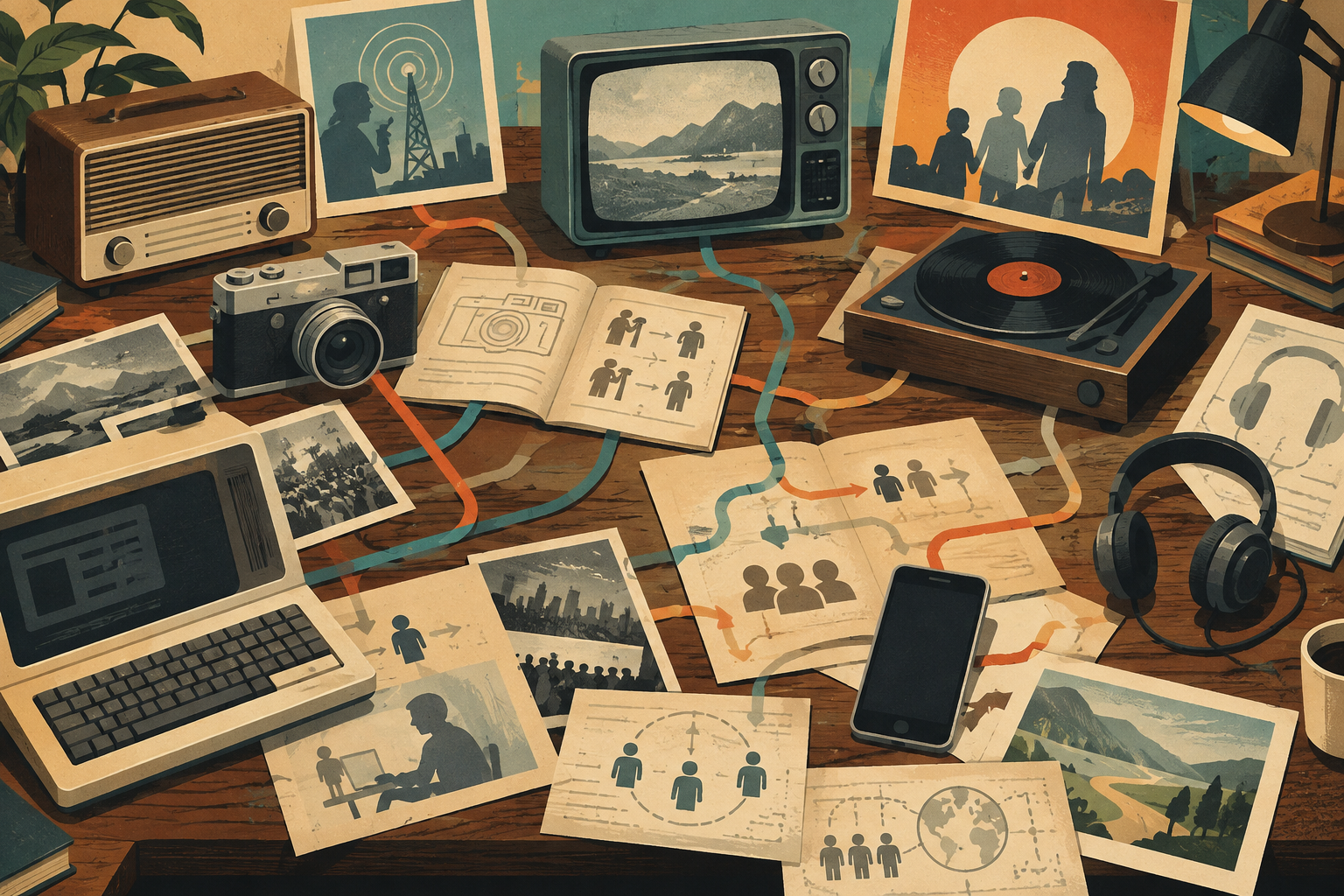
It is convenient to tell the history of technology as a row of successive devices: each object seems to occupy its place, with the next one arriving to replace it. But that picture can conceal a more useful question: what work did each object do in its own context? A RetroPause text argues that the history of computing cannot be reduced to a line of inventions. Taking that idea as a starting point does not mean discarding timelines; it means supplementing them with distinctions of use, function and setting.
The evidence assembled here offers clues at different scales, not a complete history. Teaching material from the Computer Museum at the Universitat Politècnica de València places the first European industrial applications of robots on automobile-manufacturing lines in 1970 and 1971. A document from Spain’s Ministry of Culture says that digital optical-disc technology developed during the 1970s, initially in a non-erasable form, and that Philips presented it in 1979. These are concrete references, but they do not, on their own, explain how people worked with those technologies, how widely they spread or what everyday experiences they produced.
Function matters as much as date
A robot on a manufacturing line and an optical disc are not versions of the same tool. The UPV source places one in an industrial setting; the ministry document concerns the development of a format for storing information. Even this limited comparison allows a distinction: grouping both under the label “technology” is not enough. Their tasks, settings and relationships with users differ. Reconstructing those differences in detail would require further sources—manuals, advertising, factory documentation or attributable testimony, for example. The available extracts do not provide that level of detail.
The UPM Historical Museum of Computing describes a collection of nearly 500 objects that show the evolution of computing and communications. The figure and description indicate a wide range of objects and fields, but do not justify assigning a particular use to every item. They do, however, remind us that a collection can help investigate families of devices and technical change without reducing them to a list of “firsts” and “nexts.”
What documents promise—and what they cannot prove
Documents have uses of their own. An advertisement or manual can show what a device promised and what instructions it gave its users; it cannot automatically prove that every advertised feature worked as claimed, or that the public adopted it. A historical exhibition can arrange objects and suggest connections; it cannot, by itself, reconstruct every past experience. It is therefore useful to distinguish a statement recorded by a source, an editorial interpretation and a question that remains open.
The National Museum of Science and Technology’s history page dates the beginning of the project to create the museum to 1962. That fact concerns an institutional initiative, not the invention of a technology. Likewise, an academic article in the journal CTS focuses on information and communication technologies in the period 1930–1970; its title establishes a subject and timeframe, but the available record is not enough to summarise its arguments. Using a source well also means recognising what it cannot support.
A map of tasks, not just novelties
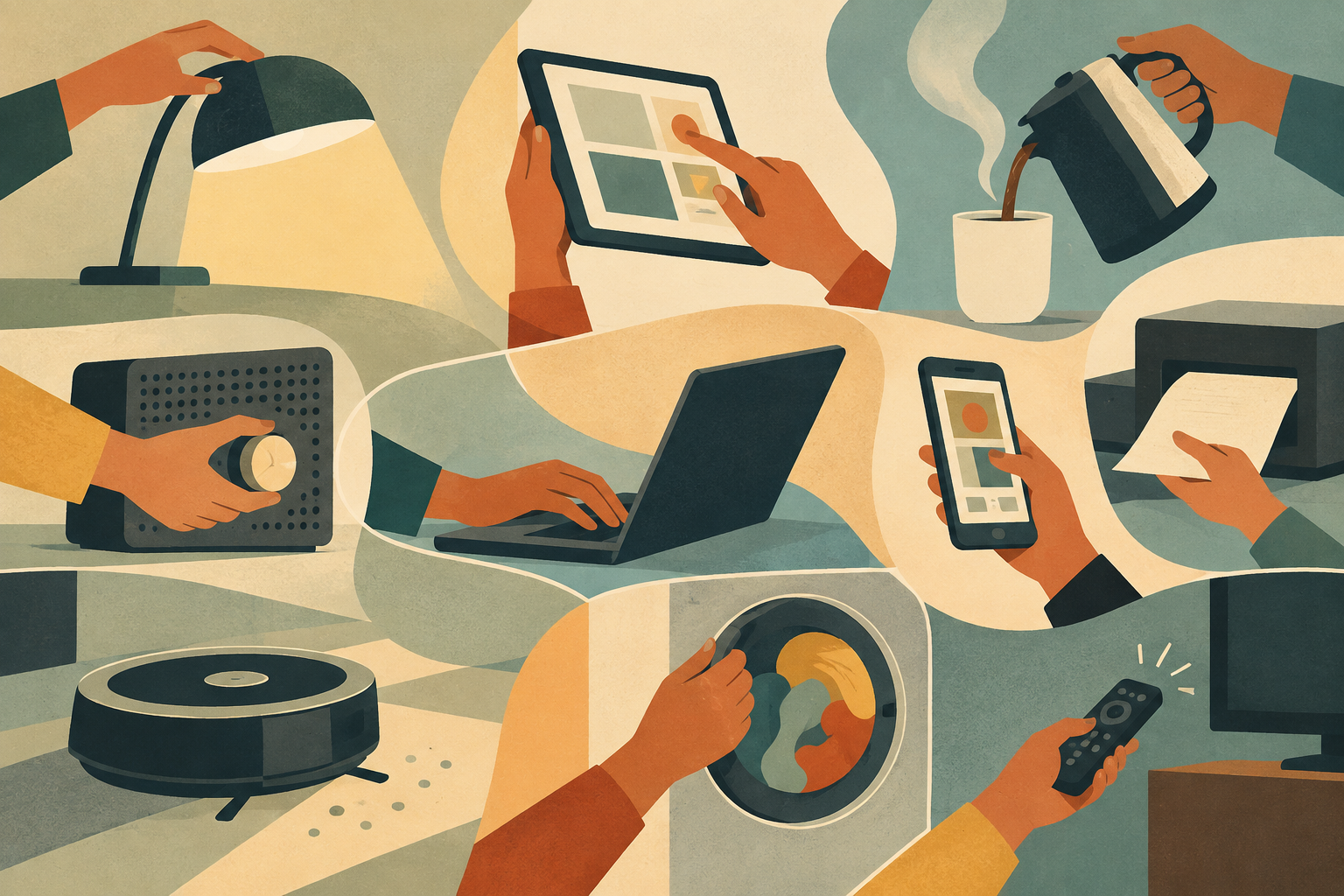
A history focused on use can organise comparable questions: What task was a device expected to perform? In what setting did it appear? What did a person have to do to operate it? What did its documents promise, and what limits did they reveal? These questions are not answers already documented for every machine. They are a guide to finding relevant sources and avoiding the assumption that an object’s appearance tells us its function.
They also help connect fields often studied separately. Computing, communications, industrial automation and storage formats belong to a broad history of technology, but they are not interchangeable. Connecting them is useful when the proposed relationship is made explicit and the evidence for it is identified. If the sources establish only that two developments belong to the same period, that coincidence should not be turned into a causal relationship.
What a responsible history can conclude
The available sources support a few bounded points: robots had European industrial applications in 1970 and 1971; digital optical-disc technology developed during the 1970s, and Philips presented it in 1979; institutional collections devoted to computing and communications exist; and the MUNCYT project dates back to 1962. They are not enough to describe the use experience of those devices exhaustively, measure their spread or compare specific outcomes.
That limit does not weaken the history; it makes it more precise. A technological device is explained not only by its date, novelty or design. The work it was meant to do, the conditions in which it was used and the distance between a documented promise and a verified practice matter too. Where the evidence runs out, the useful response is not to fill the gap, but to identify what documentation would allow it to be investigated.
- Decade
- 1970s
- Region
- Global
- Level
- Introduction
- Entities
- Museum
Sources and references
- La historia de la informática no cabe en una fila de inventoswww.retropause.com · 2026-10-07
- UN VIAJE A LA HISTORIA DE LA INFORMÁTICAmuseo.inf.upv.es · 2026-10-07
- (Nuestra) Historiamuncyt.es · 2026-10-07
- Historia de las Tecnologías de Información y ...www.revistacts.net · 2026-10-07
- Museo Histórico de la Informática UPM | madrimasdwww.madrimasd.org · 2026-10-07
- Las nuevas tecnologías y los archiveros del Cuerpo ...www.cultura.gob.es · 2026-10-07