From invention to use
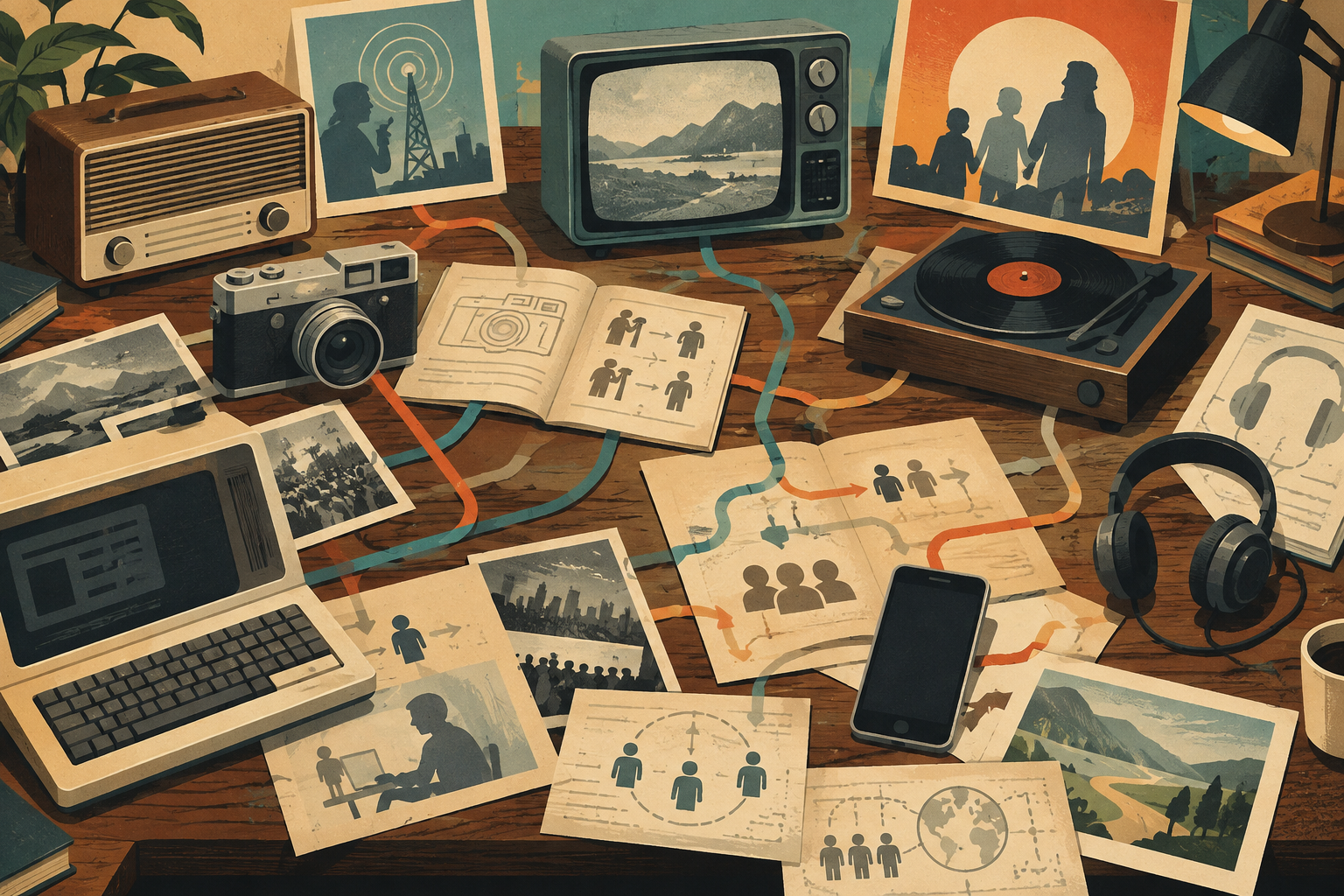
A chronology of devices can look like an explanation: one object appears, another newer one follows, and history moves forward. But that sequence leaves out the most concrete question: what could someone do with each device, in what circumstances, and within what limits? The very suggestion that the history of computing “does not fit in a line of inventions” invites us to question a linear account. This does not require denying the importance of inventions. It means recognizing that technology also has a history of design, circulation, and use.
The object tells only part of the story. Instructions, advertisements, catalogues, and institutional records may tell others. None of these sources, by itself, amounts to a complete account of everyday experience. An advertisement documents a promise; it does not prove that the promise was fulfilled in every case. A manual describes an intended use, but does not establish that every user followed its directions. The distinction matters: it lets us report what a source says without turning it automatically into a claim about what everyone did.
Promises are not uses
Asking what distinguished the uses of different devices means separating three levels. First, the capabilities attributed to them in the documentation available. Second, the tasks for which they were applied, when a specific source records them. Third, the experience of the people who used them, which may require testimony or other particular documents. If the archive preserves only a catalogue entry or an advertisement, the other two levels may remain open questions.
This caution does not make history poorer; it makes it verifiable. The material from the Universitat Politècnica de València cited here states that the first European industrial applications of robots on automobile-manufacturing lines date from 1970 and 1971. That is a bounded example of an application, not a comprehensive account of all robots, factories, or workers of those years. Precision means keeping the claim within the limits of what the supplied excerpt documents.
Following connections without inventing a straight line
Histories of information and communication technology can help situate broader changes. An article in the journal CTS covers the period 1930–1970; another university text links the historical development of electronic technology with milestones in the history of documentation. Their titles and descriptions identify fields of research and possible questions. On their own, however, they do not authorize us to summarize all their arguments or supply details absent from the evidence provided.
It is also useful to notice what each source is actually about. The history of Spain’s National Museum of Science and Technology, for example, dates the museum’s creation project to 1962. A reference to Telefónica’s historical-technological collection describes a book arranged in sections on history, technology, equipment, and models. These are clues to how objects and accounts are assembled and organized; they are not direct evidence of the everyday use of every device in a collection. Reading them carefully helps distinguish an institution’s history, the classification of its materials, and the social history of devices.
What an archive can contribute
To reconstruct actual uses, seek sources that answer specific questions: what task is mentioned, who performed it, where it is documented, and which device is involved? Instructions can clarify intended operations; a catalogue can show how an object was presented; an institutional record can show how a collection identifies it. When a source cannot answer a question, it should not be forced to do so.
The evidence available here is limited: it combines editorial descriptions, titles, and excerpts from university, institutional, and popular sources. It supports a method —not reducing technological history to a succession of inventions— and points to some contexts and cases. It does not support a complete comparison of devices or specific claims about undocumented users’ experiences. That boundary should remain visible, rather than being concealed beneath plausible-sounding detail.
A history made of objects and questions
To approach a device through its use is not to imagine what life with it must have been like. It is to connect the object to documents that record its functions, limitations, and contexts, and to state clearly where interpretation begins and evidence ends. The right editorial question is not only “what did it invent?” but also “what did it promise, what task did it address, and what evidence do we have for saying so?”
In this approach, manuals and advertisements are not merely accessories to the object. They become sources to be read according to what they can demonstrate. A device earns its place in history not only as one link in a chronology, but through the practices that documents allow us to reconstruct, the practices we cannot yet substantiate, and the questions that remain open.
- Decade
- 1970s
- Region
- Spain
- Level
- Enthusiast
- Entities
- Museum
Sources and references
- La historia de la informática no cabe en una fila de inventoswww.retropause.com · 2026-10-06
- UN VIAJE A LA HISTORIA DE LA INFORMÁTICAmuseo.inf.upv.es · 2026-10-06
- Evolución histórica de las Tecnologías de la Información y ...revistas.ucm.es · 2026-10-06
- (Nuestra) Historiamuncyt.es · 2026-10-06
- Colección Histórico-Tecnológica de Telefónica. El Museo que ...historiatelefonia.com · 2026-10-06
- Historia de las Tecnologías de Información y ...www.revistacts.net · 2026-10-06