Television was more than a sequence of programmes
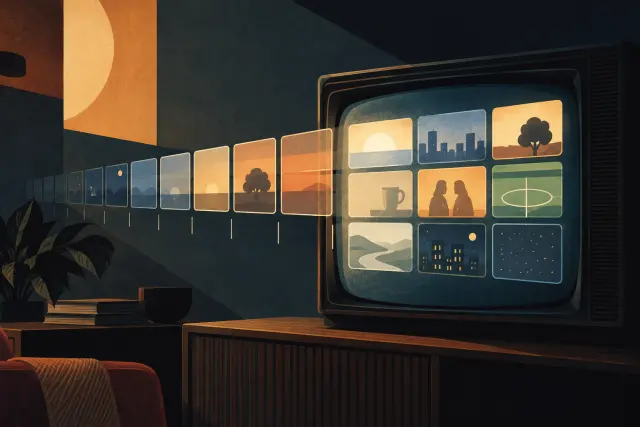
A broadcast was not made up solely of self-contained programmes. Advertisements, trailers, channel identifications and continuity segments appeared between shows, arranged within a planned sequence. Raymond Williams called this experience planned flow: the printed schedule did not fully match what viewers watched, because the broadcast also included advertising and transitions. Television therefore had a temporal form that changes when an archive preserves an isolated programme rather than the sequence in which it was seen.
That difference raises a basic question: what does it mean to preserve a broadcast? In practice, its component parts were often separated. A news report might be extracted from its bulletin; an advert stored as an independent item; or only a thematic selection from a programme retained. These decisions make particular materials easier to consult, but they also alter the context of transmission and reception. An archive does not necessarily preserve the whole television experience; it often keeps traces of it.
Recording was not the same as preservation
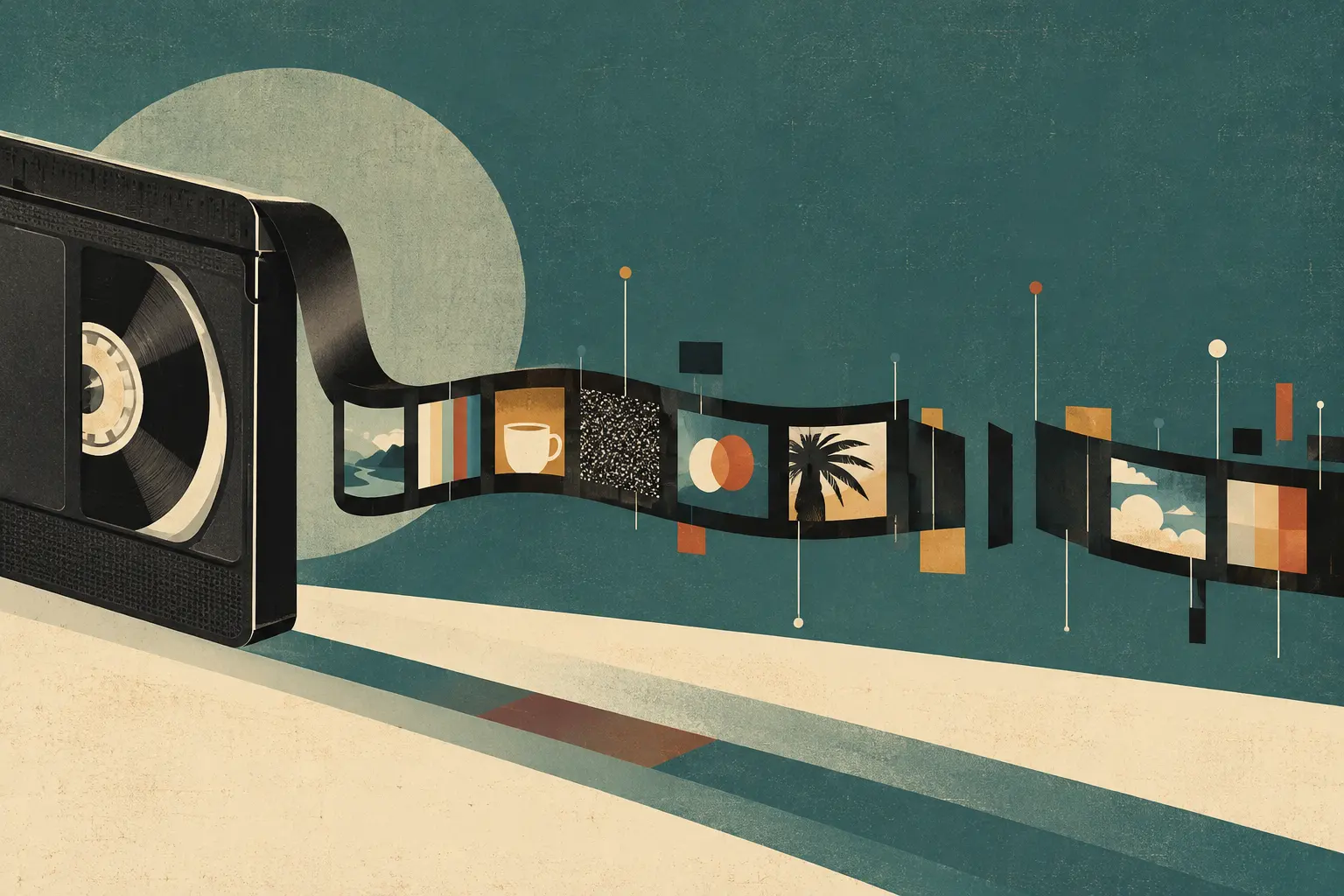
In television’s early years, many broadcasts were live and left no complete audiovisual record. Videotape, marketed by Ampex in 1956, made it possible to record, erase and reuse tapes. The new medium transformed production, but its capacity for reuse also made erasure routine. Having a technology capable of recording a broadcast did not mean there was a policy to preserve it as heritage.
Historian Elina Adduci Spina’s study of Argentina’s Historical Radio and Television Archive (RTA) shows how this logic operated in the country. Much of the material that survived was kept for practical purposes: rebroadcasting or reusing footage in new productions. Argentina’s first official television transmission, carried by Canal 7 on 17 October 1951, was live and survives as no audiovisual record. Recording expanded gradually during the 1960s; at first, videotape was used, among other purposes, for advertisements, without this implying permanent storage. Later, relocations, institutional changes, fires and discarding contributed to losses.
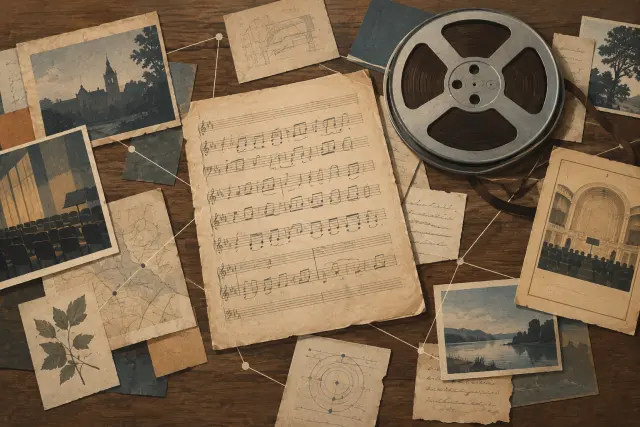
Reconstructing television history therefore requires combining sources. Surviving tapes can be compared with published schedules, production documents, photographs, press coverage and private recordings. In the case of the miniseries Los gringos (1984), for example, broadcast tapes can be considered alongside production photographs, surviving scripts and newspaper articles. None of these materials replaces the complete series, but together they recover aspects of its context and production practices.
An archive also creates connections
Argentina’s Historical Archive of the National State’s Radio and Television Broadcasting Services was established by Decree 378/2013. Its purpose was to preserve and provide access to records from state media such as Canal 7 and Radio Nacional. The collection brings together a range of formats: 16 mm film, two-inch quadruplex tape, one-inch tape, U-matic and Betacam, as well as discs and data-storage tapes.
Preservation is more than storing an object. Cataloguing determines how it is described and which connections between documents become visible. Digitisation enables new ways of consulting material, but does not by itself restore a broadcast’s original order. The Archive Prisma project, discussed by Adduci Spina, published historical excerpts online that sometimes appeared detached from their television flow. At the same time, documenting the carriers and their context could turn those excerpts into sources for studying television production and the medium’s institutional history.
The case of Los gringos also shows that a tape’s physical survival does not guarantee that its contents can be played. According to the study, fourteen of the series’ twenty-one quadruplex tapes suffer from glue flange syndrome, a form of deterioration that prevents playback. Seven readable tapes were digitised, making some episodes accessible; the others required technical investigation. Preservation therefore involves physical care, documentation, transfer and access: related but distinct tasks.
Television heritage can be uncomfortable
For a long time, television was treated as an ephemeral medium or one of limited cultural legitimacy. Recognising it as heritage does not resolve tensions over what deserves preservation and how it should be interpreted. Some content can be uncomfortable because of its political messages, the values it expresses or its distance from the present. In such cases, preservation also means documenting provenance and the circumstances of production, transmission and selection.
Adduci Spina examines official campaigns broadcast during Argentina’s last civil-military dictatorship. Detached from their context, they can circulate as autonomous audiovisual items; accompanied by information about their production and provenance, they can also be studied as propaganda and as part of television’s institutional history. Preservation and public interpretation are not separate operations: archival context affects how such material can be understood.
The study acknowledges that archiving the complete flow of every broadcaster transmitting at once is unattainable. Reconstruction, however, remains possible, though necessarily partial. Schedules show what was planned for broadcast; recordings reveal which fragments survived; and documents, catalogues and material traces help explain how programming was organised. Together, they offer a view both of the television that reached the screen and of the decisions that determined what could reach the archive.
- Decade
- 2000s
- Region
- Latin America
- Level
- Enthusiast
- Entities
- Televisión, Elina Adduci Spina, Argentina, Archivo Histórico de Radio y Televisión Argentina
Sources and references 5
- Desarrollo y conservación del patrimonio cultural-natural en el contexto neoliberal y nuevas tecnologíasdoi.org · 2026-11-16
- Memorias de archivosopenalex.org · 2026-11-16
- Exhibición, preservación y conservación del arte audiovisualtranslate.google.com · 2026-11-16
- Paradojas y desafíos del patrimonio audiovisual televisivo. ...www.scielo.org.ar · 2026-11-16
- On Your Screen (Madrid, 18-19 Sep 26)arthist.net · 2026-11-16