The schedule as an everyday clock
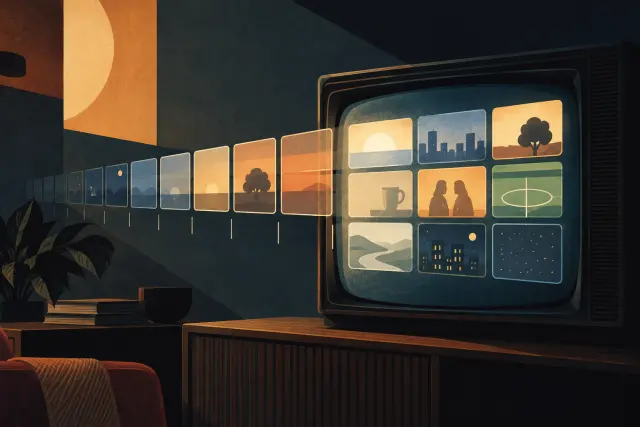
In Spain in the 1970s, television offered few alternatives, and its timings could become reference points for organising the day. The news, a series or a Sunday programme was more than content: its broadcast time helped establish shared routines. In its historical account, El Mundo recalls television as a medium that set the pace of society and gathered the attention of many households.
That memory can be considered alongside more precise documents. Tamara Antona Jimeno’s research on programming under Franco studies listings published between 1958 and 1975 in Tele Radio, ABC and La Vanguardia. It records programmes, start and end times, duration, time slots and types of content. Newspaper listings therefore help reconstruct not only what was announced, but also how the offer was arranged throughout the day.
A schedule, however, documents what was planned, not what each person watched. To approach reception, it must be compared with other traces, such as surviving recordings, audience data and testimony. Memories of a shared television appointment and records of broadcast times can complement one another, but they are not interchangeable evidence.
Recording separates broadcast from viewing
Recording technology first transformed production work. The Telecommunications Museum at the Polytechnic University of Madrid explains that, before videotape recorders spread from the second half of the 1950s, programmes were made mainly live. Film was used to show footage shot on location at a later date, by projecting it in front of a television camera. Smaller, lighter recording equipment made it easier to store programmes and broadcast them later.
The Chilean case offers a specific example, though it should not be confused with Spain’s own trajectory: Canal 13 introduced videotape in December 1965. A historical account of Chilean television describes the early programmes as live broadcasts, often made with considerable improvisation, and notes that tape opened up a different way of working. The example helps distinguish two related changes: recording altered production and preservation; home video also allowed viewers to postpone when they watched.
PBS’s timeline places the arrival of the VCR in the home market in the 1970s and notes that it gradually changed viewing habits and challenged advertisers’ assumption of a captive audience. Broadcasts still had a fixed time, but people who recorded them could watch later. The shared schedule did not disappear at once; it began to coexist with individual choice over when to view.
Competition expands the choice
In 1990, the private Spanish broadcasters Antena 3, Telecinco and Canal+ began transmitting. Their arrival ended the system in which TVE was the only state broadcaster with two channels. El Mundo connects this transformation with the arrival of the remote control and a more visible contest for viewers: audiences could switch between different offerings, while broadcasters sought to attract them with quizzes, entertainment and series.
More choice did not mean that every household stopped watching television together. What changed above all was the framework of choice. The schedule still determined when each programme was broadcast, but it no longer organised an almost identical agenda for the whole audience. Competition between channels widened the scope for selection and made choosing—and switching channels—a more visible part of the television experience.
The move from a limited offer to several broadcasters also changed the relationship between programming and audiences. Schedules remained important to broadcasters, but viewers could compare alternatives at the same moment. Control did not pass entirely to the audience: channels continued to decide what to offer and when, while viewers gained more room to switch channels or postpone viewing by recording a programme.
More signals and new forms of distribution
Digital terrestrial television widened the offer again. The Telecommunications Museum at the Polytechnic University of Madrid dates Spain’s first DTT broadcasts to 2000 and the official rollout to late 2005. For several years they coexisted with analogue transmissions, which officially ended in April 2010. Digitalisation made more efficient use of the spectrum and could mean more channels or improved picture quality.
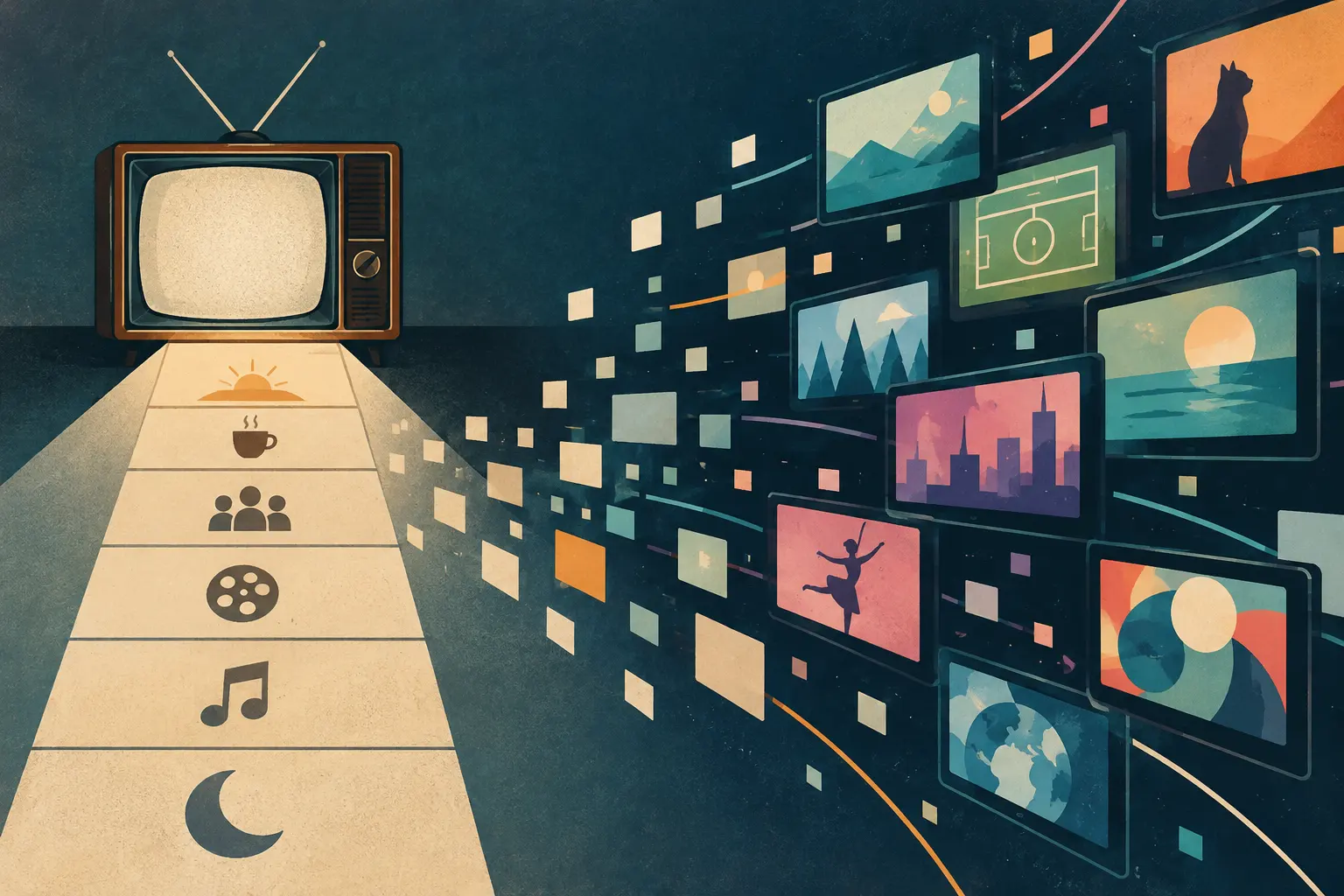
The history of television can therefore be read as a change in who controls its timing. Broadcasters programme and set transmission times; newspaper listings help reconstruct that offer; recordings preserve programmes and provide another way to watch. With more channels, the remote control and home video, viewers gained new ways to choose, without the organising role of the schedule disappearing.
- Decade
- 2000s
- Region
- Spain
- Level
- Introduction
- Entities
- Museum, Televisión
Sources and references 5
- La televisión que cambió tu vidalab.elmundo.es · 2026-11-22
- Evolución de la Televisión. TV en color y digital. La TV en España – Museo de Telecomunicacionesblogs.upm.es · 2026-11-22
- La televisión de una audiencia cautiva: historia de la programación durante el franquismoopenalex.org · 2026-11-22
- TV Milestones | American Experience | PBSwww.pbs.org · 2026-11-22
- Historia de la televisión en Chilees.wikipedia.org · 2026-11-22