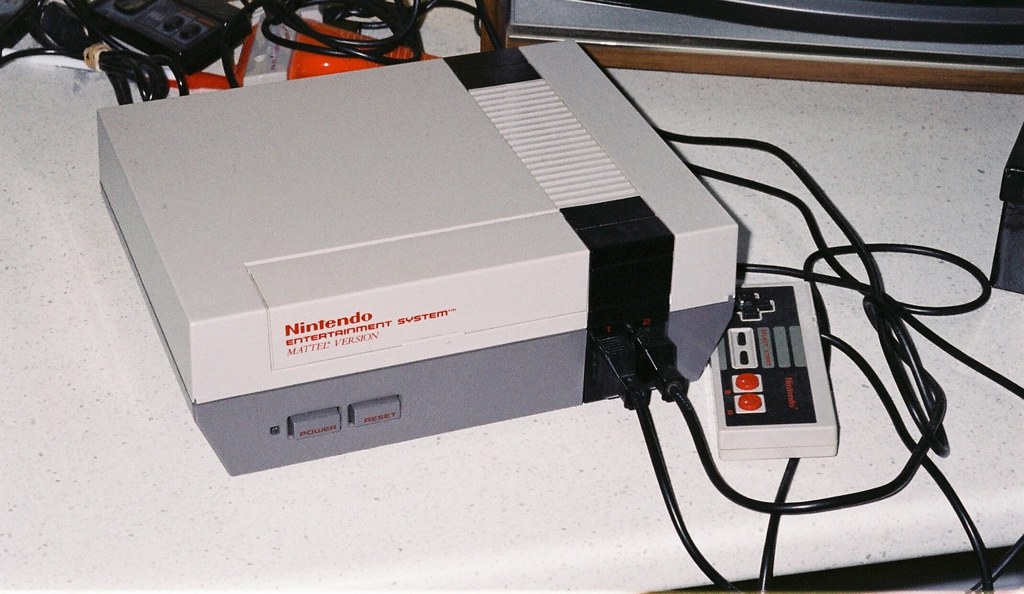
Nintendo’s official hardware history lists systems including the NES, Game Boy, SNES, Nintendo 64, Game Boy Color, Game Boy Advance and GameCube. That selection makes it possible to approach consoles not simply as collections of specifications, but as objects in which casing, controls and game media form part of a broader design proposition. The value of this account is methodological as well: it shows what a corporate chronology can suggest about design, and, just as importantly, what it leaves unresolved.
A product chronology, not the whole industry
Nintendo’s page provides information about several of the company’s consoles. It is a useful starting point for identifying models and following generations within its own catalogue. But a history published by a company is first of all an account of that company’s trajectory. It should not be mistaken for a complete history of home video games, nor does it allow a balanced comparison between Nintendo and other manufacturers.
That distinction matters because design does not happen in isolation. The cited record defines which objects can be considered, but it does not by itself supply the wider context needed to explain industry decisions, available alternatives or influence between companies. A chronology can organize questions; it cannot automatically answer them.
The console as a complete object
To look at a machine as an object of design means considering more than its technical capacity. The shape of its casing, the arrangement of its controls and the medium used for games are material dimensions of the relationship between a system and its user. The library matters too: a console is not defined only by the device, but also by the games associated with it and the conditions under which people access them.
The cited official source identifies several hardware families, but the supplied material does not describe each model’s shape, controls or media in detail. Comparison can therefore serve as an analytical framework, not as an inventory of specific differences that the available evidence does not confirm. Supporting detailed observations would require documentation for each system.
Comparing generations without imposing a straight line
The list of consoles invites comparison across generations, but chronological order alone does not demonstrate a linear evolution in design. A later model is not necessarily an improvement in every respect, and a different form does not prove a particular design intention. Without development documents, manuals or other sources, attributing motives to the people who designed a machine would be speculative.
A rigorous comparison would begin with verifiable features: which models the chronology includes and what characteristics are documented for each. Further sources could then supply context. Questions such as what distinguishes a home system from a handheld, or how controls shape play, become lines of inquiry rather than conclusions reached in advance.
What a corporate source can show
Nintendo’s history has value precisely because of its position: it reveals the selection and account the company offers about its products. That perspective provides information, but it also has limits. It does not establish how users received the consoles, how they were used in everyday life or what they meant in different cultural contexts. Nor does it independently support claims about sales, licences or relationships with third parties when those matters are not covered by the consulted documentation.
Recognizing these limits does not invalidate the source. It avoids asking it to answer questions for which it was not presented as evidence. Depending on the subject, a broader analysis would need manuals, development materials and independent studies. The evidence supplied here includes none of those documents and does not establish what they might show.
The cultural value of looking at hardware
A console’s physical form helps frame video games as a practice mediated by objects. The device occupies space, offers controls and depends on a game medium; those features may matter when studying how access to play is organized. Moving from that general observation to claims about habits or collective memories, however, requires testimony and research not documented here.
The cultural interest of the chronology lies, then, in opening a material reading of products often summarized through technical figures or game catalogues. It also reminds us that each object comes accompanied by an institutional account of its place in history.
A conclusion limited to the evidence
Nintendo’s official documentation provides a bounded basis for identifying several console generations and proposing an account of hardware that includes form, controls and media. It is not enough to explain design motivations, measure user reception or reconstruct the history of the industry as a whole. The concrete conclusion is modest but useful: a chronology makes comparisons possible; turning them into a history of design requires additional sources and claims calibrated to what those sources actually establish.
Documentary gallery

- Decade
- 1980s
- Region
- Global
- Level
- Introduction
- Entities
- Game Boy, Nintendo 64, Nintendo
Sources and references
- Ocho hitos en la historia de la cronobiologíadoi.org · 2026-10-18
- Hitos de la Historia Colonial Siglos XVI al XVIIIdoi.org · 2026-10-18
- Historia de una profesión docente: hitos fundacionales del profesorado de historia en Chile (1889-1958)doi.org · 2026-10-18
- La historia de Nintendo | Hardwarewww.nintendo.com · 2026-10-18
- 10.2: La evolución de los juegos electrónicosespanol.libretexts.org · 2026-10-18