The widespread perception of comics often centers on its icons, plots, and artists, but this view omits a decisive structural factor: the physical support. Research by Rubén Varillas, published in CuCo Cuadernos de cómic, argues that the medium cannot be separated from the formats that contain it. From its journalistic origins to the consolidation of the graphic novel, each format change has modified not only distribution but the narrative experience and critical reception of the work. This article explores how the diversity of supports, from fanzines to albums, has been key to the legitimization of comics as an independent art form.
Journalistic origins and the transition to the comic book
Comics did not emerge as an autonomous object but as an appendix to the press. Varillas notes that the medium transitioned from these journalistic origins to a plurality of formats. This initial transition was crucial for establishing the first reading conventions. The American comic book, emerging in the context of popular press, imposed a page structure and publication cadence that defined generations of readers. However, this format was linked to a commercial and mass logic that limited narrative experimentation. Subsequent evolution required a break from this journalistic dependence to allow greater creative freedom.
The 1960s explosion and the adult audience
The 1960s marked a turning point. According to available evidence, the emergence of underground comix in the United States and the rise of comic magazines in Europe contributed to a significant evolution of the medium. These new editorial spaces allowed comics to find an adult audience, moving away from the childish label that had defined it for decades. Toni Guiral, in his history of comics, highlights how magazine contents evolved until finding adults as their main reading audience. This demographic change was not only quantitative but qualitative, allowing for more complex themes and a more experimental aesthetic.
The fanzine as a circulation laboratory
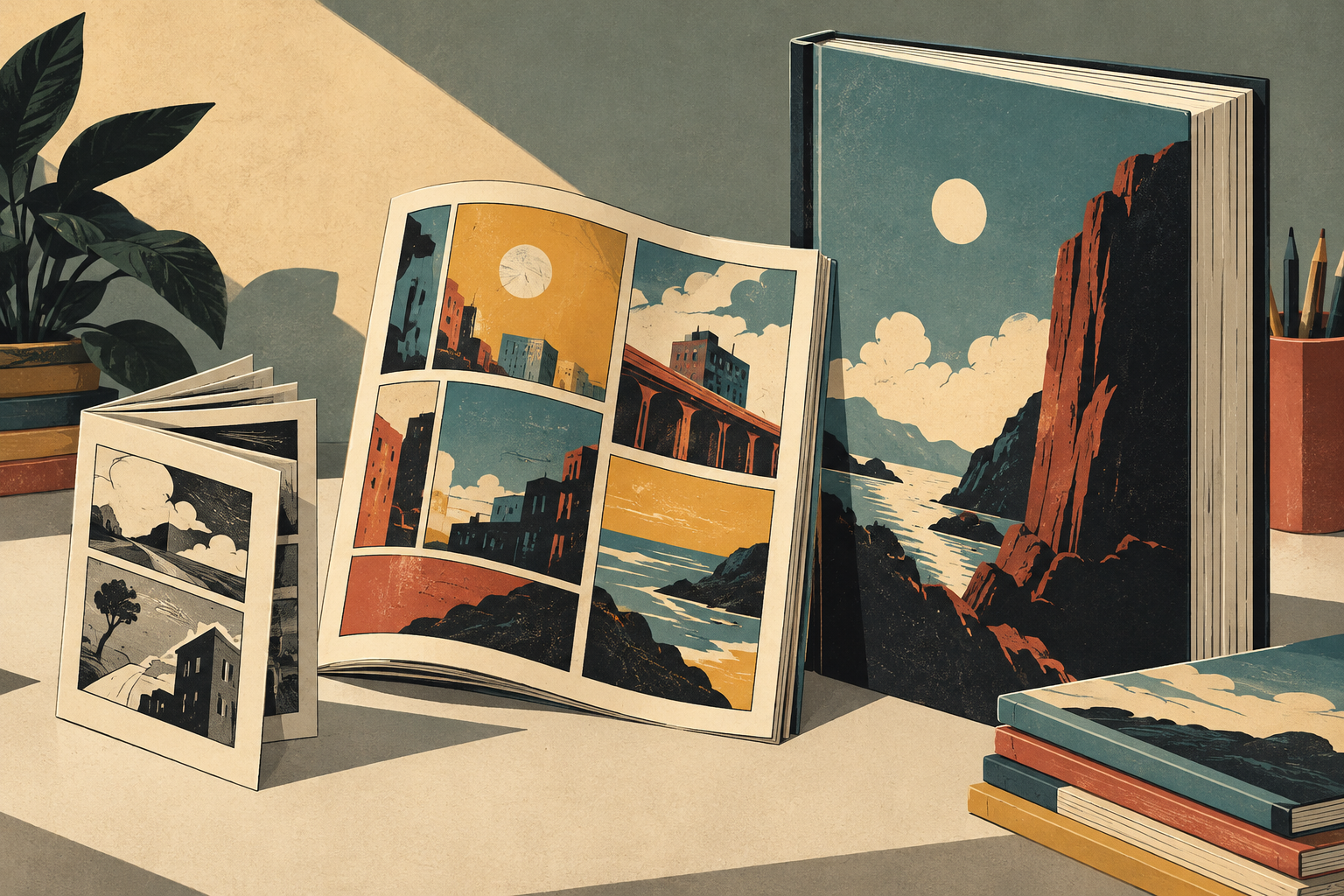
Among the formats that emerged in this period, the fanzine and mini-comic occupy a singular place. Varillas describes these supports as vehicles for more agile and experimental circulation. Unlike major publishers, fanzines allowed authors to maintain total control over production and distribution. This autonomy fostered a culture of direct exchange between creators and readers, creating communities of practice that challenged mainstream market norms. Experimentation in page design and narrative structure was more intense in these formats, where economic limitations became a source of creativity.
The consolidation of the European album
While the Anglo-Saxon world explored the underground, Europe developed the album as the dominant format. The transition from the periodical magazine to the album consolidated a more leisurely and contemplative reading experience. The album, being a unique and complete object, allowed for a more extensive and coherent narrative planning. This structure favored the creation of works with literary and visual depth that the magazine format, with its periodic interruptions, did not always permit. The album thus became the preferred vehicle for serious graphic narrative, establishing a quality standard that influenced the global perception of the medium.
The graphic novel and artistic legitimization
The evolution of these formats culminated in the emergence of the graphic novel. This term, although often used as a synonym for album, implies a specific narrative intention seeking equivalence with the literary novel. The plurality of formats, including the graphic novel, has been fundamental for the legitimization of comics as an art form. By offering a variety of supports, the medium could adapt to different reading contexts and aesthetic expectations. This diversity allowed comics to be recognized not only as entertainment but as a complex and multifaceted form of artistic expression.
Circulation conditions and page design
Understanding circulation conditions is key to appreciating how page design and narrative structure adapt to each format. A 16-page fanzine does not allow the same visual progression as a 120-page album. The cadence of the magazine imposes a rhythm of climax and resolution that differs from the sustained immersion of the graphic novel. Varillas emphasizes that comics are a matter of formats as much as content. Ignoring this material dimension leads to an incomplete understanding of the work. The support is not a neutral container but an active participant in the construction of meaning.
Legacy and limits of the evidence
The evidence suggests that the evolution of these supports has been fundamental for the legitimization of comics. However, it is important to recognize the limits of this narrative. Comic history is global and diverse, and the formats described here are only part of a broader ecosystem. Moreover, digitalization has introduced new challenges and possibilities not addressed in the primary sources analyzed. Despite this, the study of physical formats remains relevant for understanding the roots of the medium and its capacity for adaptation. The diversity of supports is not a historical accident but a defining characteristic that continues to evolve in the 21st century.
- Decade
- 1960s
- Region
- Global
- Level
- Enthusiast
- Entities
- Rubén Varillas, Cuadernos de Cómic, Revistas de cómics
Sources and references
- El cómic, una cuestión de formatos (2): revistas de cómics, fanzines, mini-cómics, álbumes y novelas gráficasdoi.org · 2026-10-20
- Formatos y evolución del cómic | PDF | Cómicses.scribd.com · 2026-10-20
- Cómics - Historietastranslate.google.com · 2026-10-20
- Historia de los Cómics, por Toni Guiralwww.zonanegativa.com · 2026-10-20
- El cómic, una cuestión de formatos (1): de los orígenes ...www.researchgate.net · 2026-10-20