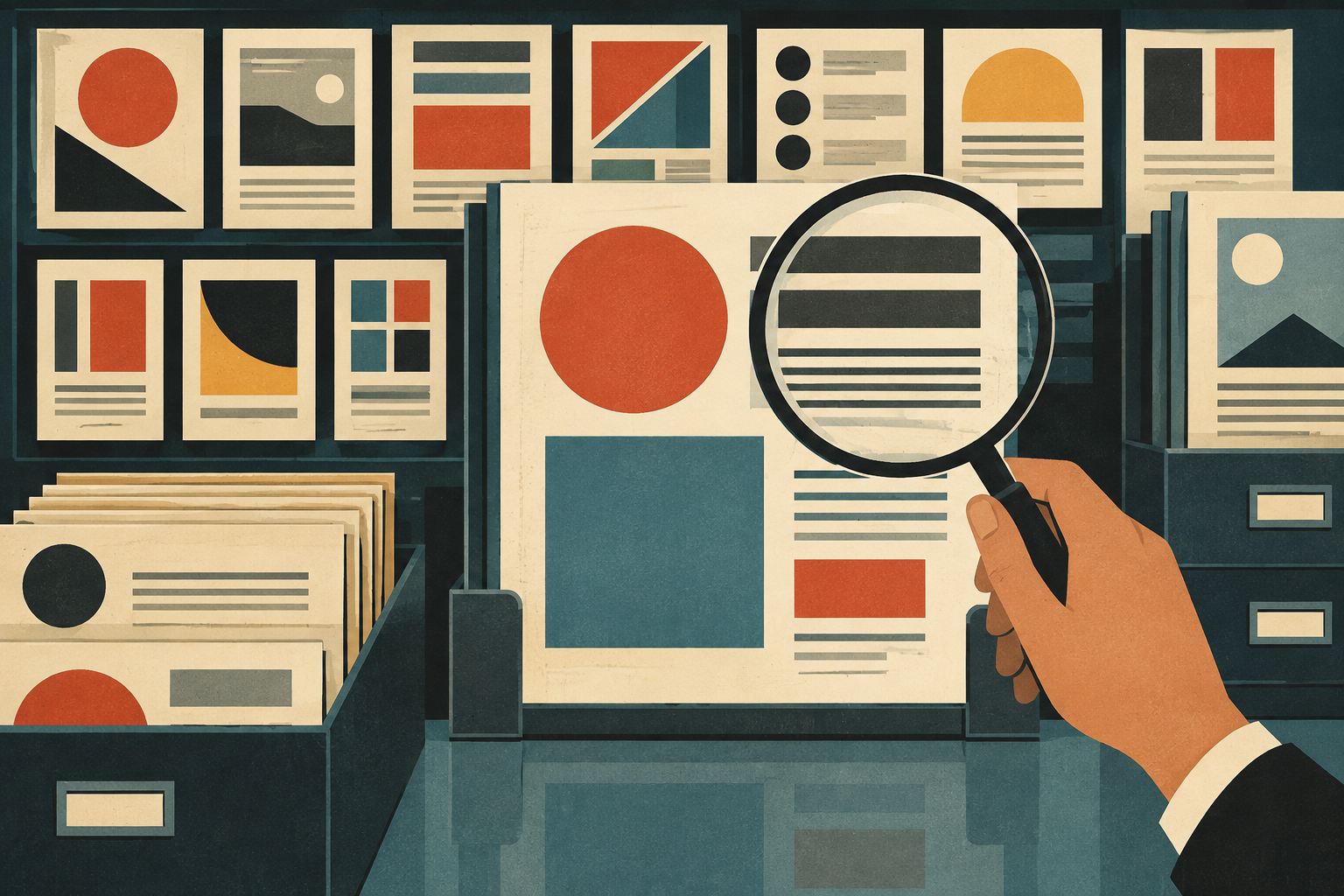
An advertisement can catch the eye through its colour, typography or image. But describing it only as “modern,” “elegant” or “striking” does not explain how it works. To analyse its design, it helps to ask what information it emphasizes, how it guides the eye, and what relationship it proposes between text and image. An archive makes this reading possible, although it does not, by itself, turn an item into a complete record of its time.
From appearance to decisions
Visual language is not decoration added to a message that is already resolved. Composition distributes elements; scale establishes hierarchies; contrast can separate information or create emphasis. These are questions to investigate, not automatic conclusions: without examining a particular piece, we cannot say what its maker intended or how its audience responded.
This distinction also helps avoid confusing an aesthetic label with a functional explanation. “Retro,” “minimalist” or “bold” may describe an impression, but they do not by themselves tell us what is understood first, where a product name appears, or which elements compete for attention. Analysis becomes more precise when it identifies what is actually visible and separates that description from interpretation.
The piece needs a medium and a context
Advertising appears in different media. A poster, a printed advertisement and a piece designed for a screen do not necessarily offer the same conditions for reading. The supplied material describes outdoor advertising as messages placed in public spaces and lists posters, billboards, illuminated signs, banners and street furniture. This inventory prompts a functional question: what needs to be visible, and from what situation, for the message to be read?
That question does not automatically reveal the size, viewing distance or design of a particular campaign. Those claims would require images, technical records or specific documentation. It does, however, allow us to look at an advertisement by asking about its medium and the relationship between its visual organization and the way audiences encounter it.
The archive as a tool for reading
The record on MUVAP describes a virtual museum active from 2001 to 2016, whose exhibitions documented the history of Spanish advertising and graphic design in Spain. Its relevance here is not that we can attribute a method or collection to it that the available evidence does not describe. Rather, it is a documented example of an initiative that brought advertising and graphic design together in an exhibition framework.
An archive of this kind makes comparisons possible, provided we know what is being compared and what information accompanies each object. Two pieces may differ in composition, graphic devices or medium; attributing that difference to a strategy, audience or historical shift, however, requires further evidence. An image’s presence in an archive shows that it can be studied there; it does not, by itself, explain every circumstance of its production and circulation.
Advertising, institutions and narratives
Information on company museums notes that the Alessi archive contains documents about the brand’s history and Italian design. This example shows that a corporate archive can encompass narratives broader than product promotion. It does not establish that all company archives work in the same way, or that their documents are neutral: selection and presentation affect what visitors can see.
Research on cultural marketing in museums, in turn, identifies specialized marketing as a relevant institutional question. Taken together, these sources invite us not to treat a museum as a transparent container. An exhibition also organizes information: it selects objects, establishes relationships and proposes a way of reading. That editorial role should be distinguished from the content of each advertisement.
What we can establish—and what is missing
The available sources support a general approach to advertising design and document some archival and exhibition contexts. They do not provide detailed reproductions, advertisement designers, campaigns, creation dates or audience-response data for analysing a particular piece. It is therefore not possible to assign design decisions to a specific person or reconstruct how audiences interpreted them.
Further research could begin with identified objects and compare their images with catalogues, institutional records and contemporary sources. Until then, the most rigorous question is not whether an advertisement “represents” an entire era, but which visible elements can be described and what evidence would be needed to interpret their function.
Looking more precisely
Reading an advertisement beyond its style means treating form as an organization of information, not as a label. Composition, medium and visual hierarchy offer useful questions, but the answers depend on the particular piece and its documentation. An archive makes comparison possible; it also makes clear that its choices and limits need to be explained. In this way, visual language becomes an object of analysis without confusing observation, interpretation and documented fact.
- Decade
- 2000s
- Region
- Spain
- Level
- Introduction
- Entities
- Museum, MUVAP
Sources and references
- Evolución y aplicación del marketing cultural en los museosbid.ub.edu · 2026-10-02
- Los Museos de Empresasevemuseografia.com · 2026-10-02
- MUVAP (2001- 2016): museo virtual que documenta la ...revistas.ucm.es · 2026-10-02
- Centro de Documentación Publicitariawww.lahistoriadelapublicidad.com · 2026-10-02
- Publicidad exteriores.wikipedia.org · 2026-10-02