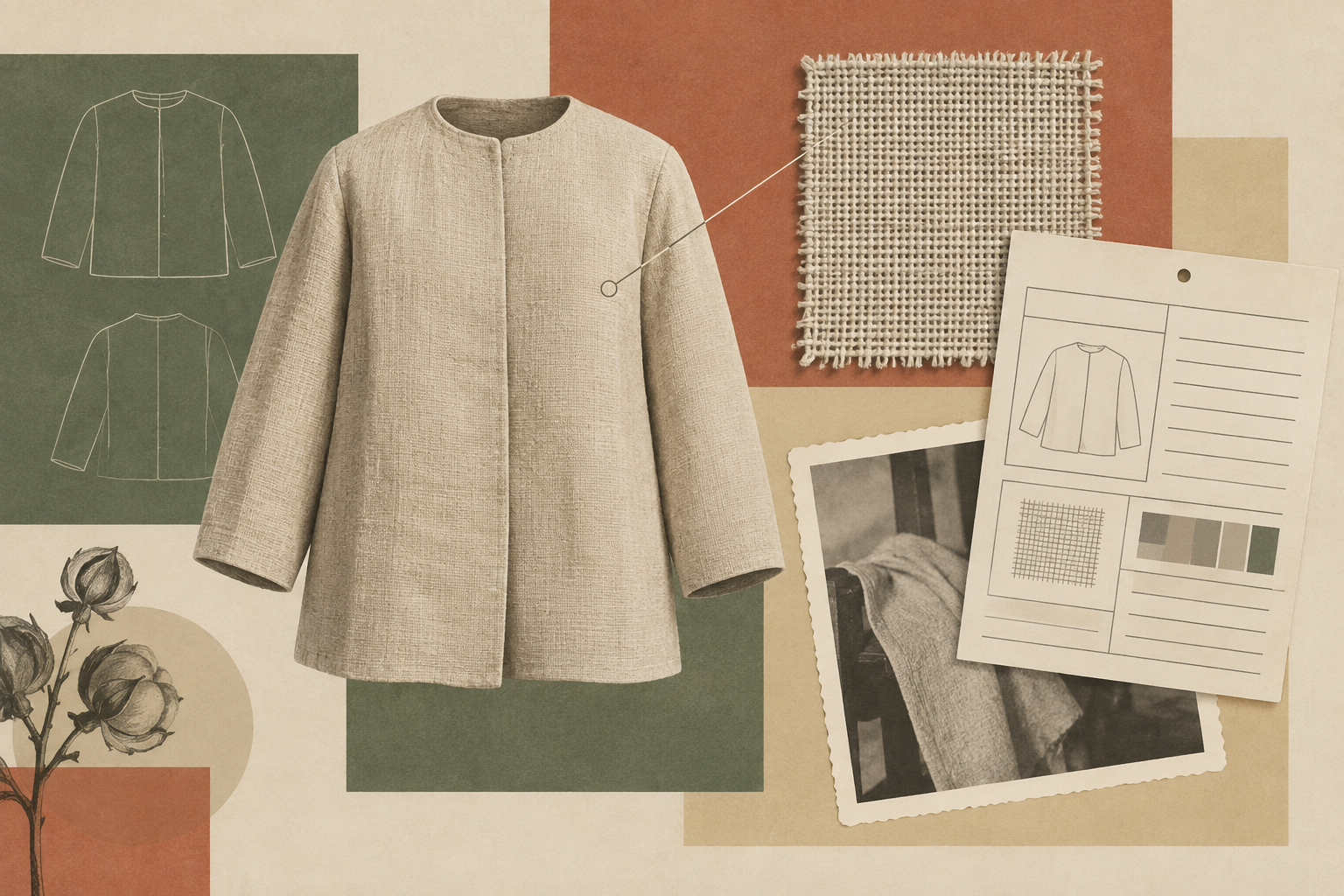
A preserved textile can reveal a technique, a weave or a decoration; on its own, it cannot identify who wore it or under what circumstances. A photograph may show a garment on a body, but it does not prove that the image represents ordinary experience. Studying fashion rigorously means bringing objects, images and records into conversation while keeping visible the distance between what each source records and what we would like to know.
Material is evidence, not biography
For example, the Museo del Traje’s entry on historical textiles explains that brocade is characterised by decoration made with precious metals and worked on a loom. That definition helps identify a process and name a material. By itself, it does not tell us who wore a particular garment, where it was used or how often. Technical description is essential, but it has a specific scope.
The proceedings of the colloquium on textiles, fashion and bodies offer another kind of material vocabulary, including details about buttons made from fabric. Indumenta, the Museo del Traje’s journal, also presents information on manufacture and weaving: it describes the interlacing of warp and weft and notes that the method can vary. These sources help frame verifiable questions about construction, surface and manufacture. They do not replace the social history of the people who wore the garments.
What a photograph adds
An image can bring dress closer to a represented situation: a body, a pose, a combination of garments or a visible setting. But a photograph preserves a selection, not the entirety of a practice. The frame leaves things out, and the image may have been made under conditions we do not know. Without establishing its provenance, date or context, claiming that it shows general use would exceed the available evidence.
The entry on traditional dress in Madrid emphasises the documentary value of paintings and prints for studying changes in dress. That is a useful reminder of the range of visual evidence, but an artwork is not automatically a direct observation of everyday life. We should ask who made the image, what kind of scene it presents and what relationship can be established with surviving garments or descriptive records.
Collection documentation matters too
An object does not necessarily arrive at a museum with a complete history. The documentation that survives—and what is missing—shapes the questions that can be asked. The article on textiles in Spanish museum collections stresses the value of recording treatment: that documentation becomes linked to the textile’s history and records conservation work. It tells us about the object’s path within the collection, not automatically about its earlier use.
The UNESCO publication on fashion and dress museums, and the bibliographical and institutional resources identified in Moreiro-González and Sales dos Santos’s article, provide a framework for locating different kinds of sources. Their value lies in directing research towards collections, memory institutions and documentary references. Finding a source does not settle a question: researchers must establish exactly what it claims and what kind of evidence supports that claim.
Uses, advertising and limits
To get closer to use, we need sources that record situations, not only promotional representations. The evidence available here supports the need to combine objects, images and documentation, but it does not include an identified series of photographs, attributable testimonies or specific advertisements that would allow us to reconstruct a particular case of use. We therefore cannot infer what “everyone” wore or present one garment or image as proof of a widespread custom.
The Cristóbal Balenciaga Museum blog includes an assessment of Balenciaga’s work with volume, but that comment does not, by itself, document the experiences of people who wore the garments. Distinguishing a statement about design from a technical description, a fashion image or a record of use prevents sources of different kinds from being collapsed into a single narrative.
Reading in layers
A careful study can begin by describing the garment and its construction, recording where each piece of information comes from, and separating observation from interpretation. The garment can then be compared with images and documents whose contexts are identifiable. If the sources cannot establish who wore it or in what situation, that absence should remain part of the account rather than being filled with an imagined scene.
The sources considered here outline a method rather than a complete history of one particular outfit. The textile supports claims about material; the record, claims about classification or documented treatment; the image, claims about what falls within its frame. Only comparison between testimonies can bring us closer to use, and even then conclusions must be limited to what those testimonies support. Dress becomes social history not when it is assigned a fictional biography, but when surviving evidence is brought together with care.
- Decade
- 2000s
- Region
- Spain
- Level
- Enthusiast
- Entities
- Museum, Museo del Traje
Sources and references
- Recursos de información sobre moda: fuentes bibliográficas, instituciones de memoria y objetos de contenidodoi.org · 2026-10-02
- Prólogo del monográfico "Documentación y Moda"doi.org · 2026-10-02
- La moda en la historia - Museo del Trajemuseodeltrajevirtual.com · 2026-10-02
- Tejidos, moda y cuerposhistoriadeldisseny.org · 2026-10-02
- Museos de la moda y el vestidounesdoc.unesco.org · 2026-10-02
- Los tejidos en las colecciones de los museos españoles, una ...revistas.ucm.es · 2026-10-02
- INDUMENTA REVISTA MUSEO DEL TRAJEwww.cultura.gob.es · 2026-10-02
- Sin categoría – Cristóbal Balenciaga Museoablog.cristobalbalenciagamuseoa.com · 2026-10-02