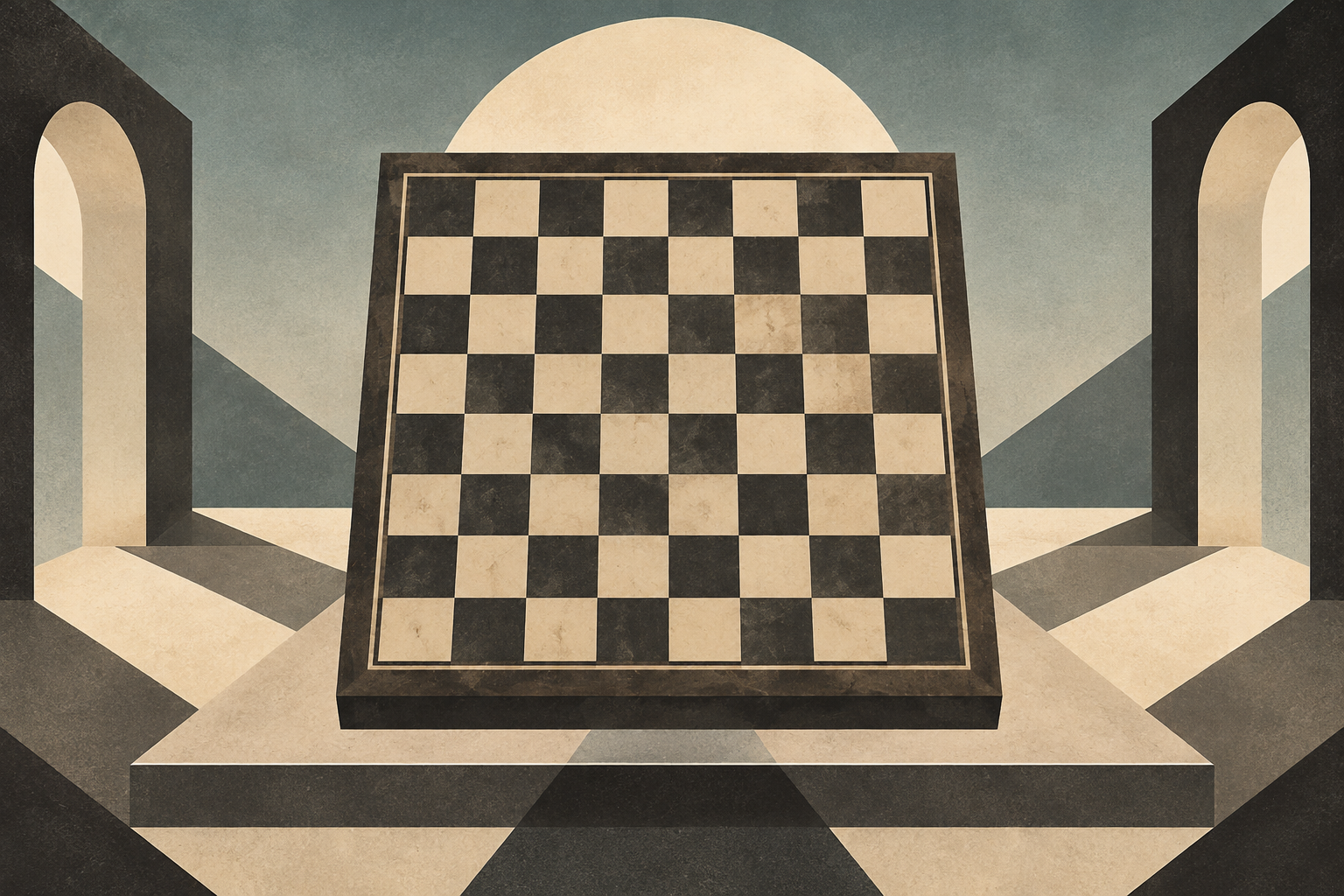
The checkers and chess board is an 8x8 structure creating 64 squares. This configuration is not arbitrary but the result of historical evolution connecting 6th-century India with 15th-century Europe. Chaturanga, the precursor to chess, established the square base that was later adapted to Persian shatranj and finally European chess. Evidence documents that this format became the standard for both games, allowing pieces with different rules to share the same physical space. The article explores how the standardization of this board facilitated the spread of strategy games in Europe, transforming a decision system into a universal cultural object. It analyzes the transition from the Indian game to the European version, highlighting that the board geometry remained constant while rules and pieces evolved. This spatial continuity is key to understanding the history of regulated board games.
Origins in India
The oldest records of board games date back to antiquity, but chaturanga is the direct ancestor of modern chess. It was practiced in India during the 6th century. This game established the square base that would be fundamental to its later development. The 8x8 square structure was already present in this initial stage, providing a defined spatial framework for strategy.
Transition to Shatranj
Chaturanga evolved into Persian shatranj. This step was crucial in the history of the game, as shatranj became the vehicle through which the game reached Europe. The board geometry remained constant during this transition, suggesting that the spatial structure was more important than the specific rules of the pieces in the spread of the game.
Standardization in Europe
Chess as it is currently known emerged in Europe during the 15th century. It was an evolution of the Persian game shatranj. The standardization of the 8x8 board was a key factor in this process. By having a fixed format, players could focus on the rules and strategies, without having to worry about the variability of the playing space.
Coexistence of Rules
One of the most interesting features of the 64-square board is its ability to host games with different rules. Both chess and checkers use the same board, but with different pieces and rules. This coexistence demonstrates the versatility of the 8x8 structure and its ability to adapt to different game systems.
The Board as a Cultural Object
The standardization of the board facilitated the spread of strategy games in Europe. Chess became a universal cultural object, with a social, educational, and therapeutic dimension. FIDE, the International Chess Federation, regulates international competitions and establishes universally accepted rules.
Spatial Continuity
The board geometry remained constant while rules and pieces evolved. This spatial continuity is key to understanding the history of regulated board games. The 64-square board is an example of how a physical structure can endure over centuries, adapting to different cultural and social contexts.
Conclusion
The 64-square board is not just a game tool, but a cultural object with a rich history. Its standardization in the 15th century was a milestone in the history of chess, allowing its spread and consolidation as a universal game. The fixed 8x8 geometry remains the basis of chess and checkers, demonstrating the durability of this structure over the centuries.
- Decade
- Before 1950
- Region
- Global
- Level
- Introduction
- Entities
- No linked entities
Sources and references
- Tablero de damas y ajedrez - Wikipedia, la enciclopedia librees.wikipedia.org · 2026-10-17
- Ajedrez Historia | PDFes.scribd.com · 2026-10-17
- Tablero de damas y ajedrez Origen y evolución Los juegos ...www.facebook.com · 2026-10-17
- Características del tablero de ajedrez | PDFes.scribd.com · 2026-10-17
- Ajedrezes.wikipedia.org · 2026-10-17