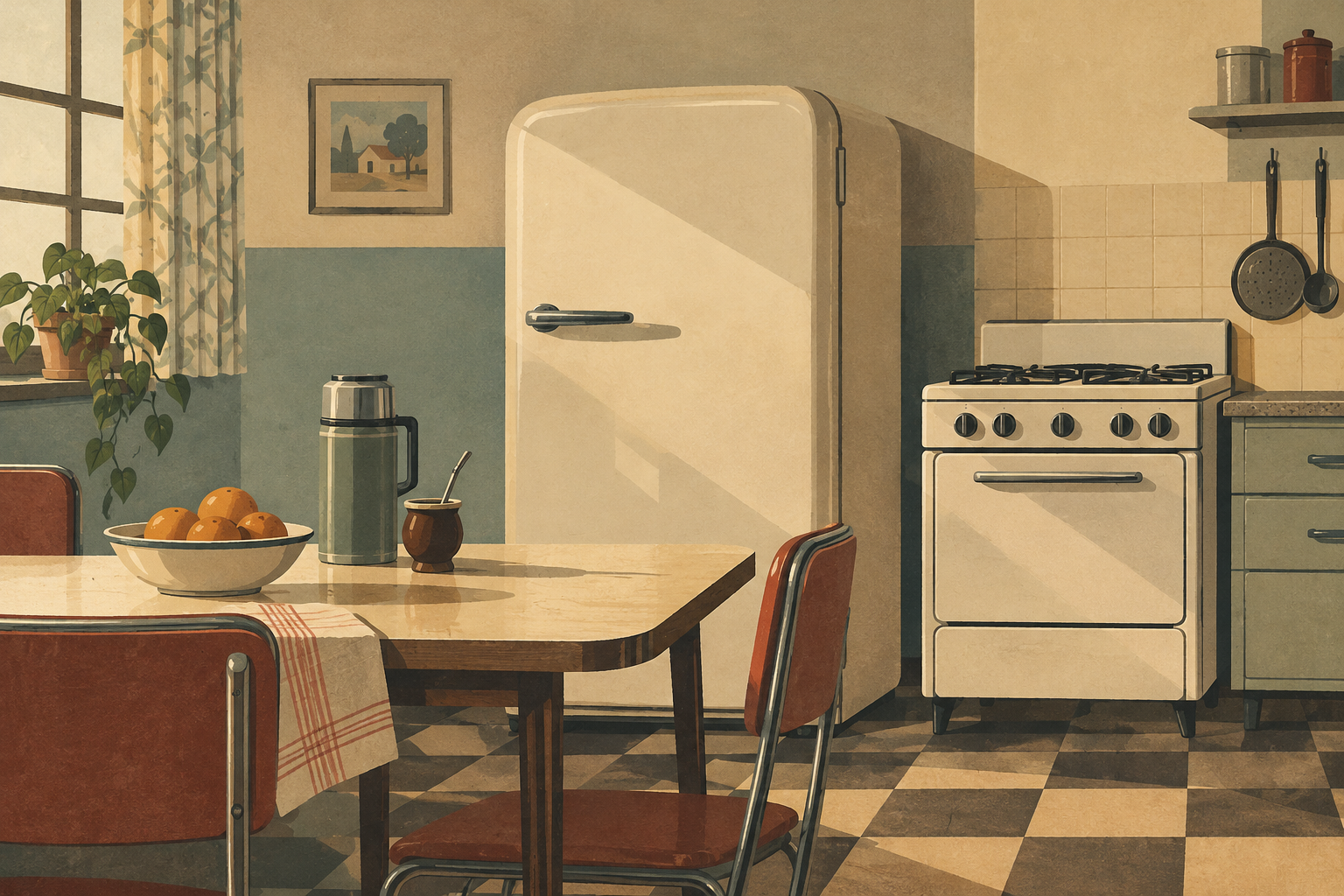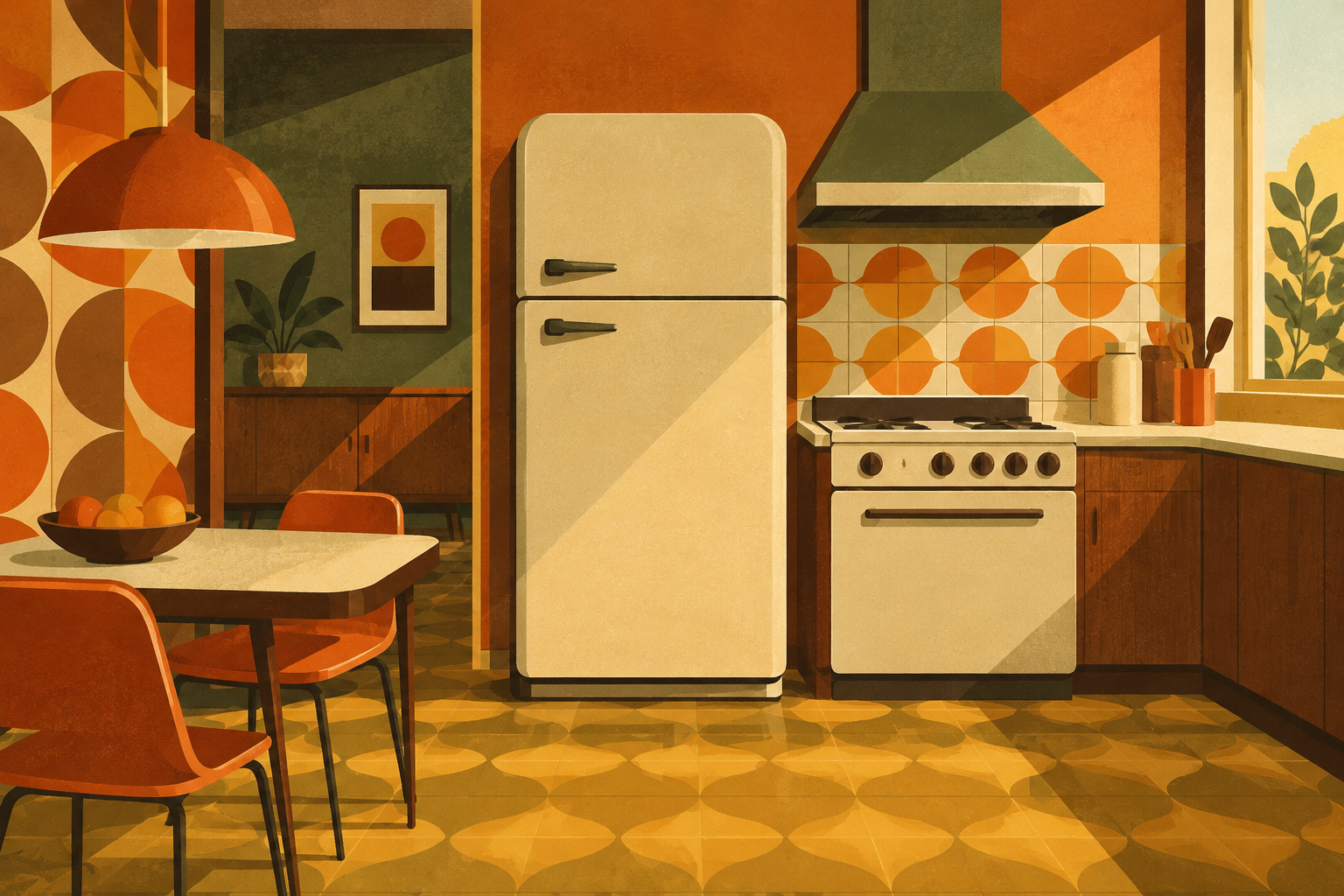
Argentine domestic life in 1970 cannot be understood without considering the objects that defined it. Recent academic sources offer a detailed look at how the incorporation of durable goods transformed internal household spaces. This article analyzes the available evidence on the evolution of appliance consumption, placing the facts within a broader historiographical framework that connects house, street, and city.
The Consumption of Durable Goods
Rocchi's (2022) study focuses on the evolution of the consumption of electric refrigerators and gas stoves in Argentina between 1920 and 1970. These two appliances constitute fundamental axes for understanding the transformation of everyday life during that period. The research does not present a linear narrative of universal adoption, but rather examines the fluctuations in access to these goods. The presence of these objects in households varied significantly according to geographical location and the economic conditions of each family.
Regional and Social Variations
It is crucial to highlight that the experience of 1970 was not homogeneous across the entire Argentine territory. The sources indicate that the availability of refrigerators and gas stoves depended on complex structural factors. While in certain urban sectors these goods had become consolidated, in other regions or social strata their adoption was incipient or non-existent. This disparity requires qualifying any generalization about the standard of domestic life at the time. The history of these objects is, to a large extent, a history of inequalities in access to domestic technology.
The Historiographical Framework
The interpretation of this data relies on the tradition of the history of everyday life. Chapters from works such as the Introduction to the History of Everyday Life analyze the family and the protagonists of these changes. These texts provide the theoretical tools necessary to read objects not only as commodities, but as elements that reconfigure social relations. The historiography of everyday life allows linking the micro, such as the purchase of a refrigerator, with broader macroeconomic and cultural processes.
House, Street, and City
Moreyra (2025) proposes a historiographical cut that thinks of the house, the street, and the city as interconnected spaces of the everyday. This perspective helps to situate cooking and refrigeration within broader social practices. The house is not an isolated space, but constantly dialogues with the urban environment. The street and the city influence what happens within domestic walls, and vice versa. This spatial approach enriches the understanding of how durable goods were integrated into Argentine urban life.
The Model of Domesticity
According to Inés Pérez, from the 1940s a new model of domesticity became popular. This model began to think of the home in a different way, linking it with modernity and consumption. Although the available fragment does not allow detailing all the consequences of this change, it is evident that it marked a rupture with previous forms of domestic organization. The popularization of this model coincided with the expansion of the appliance market, creating a virtuous circle between the ideology of the modern home and the availability of products.
Limits of the Evidence
It is important to recognize the limits of the available information. The cited texts document trends and interpretive frameworks, but do not offer a complete portrait of domestic life in every corner of Argentina. It cannot be affirmed that all Argentine households in 1970 had access to these goods. The evidence allows tracing general lines, but does not detail the individual experience of each family. This caution is necessary to avoid excessive simplifications of the past.
Cultural Relevance
For RetroPause, the value of this analysis lies in using the history of everyday life as a method. Observing objects, spaces, and habits allows understanding the material culture of an era without turning them into universal symbols. The history of the refrigerator and the gas stove in Argentina is an example of how the everyday can reveal deep social structures. This approach invites looking at the past with attention, recognizing the complexity of human experiences and the diversity of domestic realities.
- Decade
- 1970s
- Region
- Latin America
- Level
- Introduction
- Entities
- No linked entities
Sources and references
- FAMILIA Y VIDA COTIDIANA, II.doi.org · 2026-10-17
- LA HISTORIOGRAFÍA DE LA VIDA COTIDIANAdoi.org · 2026-10-17
- la evolución de los bienes durables en Argentina, 1920-1970journals.openedition.org · 2026-10-17
- la evolución de los bienes durables en Argentina, 1920-1970www.researchgate.net · 2026-10-17
- la evolución de los bienes durables en Argentina, 1920-1970www.scielo.org.co · 2026-10-17
- Historia de lo cotidiano. La casa, la calle y la ciudad en ...portal.amelica.org · 2026-10-17