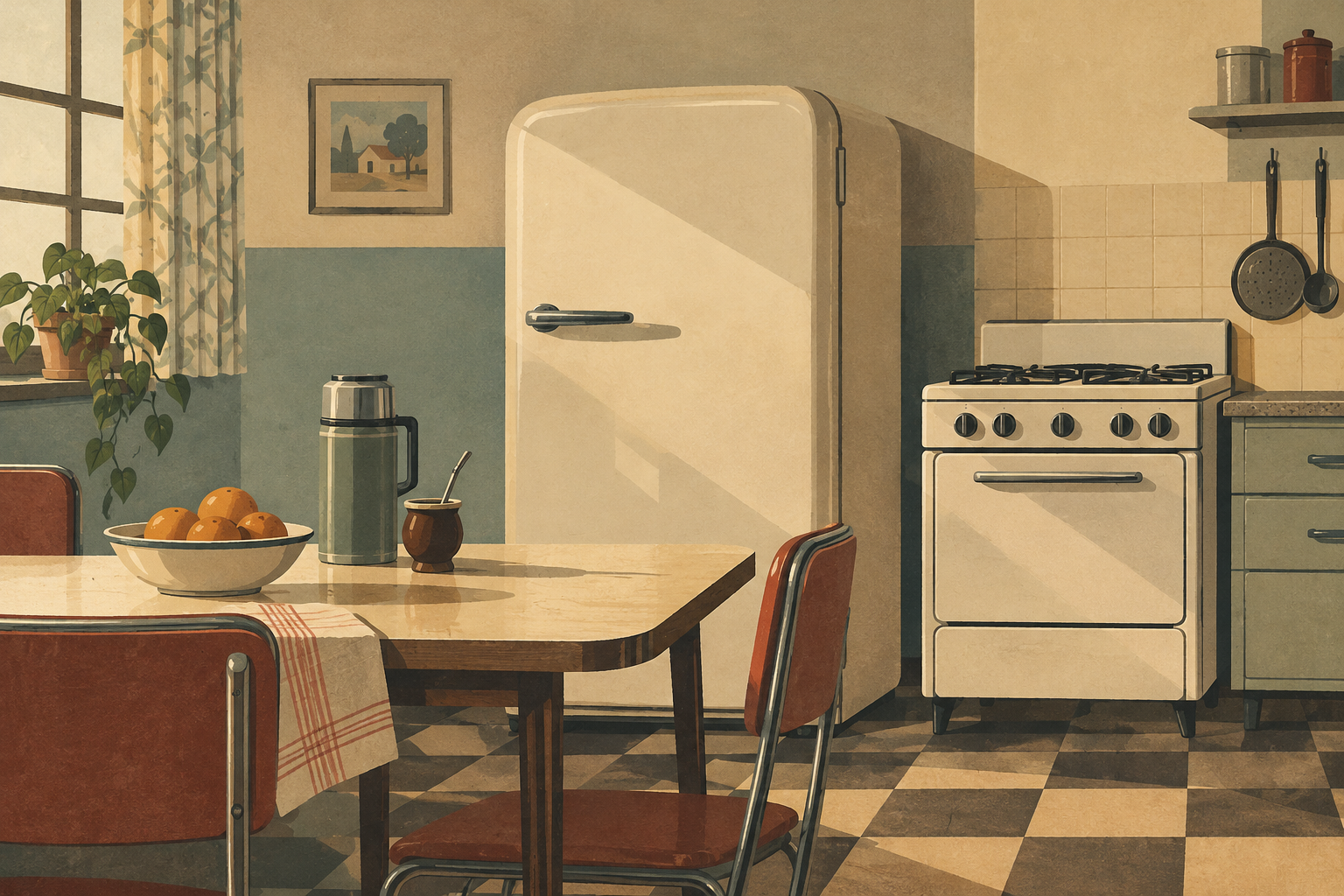
The history of everyday life is often reduced to the accumulation of objects, but Fernando Rocchi's study offers a more nuanced perspective. By examining the circulation of electric refrigerators and gas stoves in Argentina between 1920 and 1970, the research does not seek to celebrate the arrival of technology, but rather to understand how these durable goods reconfigured domestic practices and material life. This approach allows for a move away from the idea of linear progress and into the complexities of consumption in a transforming society.
The Context of Consumption in 20th-Century Argentina
The period analyzed coincides with a stage of accelerated industrialization and urbanization in Argentina. During these decades, the social and economic structure of the country underwent profound changes that directly impacted the home. Rocchi's research places these artifacts within a broader framework of studies on the conditions of material life, food, and cooking. It is not just about machines, but about elements that modified the relationship of families with time, space, and food resources.
Refrigerators and Stoves as Durable Goods
Electric refrigerators and gas stoves are classified as durable goods, which implies that their acquisition and use extend over time. Unlike fast-moving consumer goods, these objects require a significant investment and are permanently integrated into the structure of the home. Their presence is not uniform; it varies according to the economic capacity of families and their access to the necessary infrastructure, such as the electrical grid or natural gas. This distinction is crucial for understanding that the possession of these goods was not a universal experience, but a marker of status and consumption capacity.
The Transformation of Domestic Practices
The introduction of these appliances did not only change the aesthetics of the kitchen, but also daily routines. The refrigerator allowed for more efficient food preservation, reducing the need for daily shopping and altering dietary patterns. For its part, the gas stove offered a more controllable and safer heat source than traditional methods, facilitating meal preparation and modifying gender roles associated with cooking. These changes, although subtle, had a profound impact on the organization of domestic time and family dynamics.
Limitations of Available Evidence
It is important to note that the available evidence for this period does not always allow for broad generalization. Data on the adoption of these goods is limited and does not always reflect the reality of all social strata. Rocchi's research highlights the need to distinguish between the historical relevance of these objects and the unsupported claim that they were common in all households. Regional and socioeconomic differences play a fundamental role in the diffusion of these goods, and any analysis must take these variations into account.
Consumption History as a Field of Study
The study of durable goods is part of a broader field of research that encompasses the history of consumption, food, and material culture. This approach allows for an understanding of how consumption decisions reflect and, in turn, shape social and cultural structures. By analyzing the circulation of refrigerators and gas stoves, the research contributes to a deeper understanding of everyday life in Argentina, highlighting the intersection of technology, economy, and culture.
Implications for Future Research
Rocchi's research opens new lines of inquiry for understanding the history of consumption in Argentina. More studies are needed to examine regional and socioeconomic differences in the adoption of durable goods, as well as the impact of these objects on domestic practices and material life. Furthermore, it is crucial to incorporate testimonies and primary sources that allow for a richer and more nuanced understanding of the everyday experience of Argentine families during this period.
Conclusion
The study of electric refrigerators and gas stoves in Argentina between 1920 and 1970 offers a window into the transformations of everyday life in the 20th century. By avoiding simplistic progress narratives and focusing on the complexities of consumption, Fernando Rocchi's research contributes to a deeper understanding of Argentina's material and cultural history. This approach not only illuminates the past but also provides tools to analyze the dynamics of consumption in the present.
- Decade
- 1970s
- Region
- Latin America
- Level
- Enthusiast
- Entities
- No linked entities
Sources and references
- FAMILIA Y VIDA COTIDIANA, II.doi.org · 2026-10-17
- LOS PROTAGONISTAS DE LA VIDA COTIDIANA, IV.doi.org · 2026-10-17
- la evolución de los bienes durables en Argentina, 1920-1970journals.openedition.org · 2026-10-17
- la evolución de los bienes durables en Argentina, 1920-1970www.researchgate.net · 2026-10-17
- la evolución de los bienes durables en Argentina, 1920-1970www.scielo.org.co · 2026-10-17