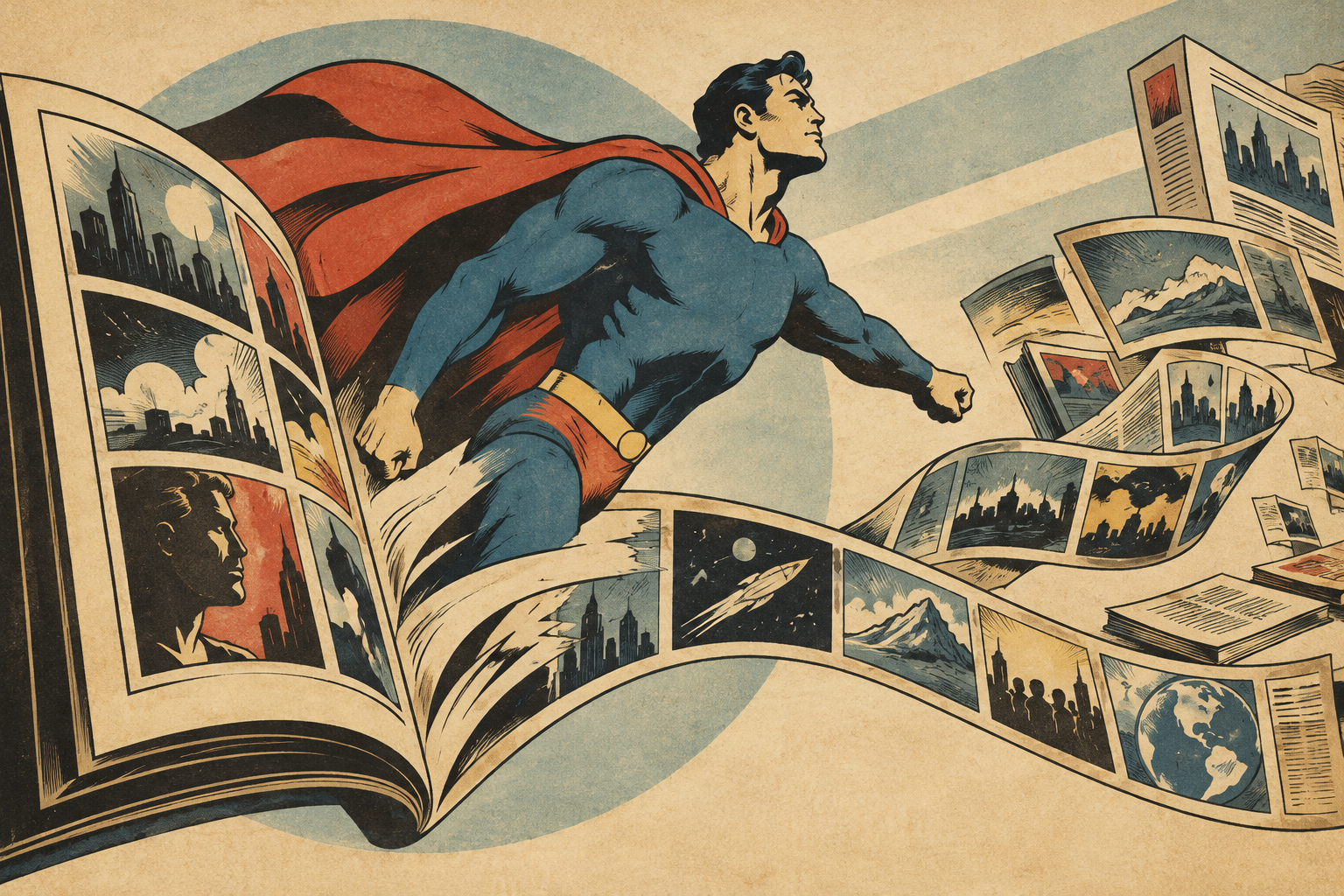
A character’s story is not necessarily fixed by the page on which it first appears. In Superman’s case, the available evidence points to two early steps beyond Action Comics: a newspaper strip commissioned in 1939 and a novel written in 1942. The details are sparse, but they raise a substantial cultural question. When a popular figure moves between media, what remains of the story, and what can be developed differently?
Answering that question requires restraint. The evidence confirms the move into other formats and identifies some of the people involved, but it does not provide a detailed comparison between versions. Rather than present a complete, linear evolution of Superman’s origin, it is more useful to examine what these milestones establish—and where the record stops.
A starting point in Action Comics
The original article places Superman’s first appearance in Action Comics #1 in 1938 and describes that publication as establishing the character’s foundations. The material provided does not itemize the elements of that first version or include passages from the comic for comparison. It does, however, offer a starting point for tracing the story’s continuation in other media.
That distinction matters. Calling something an origin does not mean it began as a finished account, identical in every appearance. The available material presents Superman’s origin as open to expansion, but it does not specify what changed or when.
The newspaper strip creates room
In 1939, the McClure Syndicate commissioned a Superman newspaper strip. The supplied account says that this gave Jerry Siegel and Joe Shuster an opportunity to expand the origin and use elements that did not fit the magazine format. This suggests a connection between the medium and the space available for storytelling, though the evidence does not name those elements or describe particular episodes in the strip.
The format difference can therefore be understood as a working condition, not proof of a specific change in characterization. A newspaper strip offered a different publishing space, and the cited account says that this made it possible to extend the story. Without the strips themselves or fuller descriptions, it is not possible to say how much was added, how the material was structured, or how readers received it.
Wider circulation, uncertain continuity
The move from a comic book to a newspaper strip shows Superman appearing through more than one print channel. That matters culturally because it places the character’s story within an industry able to adapt material to different formats. But the existence of multiple outlets does not, by itself, establish that they shared a consistent narrative continuity.
Nor can the evidence show that readers consequently understood the hero’s identity in a new way. More material may have changed the experience of reading, but there are no reader accounts, circulation figures, or reception studies in the record provided here. A plausible interpretation should not be mistaken for a documented result.
George Lowther’s novel
In 1942, George Lowther wrote a novel about Superman. The evidence identifies him as one of the writers for the radio program The Adventures of Superman. That connection gives context to his work on the character, but it does not establish a specific narrative relationship between the novel and the radio program or explain how their stories were coordinated.
The novel confirms that Superman had entered another print form, distinct from both the comic book and newspaper strip. Without a synopsis, excerpts, or a comparison of their contents, it is not possible to say what Lowther added to the origin or how he presented the character’s identity. The evidence documents editorial expansion, not a particular transformation in itself.
What changed, and what remains unknown
The sequence of 1939 and 1942 supports a limited conclusion: Superman’s origin was not confined to his first appearance and was taken up in publications using different formats. The account of Siegel and Shuster’s work on the strip supports the claim that they had an opportunity to expand the story there. Lowther’s novel, in turn, confirms that Superman also entered prose fiction.
The material does not provide detailed publication dates for individual instalments, primary texts, a complete chronology of revisions, or evidence sufficient to measure the effects of these changes. Describing the process as a continuous evolution of the hero’s identity would therefore go beyond what can be verified. What can be said is that movement between media opened up space to retell and potentially enlarge his origin. That is the clearest legacy of these early steps: Superman could be encountered not only through a first appearance, but through a story that continued in other formats.
- Decade
- 1970s
- Region
- North America
- Level
- Enthusiast
- Entities
- Superman, Action Comics
Sources and references
- La evolución del origen de Supermantranslate.google.com · 2026-10-16
- Superman - Wikipedia, la enciclopedia librees.wikipedia.org · 2026-10-16
- El legado de Superman, el hombre de acerounamglobal.unam.mx · 2026-10-16
- el origen del personaje de Superman como un rebelde ...www.bbc.com · 2026-10-16
- Universo DCes.wikipedia.org · 2026-10-16


