Building a Spanish automotive industry
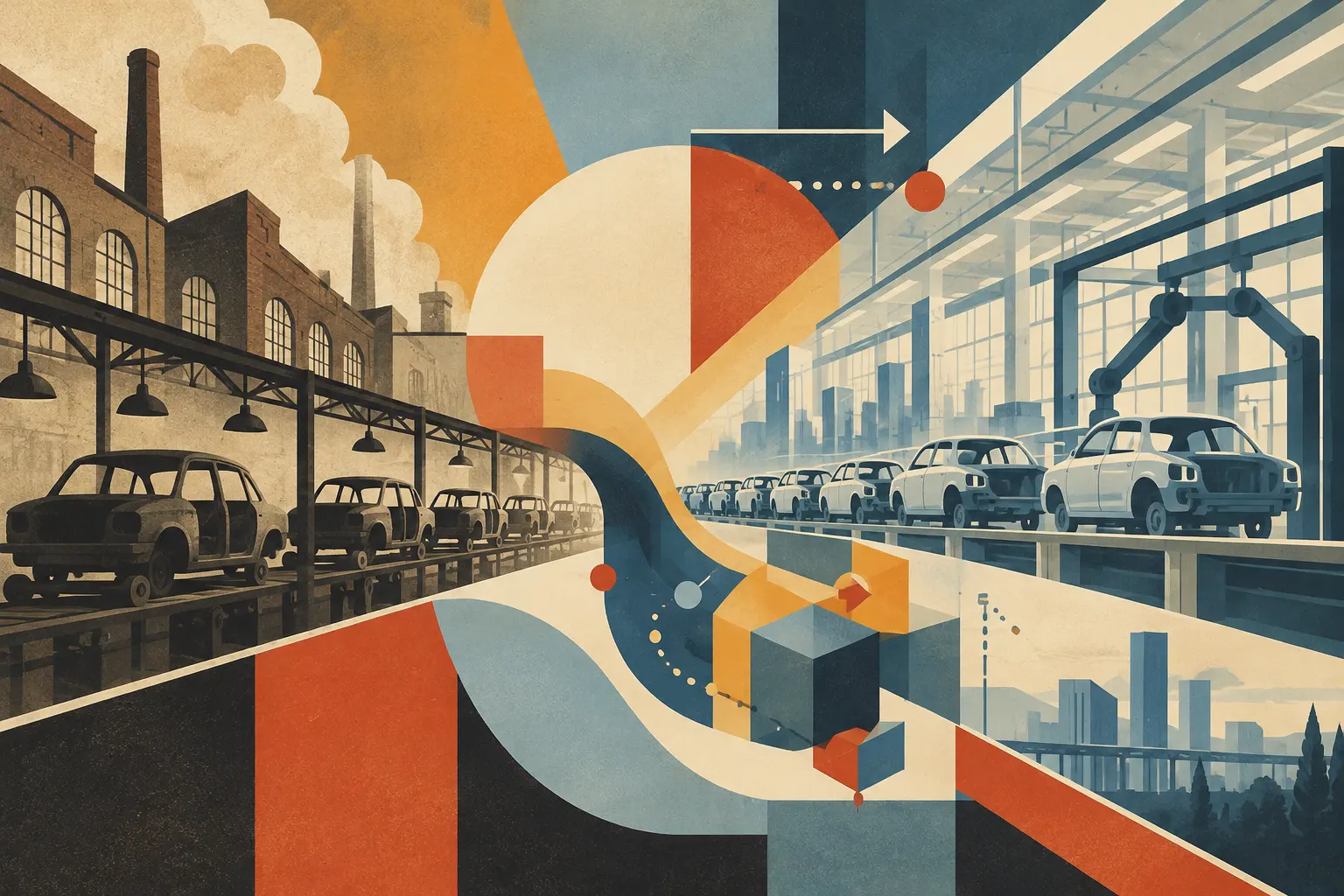
SEAT was founded in 1950 as a mixed-capital company: the National Institute of Industry (INI) held the majority stake, Spanish banks supplied capital, and Fiat was a minority shareholder and technical partner. The company set out to manufacture cars on a large scale in Spain, where the market was still limited and the industry relied on foreign firms and imported components. Fiat provided designs and production expertise; state participation reflected the goal of establishing local manufacturing capacity.
The Zona Franca plant in Barcelona began production in 1953. Its first car was the SEAT 1400, derived from the Fiat 1400. Establishing the factory also meant developing suppliers and gradually increasing the proportion of components made in Spain. SEAT was therefore both a car brand and part of an industrial project: its history reveals who supplied the capital, where the technology came from and how production was organised.
From licensed production to in-house capabilities
During its first decades, much of SEAT’s range was tied to Fiat models. Licensing made it possible to begin production and build an industrial network, but it did not amount to independent control over design and technology. Launched in 1957, the SEAT 600 became an emblem of the expansion of private car ownership in Spain. Its cultural significance was inseparable from a production system supported by Fiat’s technology and agreements.
The relationship did not stand still. Agreements in 1967 expanded export opportunities and gave SEAT more room to adapt models. In the early 1970s, the company began developing a technical centre in Martorell to build its own engineering expertise. The SEAT 133 and 1200 Sport represented different degrees of adaptation and development within an industry still closely connected to Fiat. Local production of someone else’s design, modifying it and conceiving a model for oneself were distinct steps, each requiring different capabilities.
Autonomy also depended on commercial terms. During part of the partnership, Fiat retained an important role in exporting and distributing cars made by SEAT. The Spanish company could gain manufacturing experience and reach more markets, but still had to negotiate the limits of its independence. This tension—between the immediate advantages of proven technology and the ambition to control products and markets—shaped much of SEAT’s early history.
The end of the Fiat relationship
In the early 1980s, disagreements over funding, control and the company’s future brought Fiat’s shareholding to an end. The Spanish state took control of SEAT, which had to maintain its operations without the same technological and commercial partner. The break did not erase the technical legacy of the licensing years overnight: SEAT still had to distinguish its products and build an identity of its own.
The Ronda, introduced in 1982, made that difficulty visible. Fiat challenged whether the car differed sufficiently from a model in its own range. In international arbitration, SEAT demonstrated the differences between the two vehicles and obtained permission to market the Ronda under its own brand. The case was about more than one car: it showed how difficult it could be to separate from a former partner after years of cooperation had shaped a company’s knowledge, components and product range.
Against this background, SEAT sought a new partner. The 1982 industrial and commercial agreement with Volkswagen included the production of German-brand models in Spain, helping maintain activity at the plants while establishing a new technical relationship. In 1986, Volkswagen acquired a majority stake and increased its control later that year. SEAT moved from state control into an international automotive group. The ownership change altered who made decisions about investment, products and production, though it did not immediately erase the Spanish company’s identity or accumulated capabilities.
The Ibiza and a transformation in progress
Launched in 1984, the Ibiza captures the gradual nature of this transformation. SEAT presented it as a car developed by the company with contributions from outside specialists. Its design involved Giorgetto Giugiaro, while other external partners contributed to body development and engine technology. The model arrived before Volkswagen acquired a majority stake in SEAT; describing it as a product created entirely under German ownership would therefore collapse distinct stages into one.
The Ibiza helped project an identity of its own and expand SEAT’s international presence. Its history also shows that industrial autonomy does not mean working in isolation: a company can rely on external specialists while taking responsibility for integrating their knowledge into its own product and strategy. What matters is the kind of control and capability it retains, not the complete absence of collaboration.
From Zona Franca to Martorell
The change in scale was also visible in the company’s geography. The new Martorell plant opened in 1993, after the period covered here, and became SEAT’s main production centre. The gradual transfer of vehicle assembly from Zona Franca to Martorell reorganised the roles of the two sites: the older factory moved away from concentrating on car assembly and took on other industrial work.
Martorell represented a major investment and closer integration into the Volkswagen Group’s production structure. Building shared models or vehicles based on common platforms did not mean that SEAT stopped contributing to design, development and manufacturing, but those activities now formed part of a larger corporate organisation. The plant thus offers a way to understand the shift: integration concerned not only ownership, but also industrial coordination and the allocation of work.
Between 1950 and 1990, SEAT underwent three connected changes: building local automotive capacity with state capital and foreign technology; seeking greater decision-making room after the Fiat partnership ended; and joining Volkswagen as a new framework for investment and production. The best-known cars make this history visible, but do not explain it on their own. Understanding the transformation requires looking at the agreements, ownership and role of the factories as well as the cars themselves.
- Decade
- 1980s
- Region
- Spain
- Level
- Enthusiast
- Entities
- SEAT, SEAT 600
Sources and references
- ASIENTOtranslate.google.com · 2026-11-07
- Fabricamos coches desde 1950 – Historia de SEATwww.seat.es · 2026-11-07
- SEAT: 70 años sobre ruedaswww.seat-cupra-mediacenter.es · 2026-11-07
- SEAT - Wikipedia, la enciclopedia librees.wikipedia.org · 2026-11-07
- Historia del SEAT Ibiza: 30 años de éxito en las carreterasnoticias.coches.com · 2026-11-07