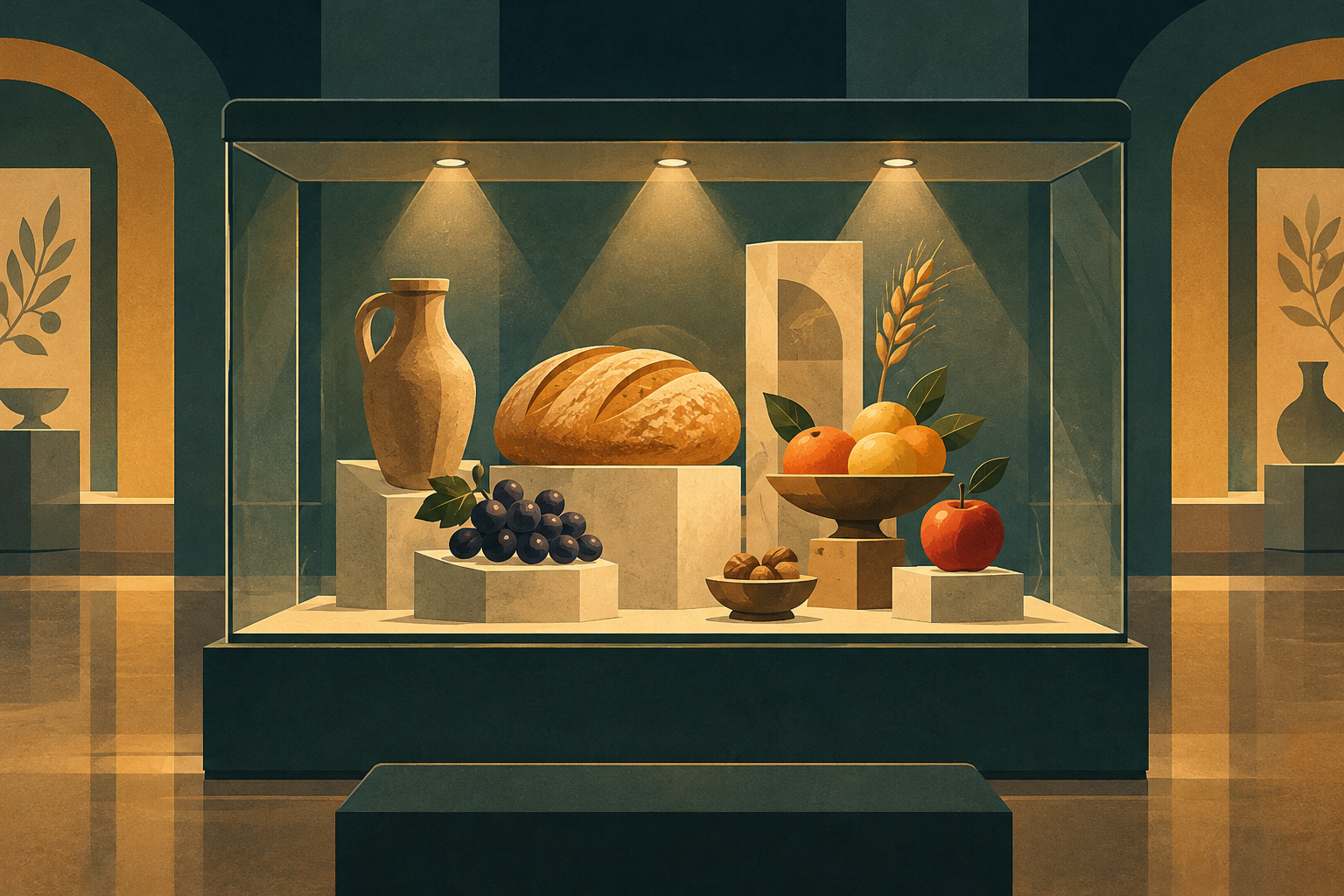
The notion that a museum must contain inert objects has begun to crack. In recent decades, cultural institutions have broadened their scope to include gastronomy, not as a mere complement, but as a fundamental pillar of intangible heritage. This transition is not trivial; it implies recognizing that taste, aroma, and texture are carriers of identity as valid as stone or pigment. However, the materiality of food poses a technical and philosophical challenge that few other fields face with the same intensity. Food is, by definition, perishable. Its presence in the display case is an act of resistance against time, a forced pause in a process of decomposition that nature dictates without mercy.
The Sensory Dimension of the Archive
Recent studies, such as Bak-Geler Corona's 2019 work, emphasize that gastronomy cannot be reduced to a list of ingredients or a written recipe. It is a biological, sensory, emotional, and social fact. When a visitor approaches a display of artisanal sausages or regional sweets, they are not just observing an object; they are activating a network of memories and associations that define a community's identity. Olivares, in his 2021 work, highlights how these exhibitions allow for an immersive experience that traditional texts fail to achieve. In this context, food becomes a narrative vehicle. It is not just about nourishing the body, but about feeding collective memory. This perspective forces curators to rethink the role of the museum: it is no longer just a place of custody, but a space of evocation.
The Case of Benicarló and the Artichoke Festival
A concrete example of this new curation can be found in Spain. In 2014, the Ethnographic Museum of Benicarló presented an exhibition centered on the "Festa de la carxofa." The display did not limit itself to exhibiting local products; it accompanied them with oral narratives and cultural contexts. This integration of the tangible and the intangible demonstrated that food is a social fact. The artichoke, in this case, was not just a vegetable, but a symbol of a community tradition passed down through generations. The exhibition allowed visitors to understand how an agricultural product becomes an element of social cohesion. This approach, which combines objects, narratives, and contexts, has become a model for other institutions seeking to document food heritage.
The Limits of Physical Preservation
Despite the cultural value of these exhibitions, the physical reality of food imposes strict limits. Preventive conservation, as described in reports from institutions like the Jesuit National Museum, requires controlled temperature and humidity conditions. The goal is to prevent microbial decomposition and color loss, processes that alter the integrity of the object. However, food is a living system. Even under optimal conditions, its degradation is inevitable. Museums must decide when to remove a sample to prevent it from becoming a deteriorated object that loses its aesthetic and educational value. This decision is not just technical; it is ethical. Removing food from the display case means admitting its end, but also protecting the memory it represents.
Digital Documentation as Safeguard
Given that physical preservation is limited, digital documentation practices have gained prominence. Recipes, culinary techniques, and preparation processes can be captured in video, audio, and text. This documentation allows for the preservation of knowledge that might be lost over time, especially in communities where oral traditions are at risk. Digitalization does not replace the sensory experience, but it complements it. It offers an archive that can be consulted, studied, and shared without the physical limitations of the display case. In this sense, the museum becomes a node of information, not just a container of objects. The combination of the physical and the digital creates a more robust and accessible preservation network.
The Tension Between Display and Conservation
Balancing public display with long-term preservation is one of the greatest challenges for contemporary museums. Display requires the object to be visible and accessible, which exposes it to deterioration factors. Conservation, on the other hand, demands isolation and control. This tension is reflected in the daily decisions of conservators. How long can a sausage remain in the display case before its quality degrades? How can the educational experience be maintained without compromising the integrity of the object? These questions do not have simple answers. They require a flexible approach that adapts conservation strategies to the specific nature of each object. Collaboration between curators, conservators, and local communities is essential to find a balance that respects both memory and science.
The Legacy of an Emerging Practice
The inclusion of gastronomy in museums is an emerging practice that is still developing. There is no universal consensus on how to approach these topics, and the tensions between the tangible and the intangible, between science and culture, remain present. However, the impact of this new perspective is significant. It has broadened the definition of cultural heritage and given voice to traditions that were previously on the margins of formal institutions. Food, upon entering the museum, becomes an object of study and preservation, but also a bridge between the past and the present. This legacy is not just cultural; it is social. It reinforces the sense of belonging of communities and allows them to share their identity with a wider audience. In a world where traditions are at risk of disappearing, the museum becomes a refuge for collective memory, a place where taste can be preserved, if only for a time.
- Decade
- 2000s
- Region
- Global
- Level
- Introduction
- Entities
- Museum
Sources and references
- El patrimonio alimentario en los museos etnográficos. 2019www.academia.edu · 2026-10-16
- Conservación y Restauración del Patrimonio Cultural en soporte Papel - Museo Jesuítico Nacional de Jesús Maríadoi.org · 2026-10-16
- Patrimonios alimentarios : entre consensos y tensioneshorizon.documentation.ird.fr · 2026-10-16
- Lo inmaterial en el museo. Museos y patrimonio alimentarioriunet.upv.es · 2026-10-16
- LA CONSERVACION PREVENTIVA EN LOS MUSEOSwww.museosdetenerife.org · 2026-10-16