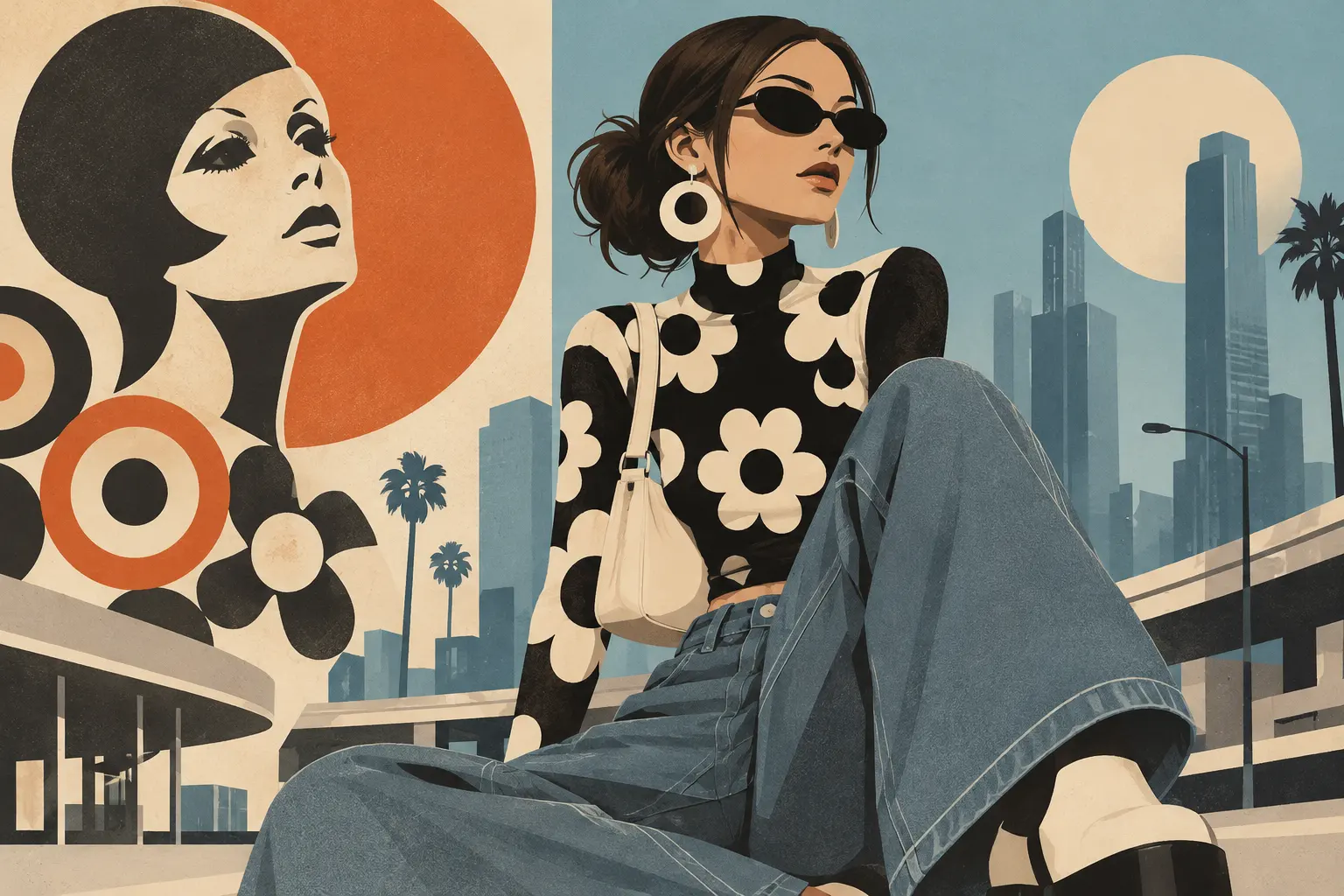
The fashion of the 2000s did not operate as an absolute rupture with previous traditions, but as a space for selective re-reading where the past was filtered through the aesthetic needs of the present. According to the FIT fashion history chronology, retro styles inspired directly by the 1960s emerged in the mid-decade. This influence did not present itself as a literal copy of old garments, but as an adaptation that responded to new visual sensibilities. This article examines how these historical elements remained alive in the urban and digital context of the 2000s, and how they were modified to fit the everyday reality of the time. It explores the relationship between nostalgia and innovation, showing how designers used historical references to create something new. Available evidence suggests that retro fashion is not a simple repetition, but a dialogue between eras. This analysis helps understand how the visual culture of the 2000s was built on the foundations of the past, transforming memory into trend. The focus is on contemporary reinterpretation, avoiding the idealization of the past and recognizing the contextual differences between both decades.
The historical starting point
The FIT fashion history chronology establishes that, in the mid-2000s, retro styles inspired by the 1960s emerged. This phenomenon was not isolated, but was part of a broader trend of recovering aesthetic elements from the past. The influence of the 1960s manifested through British indie pop groups, which acted as catalysts for the reintroduction of certain silhouettes and textures. This connection between music and fashion is fundamental to understanding how nostalgia became a creative force. Designers did not simply copy 1960s garments, but reinterpreted them in light of the new aesthetic sensibilities of the time. This process of adaptation allowed retro fashion to integrate into the urban and digital context of the 2000s, without losing its historical essence.
The influence of British indie pop
British indie pop groups played a crucial role in reintroducing the 1960s aesthetic into 2000s fashion. This musical and visual connection was not accidental, but reflected a search for authenticity and nostalgia in an increasingly digitized cultural context. Indie pop, with its melodic sound and retro aesthetic, provided an aesthetic framework that designers could translate into garments. This influence manifested in the popularization of certain silhouettes, colors, and textures that recalled the 1960s, but adapted to the needs of contemporary fashion. The relationship between music and fashion in this period is a clear example of how different forms of cultural expression influence each other, creating new trends that transcend the boundaries of each discipline.
Adaptation to the urban context
The retro fashion of the 2000s was not limited to haute couture or runways, but integrated into everyday urban fashion. This adaptation to the urban context was possible thanks to the reinterpretation of 1960s elements, which were modified to fit the reality of daily life. Retro garments were combined with contemporary elements, creating a style that was both nostalgic and modern. This fusion allowed retro fashion to become an integral part of the visual culture of the 2000s, without losing its historical identity. The ability of fashion to adapt to different contexts is one of its most important characteristics, and the reintroduction of the 1960s aesthetic into 2000s urban fashion is a clear example of this ability.
The relationship between nostalgia and innovation
The relationship between nostalgia and innovation is a central theme in 2000s fashion. Nostalgia did not present itself as a simple evocation of the past, but as a tool to create something new. Designers used historical references to inspire their creations, but transformed them to adapt to the needs of the present. This process of reinterpretation allowed retro fashion to become a form of innovation, rather than a simple repetition. Nostalgia, in this context, is not a conservative force, but a source of creativity that allows exploring new aesthetic possibilities. This relationship between nostalgia and innovation is fundamental to understanding how 2000s fashion was built on the foundations of the past, without losing its contemporary character.
The dialogue between eras
The retro fashion of the 2000s is not a simple repetition of the 1960s, but a dialogue between eras. This dialogue manifests in the way designers combine historical elements with contemporary innovations, creating a style that is both nostalgic and modern. Evidence suggests that retro fashion is not a literal copy of the past, but a reinterpretation that responds to the needs of the present. This dialogue between eras allows fashion to remain alive and relevant, without losing its connection to history. The ability of fashion to dialogue with the past is one of its most important characteristics, and the reintroduction of the 1960s aesthetic into 2000s fashion is a clear example of this ability.
The limits of verification
Although the FIT fashion history chronology provides a solid basis for understanding the influence of the 1960s on 2000s fashion, it is important to recognize the limits of verification. Available evidence focuses on the relationship between music and fashion, and on the reinterpretation of historical elements, but does not provide specific details about the designers or the specific garments used. Furthermore, the influence of the 1960s on 2000s fashion was a global phenomenon, but available evidence focuses mainly on the British and American context. It is important to take these limitations into account when interpreting available information, and to recognize that fashion is a complex phenomenon that cannot be reduced to a single narrative.
Conclusion
The fashion of the 2000s was not a period of total rupture with the past, but of selective re-reading. The influence of the 1960s manifested through the reinterpretation of historical elements, which were adapted to the urban and digital context of the time. The relationship between nostalgia and innovation was fundamental to understanding how retro fashion became a form of contemporary creativity. This analysis helps understand how the visual culture of the 2000s was built on the foundations of the past, transforming memory into trend. The ability of fashion to dialogue with the past is one of its most important characteristics, and the reintroduction of the 1960s aesthetic into 2000s fashion is a clear example of this ability.
- Decade
- 2000s
- Region
- Global
- Level
- Introduction
- Entities
- No linked entities
Sources and references
- Activismos creativos en la comunidad soviet waveopenalex.org · 2026-10-22
- 2000-2009 | Cronología de la historia de la modatranslate.google.com · 2026-10-22
- 60Sriunet.upv.es · 2026-10-22
- Versión (música)es.wikipedia.org · 2026-10-22
- Girl groupes.wikipedia.org · 2026-10-22