The management of film heritage has ceased to be an exclusive task of chemical conservation to become a complex institutional challenge. Academic sources and documents from international bodies indicate that film museums and archives do not act merely as custodians of objects, but build social contexts for animated images. This duality between physical preservation and the democratization of digital access constitutes the central axis of current cultural memory.
From chemical stability to social context
Traditionally, film conservation focused on the chemical stability of celluloid. However, the approach has evolved towards a hybrid model that integrates museum exhibition and digital access. UNESCO documents and other academic sources point out that the conservation and exhibition of animated image artifacts must be understood in their social context. This implies that the value of a film does not reside only in its physical support, but in the network of meanings that surrounds it.
The role of film museums
Film museums have undergone a significant transformation. Instead of being simple warehouses of copies, they have become spaces for cultural and tourist dissemination. For example, the Film Museum in certain contexts has positioned itself as a cultural and leisure attraction, acting as a major disseminator of cinematographer culture. This musealization seeks to value the film heritage, offering the public an experience that goes beyond simple projection.
The expansion of digital access
The growing importance of digital archives allows contemporary audiences to interact with film heritage without relying exclusively on the physical copy. The results of recent studies suggest that online access to digital film archives and the knowledge that cultural heritage remains accessible have a positive impact on the perception of cultural value. In a society increasingly mediated by the online, bringing cultural heritage to these spaces is fundamental for its survival.
Challenges of authenticity and permanence
Despite the advantages of digital access, this transition raises questions about the authenticity and permanence of digital formats. While the analog support has a known physical vulnerability, digital formats face challenges of technological obsolescence and data degradation. Available evidence suggests that the value of the digital archive lies in its ability to keep cultural heritage accessible, but it does not exempt institutions from the responsibility of ensuring the integrity of the content in the long term.
Film reception on multiple screens
Film reception has shifted from the projection room to multiple screens. The archive acts as a moving space that redefines the relationship between the viewer and cinematic memory. It is not about replacing the work with nostalgia, but about understanding how interaction with film has changed. The viewer is no longer a passive receiver in a dark room, but an active user who navigates digital archives and museum contexts.
Unequal contexts and preservation policies
Film preservation policies vary according to geographical and economic contexts. In Latin America, for example, film museums operate in convivial and unequal contexts, which poses specific challenges for the preservation and dissemination of heritage. These contexts require strategies adapted to local realities, integrating physical preservation with digital access in a sustainable manner.
Conclusion
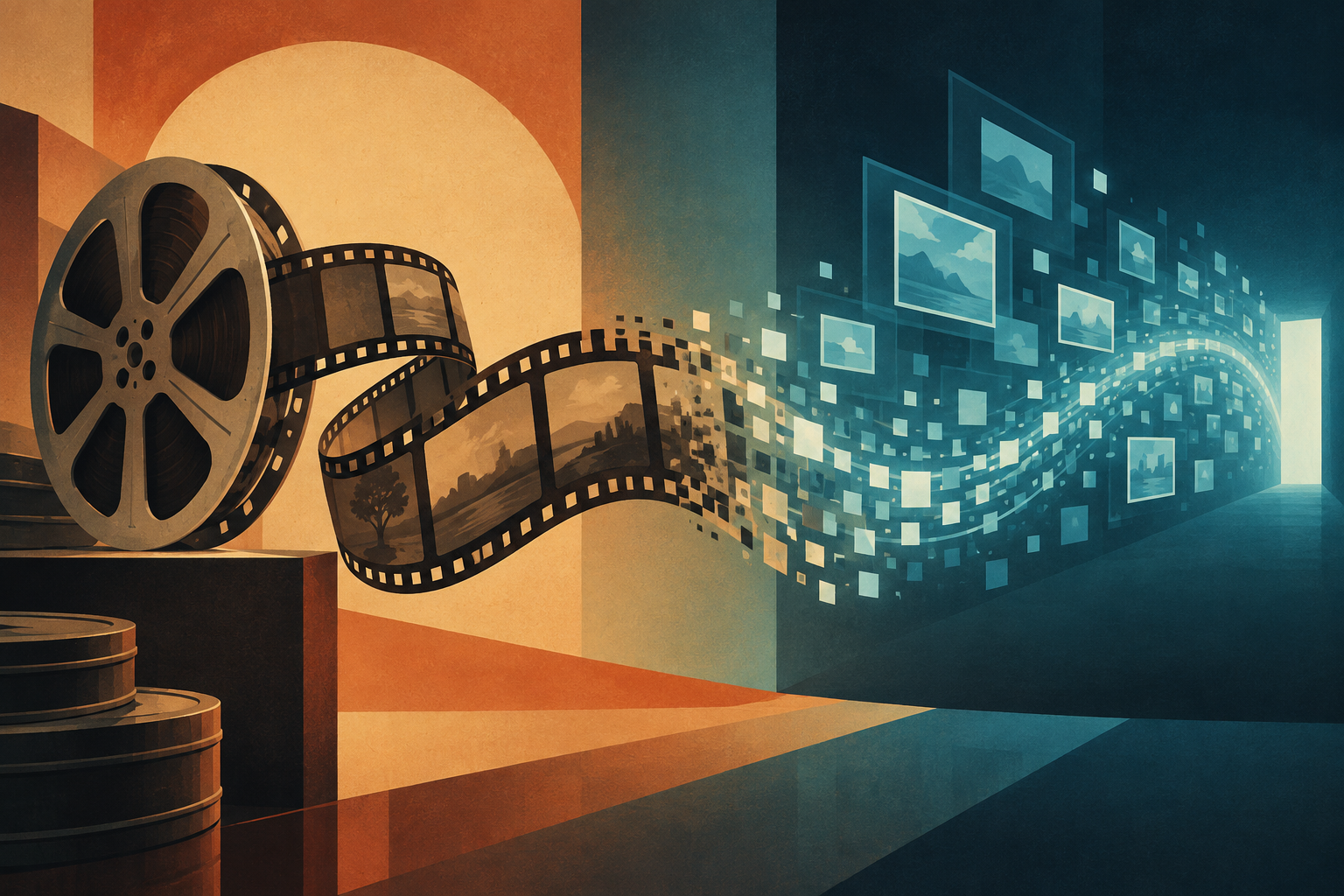
The tension between the physical copy and digital access is a fundamental aspect of current film memory. Film institutions must balance the material preservation of artifacts with the expansion of digital access to ensure the survival of film heritage. This balance is not only technical, but cultural, as it redefines how societies interact with their film history.
- Decade
- Contemporary
- Region
- Global
- Level
- Introduction
- Entities
- Museum
Sources and references
- Cine en el museoopenalex.org · 2026-10-19
- Museos del cine latinoamericanos Políticas de preservación fílmica en contextos conviviales y desigualesopenalex.org · 2026-10-19
- Museos y archivos del cineunesdoc.unesco.org · 2026-10-19
- El valor del archivo digital de la historia del cine: disposición a ...translate.google.com · 2026-10-19
- (PDF) El cine como patrimonio cultural: el caso de la ...www.researchgate.net · 2026-10-19
- musealización y puesta en valor del patrimonio cinematográficodigibug.ugr.es · 2026-10-19