The chess played today in international tournaments regulated by FIDE is not the same game practiced in India during the 6th century. Although the 64-square board and the structure of sixteen pieces per side remain, the rules, piece mobility, and game pace have undergone a profound transformation. This process was not an isolated invention but a cultural journey that crossed Asia and Europe over several centuries. Analyzing this evolution allows us to understand that current rules are the product of practical and strategic adaptations, not an immutable original design.
Roots in the Indus Valley
Historical evidence places the origin of the game in India, likely in the Indus Valley, during the 6th century AD. The original name, chaturanga, comes from Sanskrit and refers to a battle formation. This war game is mentioned in the Mahabharata epic, suggesting an early connection with the region's military and literary culture. Unlike modern chess, chaturanga did not include the piece we now know as the queen. Instead, there was a vizier with limited moves, which significantly slowed the development of the game and changed its strategic dynamics.
The Persian Interlude
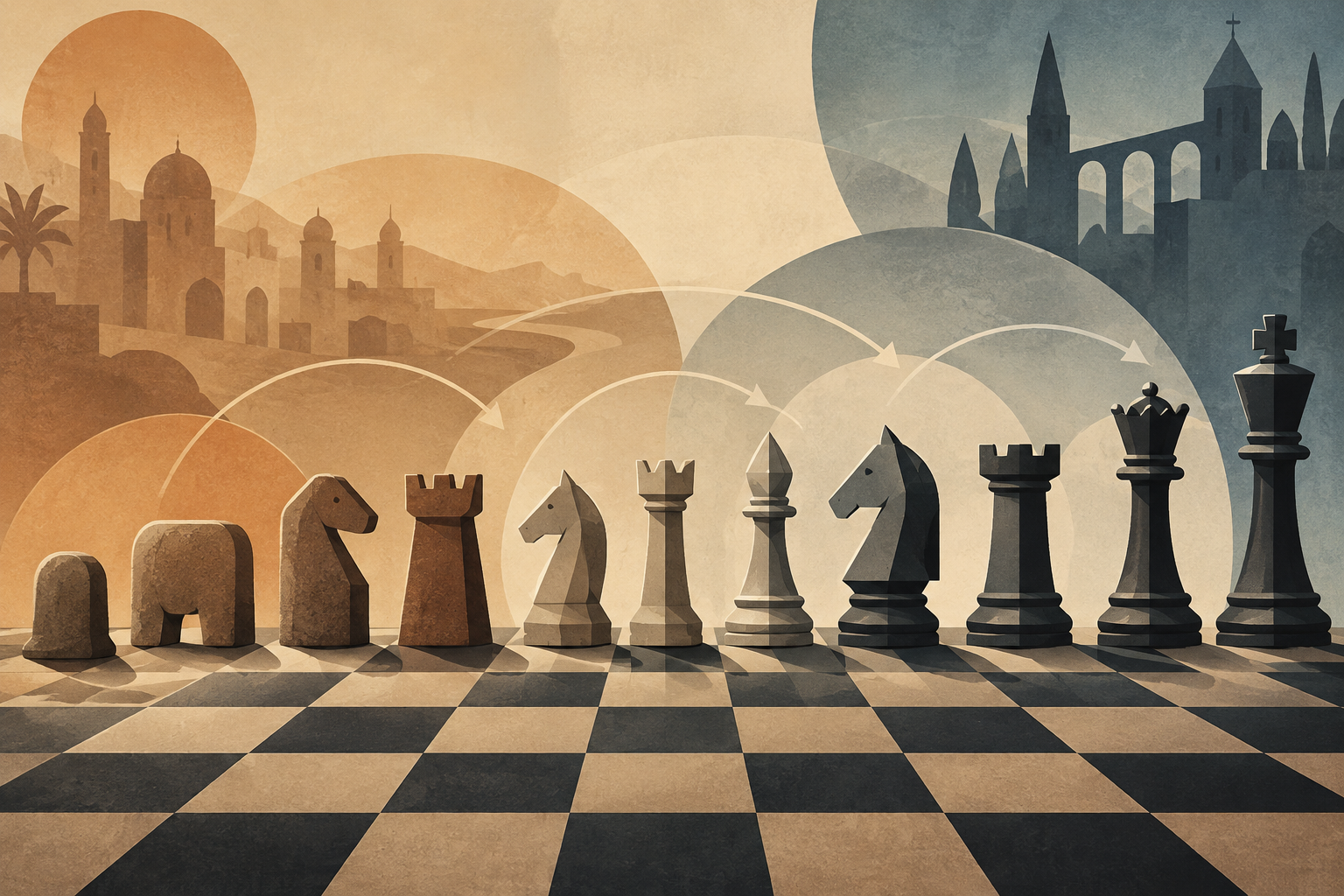
Chaturanga did not stay in India. Through trade routes and cultural contacts, the game reached Persia, where it adopted the name shatranj. This stage was crucial for the transmission of the game westward. The Muslim empires and the Silk Road acted as bridges that carried shatranj to Europe. By the mid-Middle Ages, chess was already an international pastime, known in European courts thanks to these exchanges. The Persian version maintained many of the characteristics of the Indian game but began to lay the foundations for the modifications that would follow.
The European Revolution of the 15th Century
The most radical transformation occurred in Europe during the 15th century. The European version of shatranj introduced changes that drastically accelerated the pace of the game. The piece that was previously a limited vizier became the queen, the most powerful figure on the board, capable of moving in any direction. Simultaneously, the bishop gained full diagonal mobility. These modifications were not arbitrary; they responded to a cultural preference for faster and more dynamic games. The result was a game with a distinct strategic structure, where attack and defense were balanced differently.
Standardization and Competition
Once the modern form of the game was established, the next stage was organization. The tradition of organizing chess competitions began in the 16th century, consolidating the game as an intellectual sport. This period saw the standardization of rules, allowing players from different regions to compete under the same conditions. The first official world chess championship was organized in 1886, marking a milestone in the history of the game. Since then, FIDE has regulated international competitions, establishing universally accepted rules.
A Game of Multiple Cultures
It is a common mistake to attribute chess to a single culture. Historical evidence shows that the game was shaped by commercial and cultural exchanges over several centuries. India provided the roots, Persia facilitated transmission, and Europe defined the modern form. This collaborative process explains why chess has a global resonance. It is not an Indian, Persian, or European game, but a synthesis of all these traditions. Understanding this complexity helps appreciate the richness of the game and its ability to transcend cultural boundaries.
Limitations of Evidence
Although the general trajectory of the game is clear, there are uncertainties in the details. The exact origin of chaturanga remains a mystery, and there is no credible evidence that chess existed in a form similar to the modern game before the Indian stage. Ancient sources are limited and often contradictory. For example, the exact date of shatranj's arrival in Europe is not fully established. Additionally, the specific rule changes during the 15th-century transition are not documented with the same precision as later events. Recognizing these limitations is important for maintaining a rigorous perspective on the game's history.
Conclusion
Modern chess is the result of a slow and complex evolution. From the 6th-century chaturanga to the standardized rules of the 19th century, the game has changed in form, speed, and structure. These transformations were not accidental but the product of cultural and strategic adaptations. By understanding this history, players and spectators can better appreciate the depth of the game and its place in global culture. The 64-square board is, ultimately, a map of human history, marked by the movement of ideas and people across continents.
- Decade
- Before 1950
- Region
- Global
- Level
- Introduction
- Entities
- Ajedrez, Mappa
Sources and references
- Historia del ajedrez - Wikipedia, la enciclopedia librees.wikipedia.org · 2026-10-18
- Ajedrez - Historiatranslate.google.com · 2026-10-18
- La historia del ajedrez, un desafío intelectualhistoria.nationalgeographic.com.es · 2026-10-18
- Historia del Ajedrezusers.dcc.uchile.cl · 2026-10-18
- Ajedrezes.wikipedia.org · 2026-10-18