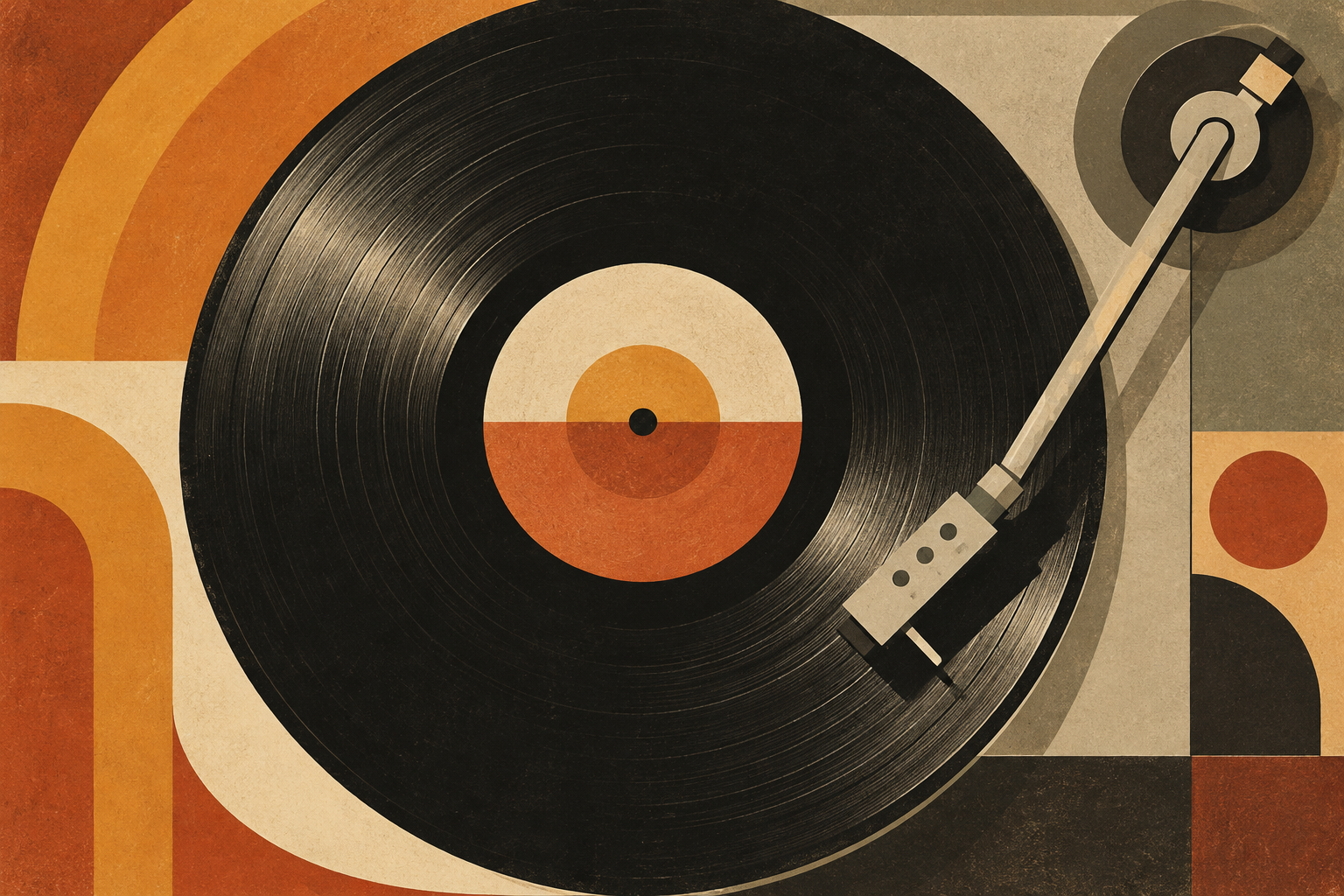
The perception of music in the 1970s was not limited to the passive reception of melodies, but was mediated by the technology that allowed its reproduction. While hit lists record the quantitative popularity of artists such as Bee Gees, Fleetwood Mac, Elton John, and Donna Summer, the actual experience of the listener was conditioned by the dominant physical medium: vinyl. This article analyzes how the materiality of the record and its complementarity with radio configured a specific sound environment, where physical interaction with the medium was an integral part of the construction of musical taste.
Materiality as an aesthetic condition
Unlike later digital formats, vinyl required active participation from the listener. Selecting the side of the record, precisely placing the needle, and paying attention to the track sequence were not mere technical steps, but acts that structured the perception of the work. This physical interaction separated the record edition from the listening experience, creating a distance that the listener had to traverse. Song duration and sound production adapted to the limitations and possibilities of this format, influencing how composers and producers conceived their works. The popularity of certain artists can be understood, in part, by their ability to adapt to the technical and aesthetic demands of the medium.
The role of radio and media complementarity
Radio did not directly compete with vinyl, but complemented it. While the record allowed for a deeper and more controlled listening, radio offered constant and accessible exposure. This duality created a sound ecosystem where music was consumed in diverse ways depending on the context. Radio could introduce new songs and artists, while vinyl allowed exploring the complete catalog of a musician. This relationship between both media was crucial for the dissemination of popular music in the decade, establishing consumption patterns that transcended simple audio reproduction.
Local and global identities in sound culture
The social history of popular music, as documented in studies on Chile between 1950 and 1970, reveals that sound culture was not homogeneous. In regions like Chile or the United States, popular music involved local and global identities that interacted in a complex manner. Globalization and musical mestizaje generated mixes of styles and genres, reflecting the cultural interaction between different societies. Vinyl, as a distribution medium, facilitated this global circulation, but also allowed the preservation of local traditions. The music of a society is closely related to its economic organization, technological development, and traditions, meaning that listening in the seventies cannot be understood without considering these contextual factors.
Sound production and technical limitations
Musical production of the era was subject to the technical limitations of vinyl. Track duration, sound quality, and the capacity to store information on the record influenced the decisions of producers. Unlike digital recordings, which allow almost infinite editing, vinyl imposed restrictions that required careful planning. These limitations were not just obstacles, but also defined the sound language of the era. Sound engineers and musicians had to work within these parameters, resulting in a particular aesthetic that characterized the music of the seventies. Adaptation to these technical conditions was a key factor in the evolution of popular music.
Beyond the chronology of hits
Reducing the 1970s to a mere chronology of hits ignores the complexity of the musical experience of the time. Hit lists offer a quantitative view, but do not capture the qualitative dimension of listening. The technology of the medium was not a mere container, but an active participant in the construction of musical taste. The way sound reached the ear, mediated by vinyl and radio, defined the relationship between the listener and the work. This perspective allows understanding the music of the seventies not only as a set of songs, but as a cultural and technological phenomenon that involved multiple dimensions.
The legacy of analog listening
The analog listening experience of the seventies left a legacy that transcends mere nostalgia. The materiality of vinyl and the physical interaction with the medium created a deeper relationship between the listener and the music. This relationship, conditioned by the limitations and possibilities of the medium, remains relevant in the digital era, where immediacy and accessibility have transformed the way we consume music. Understanding the listening of the seventies allows appreciating the evolution of sound culture and the importance of technology in the construction of musical meanings. Vinyl was not just a reproduction medium, but a fundamental element in the definition of the musical experience of the time.
Conclusion: The interface as a meaning constructor
The technology of vinyl and radio acted as an interface that conditioned the perception of music in the seventies. This interface was not neutral, but imposed a listening structure that influenced the production, dissemination, and reception of popular music. The materiality of the record, the complementarity with radio, and the interaction with local and global identities created a unique sound environment. By analyzing this relationship, one avoids reducing the decade to a list of hits and recognizes the complexity of the musical experience of the time. The listening of the seventies was an active process, mediated by technology and cultural context, that defined the musical taste of a generation.
- Decade
- 1970s
- Region
- Global
- Level
- Enthusiast
- Entities
- No linked entities
Sources and references
- Historia Social de la Música Popular en Chile 1950-1970 ...www.academia.edu · 2026-10-19
- Los mayores éxitos de los años 70 por año (1970–1979)translate.google.com · 2026-10-19
- Michael Jackson hace historia: Top 10 en seis décadaswww.diariolasamericas.com · 2026-10-19
- Reseña bibliográfica: Historia Social de la Música Popular en ...observatorio.cultura.gob.cl · 2026-10-19
- Historia de la músicaes.wikipedia.org · 2026-10-19