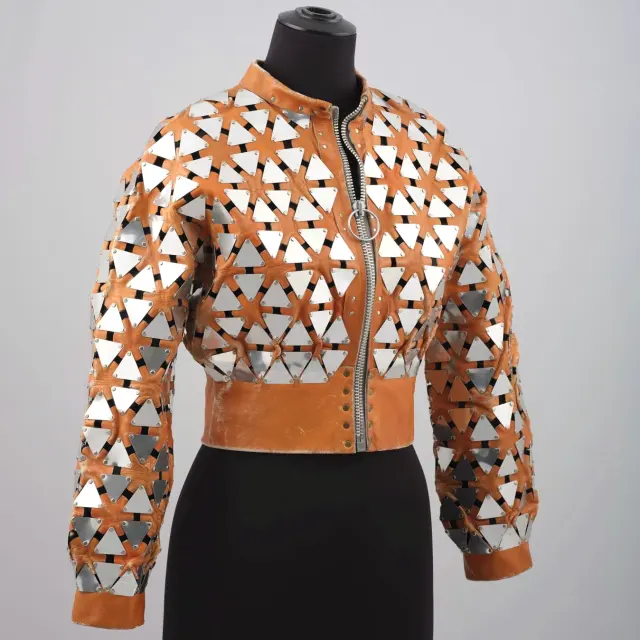
The Museo del Traje catalogue states that Francisco Rabaneda Cuervo was known in the fashion world as Paco Rabanne and registered the accessories brand Rhodoia in 1965. The source does not support further detail here about his career or associated objects.
Selected excerpts from our archive offer more context on this subject. Each reading links to the original article and its sources.
Paco Rabanne and the garment built from components
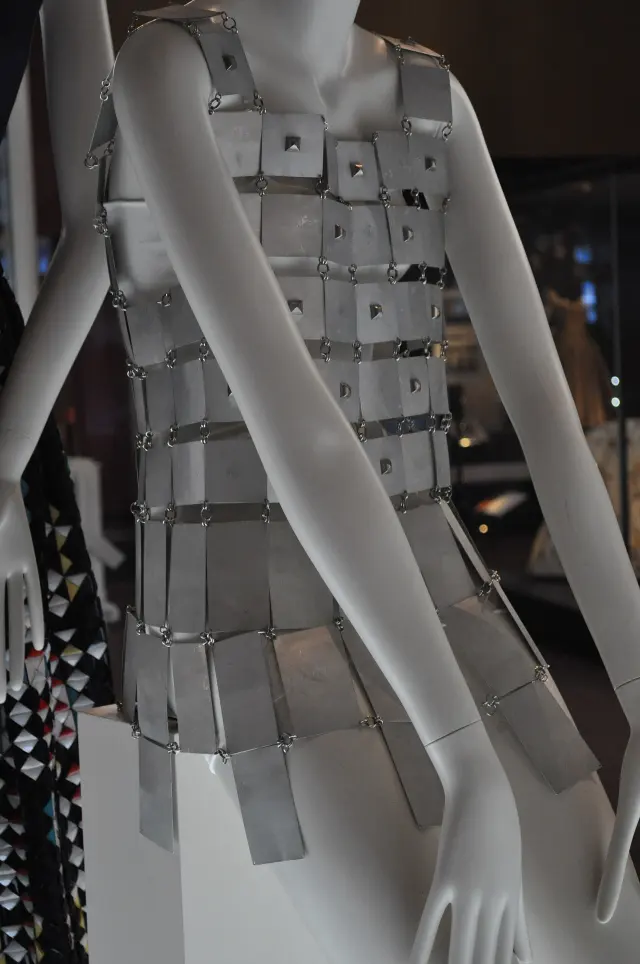
In 1966, Paco Rabanne presented garments that invited viewers to look at clothing differently: not as a surface of fabric cut and sewn, but as a structure made from connected parts. Discs of metal and plastic, linked by rings, formed clothes whose appearance suggested light armor. The proposal did not remove the body from the picture; it made the construction around it visible. That distinction helps explain why the collection remains useful for thinking about the relationship between fashion, material and form.
The 1966 collection is often described as a manifesto. The word suggests more than visual novelty: the garments proposed that clothing could be built through industrial assemblies rather than relying on the familiar logic of seams. This was not simply a matter of substituting one fabric for another. It changed how a surface was organized and how its separate parts related to one another.
The collection’s historical interest therefore lies in its method as much as in its materials. A dress could be read as a sum of linked components, with its construction on display. The seam was no longer an invisible principle holding the whole together; the connections became part of the appearance.
The discs and rings produced a surface unlike that of continuous cloth. The material asserted itself, making the structure perceptible. This helps explain the comparison to armor: the garment seemed built around the body rather than draped over it. An architectural reading is useful if understood as a formal analogy, not as a claim that the clothes functioned as architecture in a literal sense.
Rhodoia: the 1965 registration that separated Paco Rabanne's accessories
The history of 1960s avant-garde fashion often focuses on radical silhouettes and unconventional materials, but an administrative and strategic aspect remains in the shadows: the management of brand identity beyond the main garment. In 1965, Francisco Rabaneda Cuervo, known professionally as Paco Rabanne, registered the brand Rhodoia. This act was not a mere bureaucratic formality, but a statement of intent that delineated the scope of his aesthetic proposal. Available evidence, documented in the catalog 'La moda imposible. Moda de vanguardia, 1960 - 2010', indicates that Rhodoia was created specifically to refer to a collection of accessories, distinguishing it from the clothing items that bore the designer's name. This distinction is fundamental to understanding how designers of the era structured their commercial and artistic offerings.
The 1960s represented a break in the relationship between designer and material. Avant-garde fashion ceased to be exclusively a matter of cut and fabric to incorporate industrial elements, plastics, and metals. In this scenario, the accessory ceased to be a secondary complement to become a structural element of the image. Paco Rabanne, a pioneer in the use of metal plates and synthetic materials, needed a way to organize this new complexity. The registration of Rhodoia in 1965 fits into this context of experimentation, where the boundary between clothing and decorative object became increasingly blurred.
Consulted sources, including documentation from the National Autonomous University of Mexico, confirm that Rhodoia was not a clothing line, but an exclusive reference for accessories. This nomenclatural separation allowed the designer to maintain the coherence of his main identity, associated with clothing, while accessories could be developed under their own label. This suggests a conscious segmentation strategy. By registering a distinct brand, Rabanne could protect and promote his accessories independently, recognizing their intrinsic value within the total fashion experience he proposed.
The existence of Rhodoia is not based on rumors or anecdotes, but on formal records. The catalog 'La moda imposible', published in the context of an exhibition covering avant-garde fashion from 1960 to 2010, documents this registration as a verifiable historical fact. Furthermore, the mention of this brand in academic works, such as those from UNAM, reinforces its legitimacy within fashion historiography. These documents serve as an anchor for any serious analysis of Rabanne's trajectory, avoiding speculation about the actual scope of this sub-brand.
KEY FACTS
- Type
- Designer
References
- La moda imposible. Moda de vanguardia, 1960 - 2010cultura.gob.es