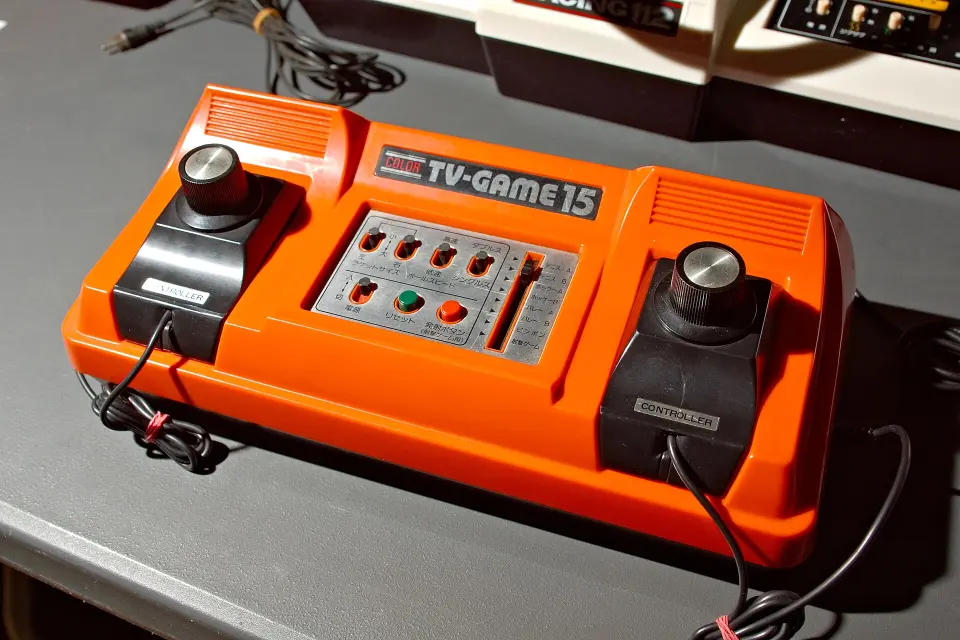
Exhibition of the Color TV-Game 15 console (1977), highlighting its collaborative design with Mitsubishi Electric and its role in defining the Japanese video console market. It is contextualized within the evolution of digital gaming spaces.
Selected excerpts from our archive offer more context on this subject. Each reading links to the original article and its sources.
Fifteen Titles in the Shell: Nintendo's Color TV-Game 15
The arrival of the Color TV-Game 15 in 1977 was not merely a commercial launch, but a reconfiguration of the relationship between the player and the machine. Jointly developed by Nintendo and Mitsubishi Electric, this console represented a turning point in the history of home video games in Japan. Unlike previous systems that relied on external peripherals or a single shared control unit, this device integrated the gaming experience directly into its physical structure. The model name was not arbitrary; the number fifteen explicitly indicated the quantity of available titles, a transparent marketing strategy that differentiated this unit from its immediate predecessor, the Color TV-Game 6. This numerical nomenclature established a standard of direct communication with the consumer, where technical specification became the primary value proposition.
The collaboration between Nintendo and Mitsubishi Electric was fundamental to the technical viability of the Color TV-Game 15. Mitsubishi, a company with a solid track record in consumer electronics and industrial components, brought the necessary expertise to integrate the game circuits within the console's casing. This synergy allowed Nintendo to explore new frontiers in industrial design and component miniaturization, laying the foundations for future hardware iterations. The relationship was not limited to manufacturing but influenced the product philosophy, prioritizing robustness and ease of use for a domestic audience still adapting to the idea of electronic entertainment.
The most distinctive aspect of the Color TV-Game 15 was the absence of cartridges. The fifteen games were burned into the console's internal memory, eliminating the need to purchase additional software to access basic content. This design decision had significant economic and usability implications. For the consumer of the time, having a game library included in the console's price reduced the barrier to entry into the market. Furthermore, by not relying on removable media, mechanical wear and software loss were minimized, offering a more stable and durable experience. The integration of games also allowed for instant loading, eliminating the wait times associated with cartridge insertion.
One of the most notable improvements over the Color TV-Game 6 was the implementation of independent controls. In previous models, players often shared a single control unit or used peripherals that were not optimized for simultaneous play. The Color TV-Game 15 incorporated two independent controllers, which greatly facilitated local multiplayer modes and made the experience more comfortable for users. This ergonomic change was not minor; it transformed the console from an individual or turn-based entertainment device into a social platform capable of hosting dynamic interactions between players. Control comfort became a key factor for the mass adoption of the system in Japanese households.
A Console Enters a Collection; Its History Doesn’t End There
The supplied information on Nintendo says that the company distributed its first home video game console in Japan, the Color TV-Game 15, in 1977. This provides a specific example from the 1970s. It does not tell us about the console’s history as a museum object, its provenance, or the documents accompanying preserved examples. Here, the console is a reference point for an archival question, not evidence of a collection history.
The available sources support a modest but useful idea: museum archives preserve documentation about objects and can help us study both collections and institutions. They do not provide an inventory of documents about consoles, or a documented museum history for the Color TV-Game 15.
KEY FACTS
- Type
- Console
References
- Historia de Nintendotranslate.google.com
- Color TV-Game 6 y Color TV-Game 15 | 100% RETROinfoconsolas.com
