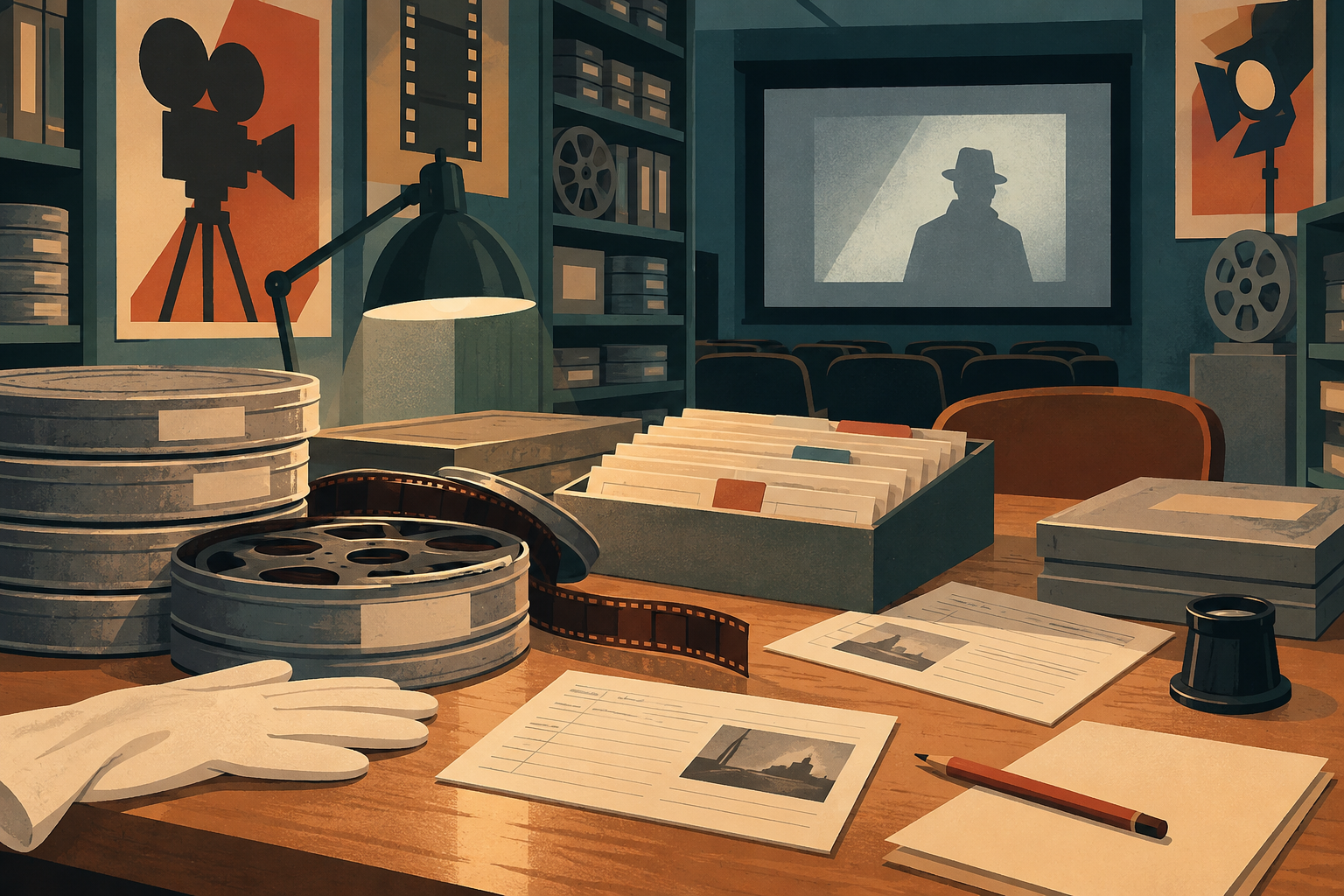
A film does not end with the image we see. Around it are carriers, prints, equipment, photographs, posters and documents that tell us how it was made and how it reached audiences in other times. When an institution preserves these traces, it does not merely keep works: it gathers material evidence of a culture and raises questions about what deserves to be remembered, how it is passed on and who can access it. The project announced for the former NO-DO building offers a concrete Spanish case through which to consider these questions, without mistaking the creation of a museum for an automatic solution to the problems of preservation.
From concept to objects
Cinematic heritage can be understood in different ways. A study of its presence in museums describes a tension between seeing cinema as an artwork—associated with authors and movements—and attending to its materiality. In an exhibition, a film may be presented as a work or as an idea; in an archive, its carrier and accompanying materials are also documents. These are not incompatible perspectives, but they lead to different curatorial decisions.
Research on Mexico’s Cineteca Nacional sets out a broad definition of the cinematic ensemble: alongside films, institutions may preserve photographs, posters, projection equipment and elements related to the infrastructure of mise-en-scène. These objects help researchers investigate technical and material processes rather than merely illustrate a familiar history. Their presence can make visible a part of cinema that usually remains unseen during a screening: the physical and technical conditions that allowed an image to be recorded, reproduced and preserved.
Preservation is not one single operation
The words conservation, preservation and restoration are used in professional settings that do not always define them in the same way. The study on Mexico’s Cineteca Nacional notes that languages, institutional traditions and the specific nature of processes make simple equivalence difficult. It is therefore more responsible not to treat the terms as synonyms or to assume that a particular intervention can be described without knowing the object, its condition and the criteria applied.
Filmoteca Española’s Film Conservation Department raises a further concern: audiovisual works exist on many video carriers and in many digital file formats, and the department’s mission includes both safeguarding these materials and ensuring access to their content over time. The issue is not limited to keeping a physical object. It also matters that a work remains accessible as carriers and playback technologies change.
The archive as memory in use
A film archive is not defined solely by the materials it stores. Writing on the role of film archives in Spain emphasizes both preservation and dissemination, and places research resources such as specialist libraries within that work. Dissemination is not an ornamental extra: it allows materials to be consulted, studied and connected to new questions. At the same time, preservation without explanation can leave visitors facing objects whose meaning is not self-evident.
A museum can build a bridge between research, exhibition and public experience. But that bridge should show what is known and what cannot be claimed from the displayed materials. A projector, for instance, can document technical processes; on its own, it cannot reveal how each venue used it or what every viewer experienced. Distinguishing evidence from interpretation does not weaken the account: it helps the public understand how it is constructed.
A building with audiovisual history
Spain’s Ministry of Culture announced that the Cinema Museum would be housed in the former NO-DO building, which served as the organization’s headquarters from 1942. According to the ministry, close to 70,000 negatives from its archives are deposited at Filmoteca Española’s Conservation and Restoration Centre. The project envisages a space for interpreting the building’s history and NO-DO’s role in the audiovisual imagination, as well as a heritage archive and functions for exhibition and preservation.
The figure for the negatives describes one dimension of the collection, but does not by itself establish what will be exhibited, which narratives will be chosen or how access will be organized. The announcement sets out an institutional intention, not an account of results from a museum that has already opened. That distinction matters: the stated aims of preserving and disseminating provide a framework for future evaluation, but they do not replace an assessment of actual practice once it exists.
Exhibiting is also selecting
Every museum organizes an experience: it decides what to show, what to contextualize and what remains in storage or in the archive. In cinema, selection can make visible not only a chronology of films, but also connections among works, carriers, technologies and documents. Research on film restoration stresses that film archives and non-film collections form part of a cinematic memory broader than the films themselves.
That breadth does not require everything to be exhibited. It does, however, suggest explaining why some materials are selected and others are not, and making clear when an account derives from documentation and when it is an interpretive proposal. The challenge is to present objects without turning them into nostalgic scenery, and to discuss preservation without promising a total recovery that the available sources cannot substantiate.
What can be said, and what remains open
The available evidence supports three ideas: cinematic heritage includes more than films; preserving it means attending to carriers and possibilities for access; and a museum can connect these materials with historical memory and research. It also supports a description of the Spanish museum announcement and the deposit of the NO-DO negatives at Filmoteca Española. It does not allow us to predict the final content of the galleries or certify how the project’s aims will be put into practice.
That limit is productive. It encourages us to view the museum not as an endpoint, but as an institution whose value will depend on how it connects custody, knowledge and access. The film we watch is only the most visible part of a chain. By bringing its material traces into view, a museum can help us understand that cinema history is also written through what survived around the screen.
Documentary gallery


- Decade
- Contemporary
- Region
- Spain
- Level
- Enthusiast
- Entities
- Museum
Sources and references
- Concepto | Estudios El Patrimonio cinematográfico en el Museodigibug.ugr.es · 2026-09-28
- El nuevo Museo del Cine se ubicará en el antiguo edificio del NO-DO | Ministerio de Culturawww.cultura.gob.es · 2026-09-28
- 1 Dossiê El cine como patrimonio culturaldialnet.unirioja.es · 2026-09-28
- Acerca de los conceptos de preservación, conservación y restauración fílmica en el caso de la Cineteca Nacional de México desde los planteamientos de Paolo Cherchi Usaiwww.scielo.org.mx · 2026-09-28
- Departamento de Conservación fílmica - Filmoteca Española | Ministerio de Culturawww.cultura.gob.es · 2026-09-28
- Investigación Restauración cinematográfica. Tierra de nadiewww.iaph.es · 2026-09-28