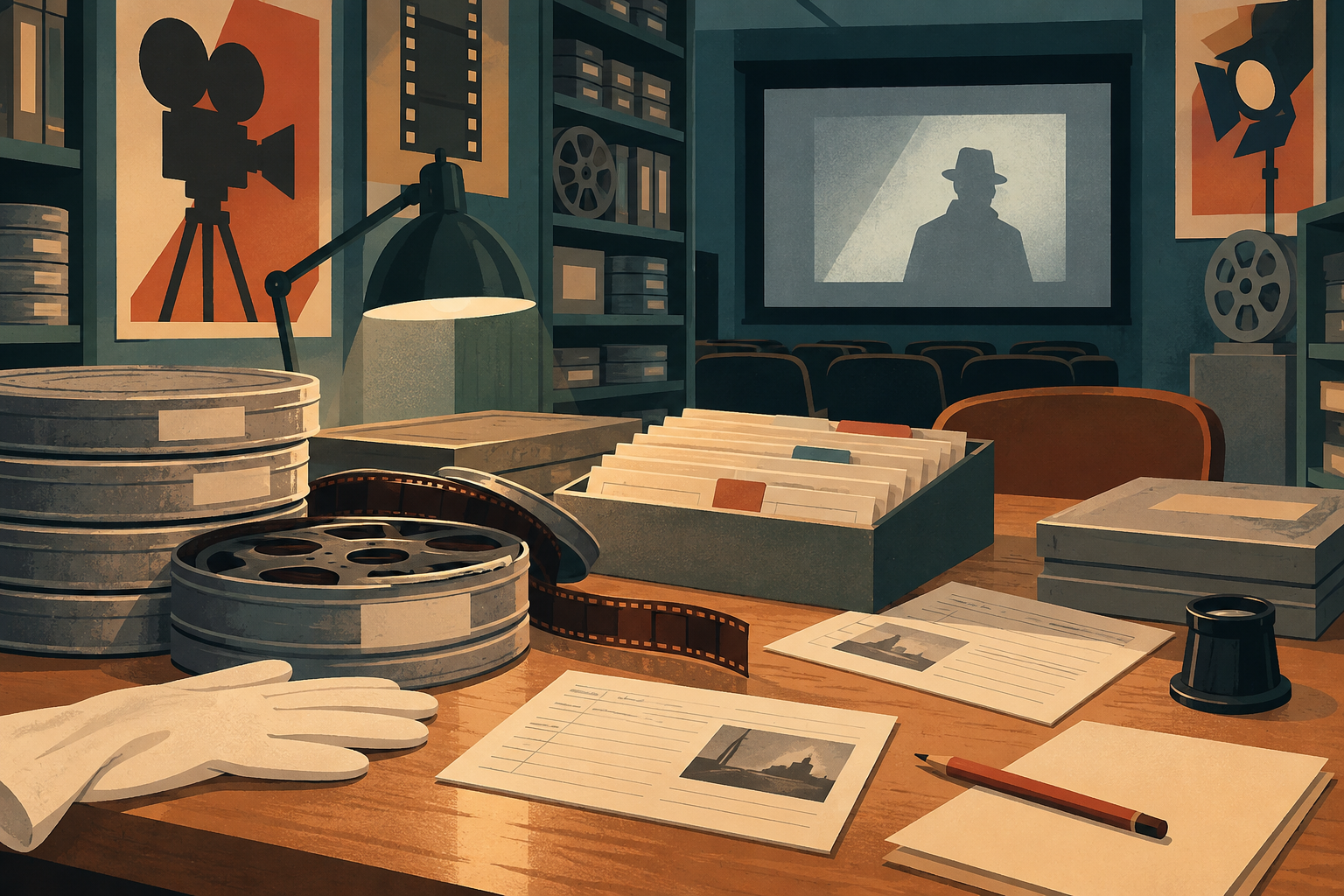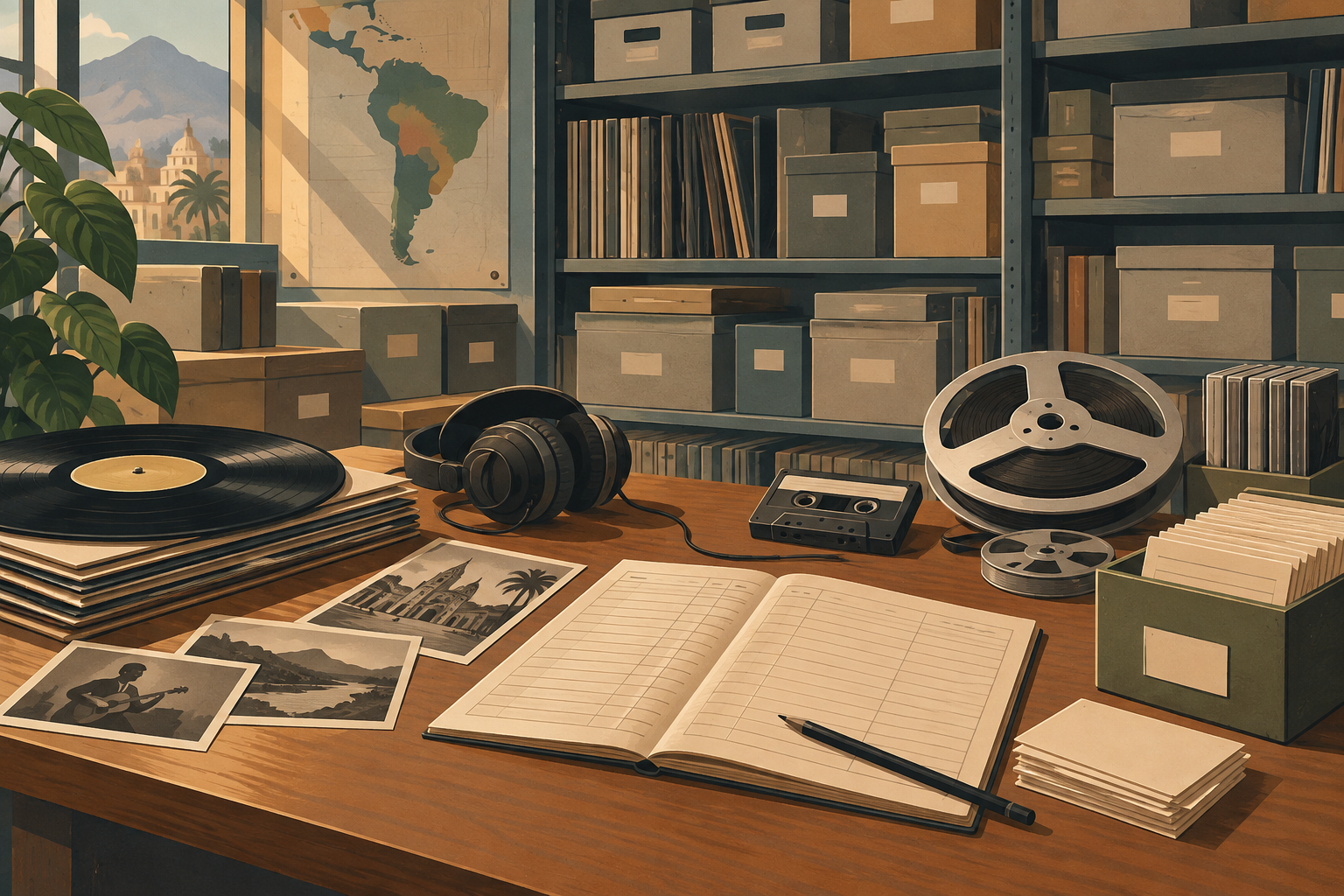
An archive does not preserve sounds alone
Speaking about music preservation often immediately brings a medium to mind: a cylinder, record, tape, CD, or digital file. That link has a real basis. Fixing music onto a carrier profoundly changed the possibility of hearing it again, classifying it, and passing it on. Yet reducing musical heritage to an audible object leaves out a decisive part of its meaning.
Musical documents are written and cultural testimony, and their management matters for old, modern, and digital holdings alike. From this perspective, a collection is not a neutral accumulation of items: it results from decisions about what is recorded, who describes it, where it is kept, and how it may be consulted. For collectors, researchers, and institutional visitors, this is a useful first rule: an isolated record says something; a record accompanied by information about its origin, use, and community says far more.
Seeing the documentary whole
Writing on musical holdings distinguishes many document types and notes that the sound and audiovisual universe is especially broad. Scores, publications, audio recordings, images, programmes, correspondence, and catalogue records can place a musical practice in time and in a social network. They will not all be present in every archive, and the available evidence does not allow them to be assigned to a specific collection; the important point is not to confuse a general typology with the contents of a particular holding.
This view also corrects a common collecting assumption: that material rarity alone explains cultural value. Rarity may matter, but heritage value also relates to the practices that brought a document into being. Musicology studies music as a physical, psychological, aesthetic, and cultural phenomenon, while also considering human interaction with music. Treating an archive as a storehouse of objects alone therefore limits what can be learned from it.
Medium, memory, and technological change
Music preservation is closely tied to formats. A public-facing text on sound archives describes the movement from memory as the sole means of preservation to carriers that fixed sound, naming wax cylinders, vinyl, compact discs, and digital files as part of that history. Its value lies in shifting the question: not only which music is preserved matters, but also which technical and cultural conditions made recording possible.
A medium, however, is neither identical to music nor sufficient to contain a community’s memory. Musical heritage includes written, sonic, oral, and instrumental dimensions. Research in the field has challenged rigid divisions between historical musicology and ethnomusicology, and between writing and orality. Reading a collection carefully therefore means asking what its institutional description contains and which experiences, interpretations, or circulations remain outside it.
A Mexican case: research, publishing, and a sound archive
Spain and Ibero-America’s Archive Census-Guide documents a significant process at Mexico’s National Institute of Anthropology and History. After INAH was created, linguists and ethnologists formed a sound archive with samples of Indigenous music and languages recorded on wire reels. The source itself presents this use of sound recording as a new stage for anthropological research, teaching, and dissemination.
The same record states that Arturo Warman and Irene Vázquez Valle proposed reissuing the historic record Testimonio musical de México in 1967. In 1974, a Record Publishing Office was established, initially linked to the Educational Services Department of the National Museum of Anthropology and History. In 1982, the Department of Oral Music and Literature Studies, DEMLO, was created under Gabriel Moedano; according to the source, it combined research, dissemination, and music preservation with projects concerning other oral traditions.
These references do not by themselves reconstruct the sound archive’s complete contents or assess the condition of every recording. They do show something essential: in this case, preserving music was tied to research, publication, education, and oral traditions, not merely to storing media.
Institutions, communities, and circulation
Musical heritage management is heterogeneous. Libraries, archives, museums, foundations, and private individuals all form part of its landscape. A volume on its management addresses, among other subjects, integrating musical holdings into general archives and libraries, instruments in museums, historic-organ restoration, and oral traditions. This range of actors makes universal formulas inappropriate: the priorities of a heritage library are not necessarily those of a sound archive, museum, or home collection.
In Latin America, the colonial context cannot be omitted from discussions of music archives. An essay on preservation stresses that Latin American archival needs have differed from European ones and describes joint publishing initiatives and, in some cases, heritage repatriation programmes involving sound archives, states, or cultural groups connected to recorded material. Preservation thus ceases to be an isolated end and becomes a means of circulating and defending musical diversity.
For audiences, this calls for ethical listening: identifying a recording does not justify treating it as a detached object. It is worth attending to the holding institution, the available description, documented provenance, and access or reproduction limits set by those responsible.
Limits of a responsible reading
The evidence assembled supports a broad understanding of musical heritage, but it does not justify turning that understanding into a technical manual for home cleaning, digitisation, or restoration. Nor does it establish that every archive follows the same policies, that every collection contains the same formats, or that institutional documentation fully resolves questions of cultural representation.
Caution does not make archives less compelling; it makes them readable. Distinguishing a documented fact—such as DEMLO’s creation in 1982—from an interpretation—that the process connects preservation, dissemination, and research—helps prevent invented stories from gathering around materials. It also prevents nostalgia for a format or musical scene from replacing analysis of the conditions under which those materials were assembled.
Conclusion
A music archive preserves traces of listening, research, and social life as well as media. The available examples and debates point to a clear lesson: a document needs context, and context includes institutions, communities, cataloguing choices, and forms of access. When approaching any holding, the most useful question is not only “what can be heard here?” but “what relationships enabled this to arrive here, and how is it described now?” That question turns a collection into living cultural heritage without claiming more than the sources allow us to verify.
- Decade
- Contemporary
- Region
- Latin America
- Level
- Collector
- Entities
- No linked entities
Sources and references
- Acervos de Documentos musicales - Bibliopos: Biblioteca de recursos para Bibliotecarios y Opositoreswww.bibliopos.es · 2026-09-17
- El patrimonio musical en la convergencia entre musicología y ...revistas.ucm.es · 2026-09-17
- por hacer cubierta La gestión del patrimonio musical.www.sibetrans.com · 2026-09-17
- Censo-Guía de Archivos de España e Iberoaméricacensoarchivos.mcu.es · 2026-09-17
- La conservación de la música - SUBURBANOsuburbano.net · 2026-09-17