The film is only one part of the whole
Speaking about film heritage often leads directly to a particular motion picture: its image, sound, authorship or historical moment. That association is valid, yet insufficient for understanding the work of a film archive, cinémathèque or film museum. Academic work on cinematic heritage notes that cinema can be understood both as art and as human testimony linked to an author, movement or cultural context. As heritage, however, it also requires attention to material form and to the documentary traces that identify, describe, preserve and exhibit it.
A specialized study of Mexico’s Cineteca Nacional illustrates this complexity. The film museum is associated with archives holding unique copies or copies relevant to film history, especially silent cinema. Yet the collection extends beyond prints: photographs, posters, projection equipment and stage infrastructure can also document technical and material processes. Reading an audiovisual archive means reading relationships, not only titles.
Conservation, preservation and restoration
These terms are often used as if they meant the same thing. The available scholarship advises caution. Specialists and institutions have debated them for decades, and differences in language, professional traditions and institutional settings make a single definition difficult. They should not become vague promises to “save” a film.
Filmoteca Española states that its conservation service addresses criteria, methods and techniques for safeguarding cultural heritage. For video and digital audiovisual files, it also identifies a mission to conserve works and guarantee access regardless of time elapsed since their origin. This joins two duties: material legibility and cultural availability.
Documents tell history too
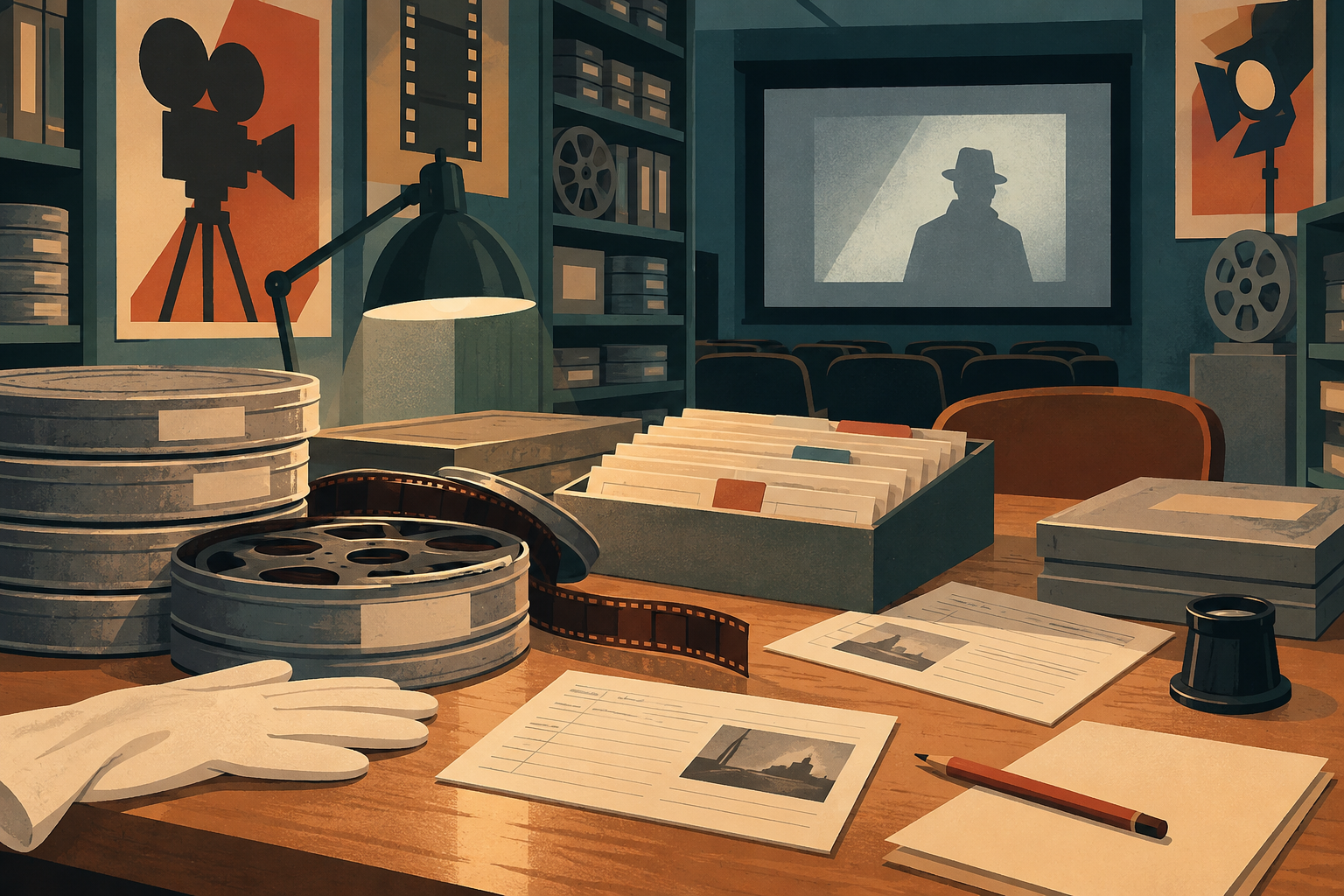
A museum cannot explain a film solely by screening it. Associated documentation can partially reconstruct an object’s institutional and technical trajectory. Filmoteca Española lists inspection and restoration reports, opening titles, end-credit reels, rights-sale deeds, transfers of ownership, exhibition licences and censorship bulletins among materials held at its Carlos Saura Conservation and Restoration Centre.
Such records help visitors and researchers distinguish promotion, condition, administration and circulation. No individual document offers a complete truth about a film. Taken together, they show that audiovisual heritage has a life after production and release: it is catalogued, treated, loaned, reproduced and contextualized.
Formats change; responsibility remains
Film heritage is not limited to photochemical film. Filmoteca Española notes that digitized or born-digital audiovisual works can exist in many formats and be stored on CD, DVD, Blu-ray, hard drives, USB devices or LTO. It mentions Blu-ray’s 2006 arrival and its high-definition capacity compared with DVD. This documents changing formats, not a guarantee of permanence.
For audiences interested in home cinema, video stores or collecting, the lesson is that a visible object alone does not explain a history of access. A disc may serve consumption, working-copy or preservation purposes depending on provenance and use. The supplied evidence does not allow such a role to be assigned to any individual copy.
Latin American audiovisual memory
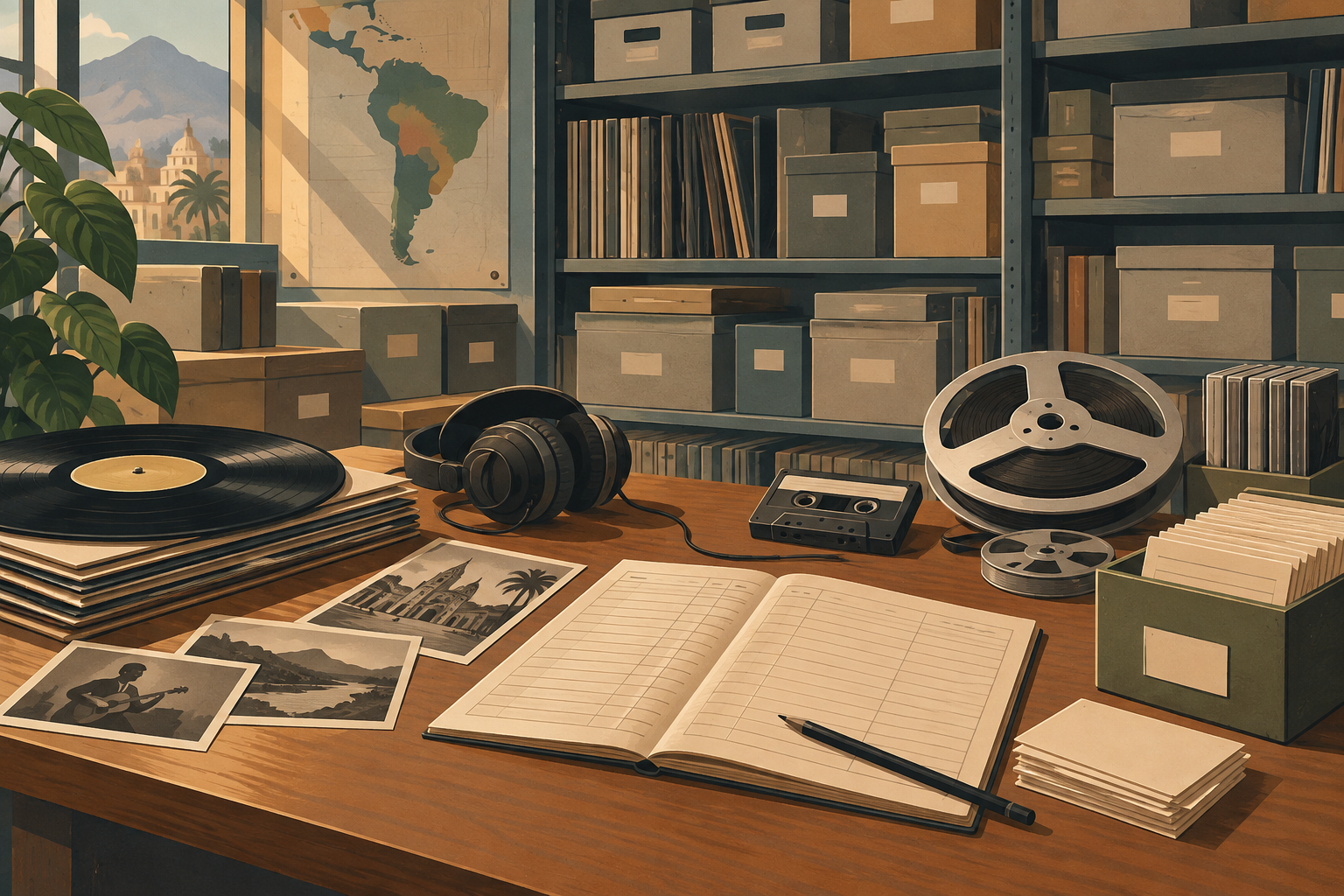
The Fundación Patrimonio Fílmico Colombiano offers a clear example. According to the Censo-Guía, in 1987 it made the Archivo Histórico Cinematográfico de Los Acevedo publicly available after restoration and preservation; its records date from 1915 to 1955. The archive contains images of Colombia’s sociocultural context in early cinema and received UNESCO Memory of the World recognition in 2018.
This does not make images transparent windows onto the past. They are sources requiring description, provenance and context. The same record identifies risks including nitrate-base flammability, decomposition, acetate vinegar syndrome, colour fading and technological obsolescence. These facts underline the value of professional preservation; they are not instructions for home intervention.
The museum as interpretation
A film museum may show objects, but its role is broader than display. In 2025, Spain’s Ministry of Culture announced a Museo del Cine in the former NO-DO building, intended to exhibit and conserve Spanish film heritage. The project includes a memory and interpretation space about the building and NO-DO’s role in audiovisual imagination, as well as access to related archives. The announcement refers to nearly 70,000 negatives held by Filmoteca Española’s Conservation and Restoration Centre.
Interpretation matters because it gives viewers tools to ask what they are seeing, where it came from, why it survives and what limits it has as a source. Public programming can support this work: a Ministry activity proposes pre-screening discussions involving specialists in history, archaeology and cinema, addressing both historical context and fictional narratives.
What to ask of an exhibition
A careful visit begins with questions. Is the material identified? Does the display distinguish an original film element, a reproduction and an associated document? Does it explain provenance, date or function where known? Does it provide cultural context without claiming a final interpretation? Does it describe access without endangering originals?
The evidence assembled here describes institutions, principles and selected holdings, not complete inventories, item-by-item condition reports or procedures for private collections. It would therefore be improper to infer the condition of a particular film or recommend domestic restoration. Archived cinema is a combination of materials, records and institutional decisions. Understanding that combination is a more rigorous way to enjoy it.
Conclusion
A film museum is neither a warehouse of nostalgia nor an enlarged screening room. It is where films coexist with formats, papers, promotional images, equipment and histories of circulation. The institutions discussed here show that conservation means sustaining diverse materials, while access means making them intelligible. Rather than asking only “what film is this?”, visitors can ask a wider question: “what objects and documents make it possible for this film to remain visible, debatable and historically situated?”
- Decade
- Contemporary
- Region
- Latin America
- Level
- Technical
- Entities
- Archivo de Filmoteca Española
Sources and references
- Concepto | Estudios El Patrimonio cinematográfico en el Museodigibug.ugr.es · 2026-09-17
- El nuevo Museo del Cine se ubicará en el antiguo edificio del NO-DO | Ministerio de Culturawww.cultura.gob.es · 2026-09-17
- fundación patrimonio fílmico colombiano (bogotá, colombia)censoarchivos.mcu.es · 2026-09-17
- Acerca de los conceptos de preservación, conservación y restauración fílmica en el caso de la Cineteca Nacional de México desde los planteamientos de Paolo Cherchi Usaiwww.scielo.org.mx · 2026-09-17
- Departamento de Conservación fílmica - Filmoteca Española | Ministerio de Culturawww.cultura.gob.es · 2026-09-17
- Archivo - Filmoteca Española | Ministerio de Culturawww.cultura.gob.es · 2026-09-17