Music does not fit on a single medium
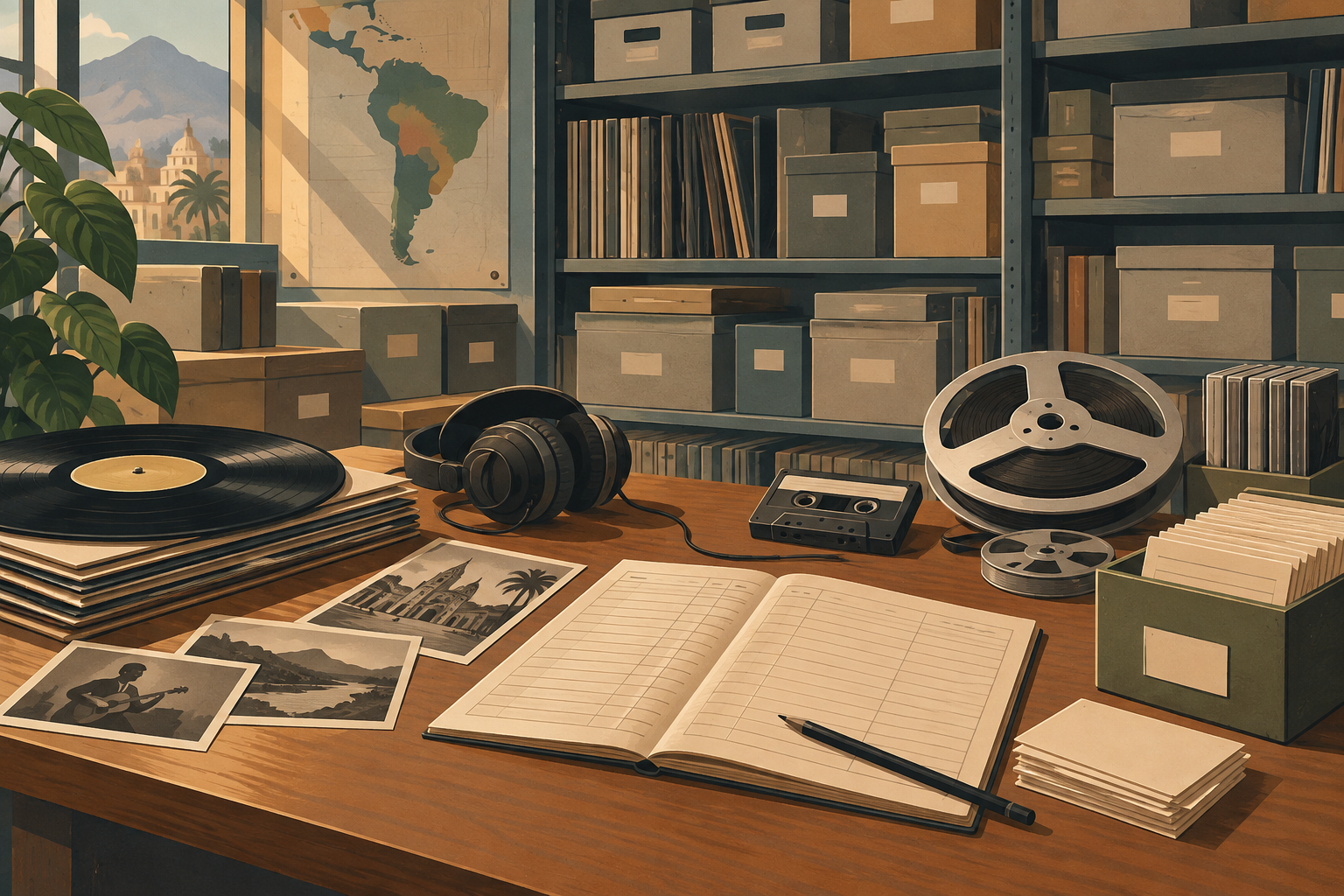
A piece of music can live in memory, in a score, in a recording, or in the documents that explain how it circulated. Each medium preserves something different. A score records a written form of music; a recording gives access to fixed sound; other documents may help place a work within a practice or an institution. That is why musical heritage cannot be reduced to instruments or records alone.
Writing on musical collections describes documents as a means of preserving and sharing knowledge, and as evidence of culture. It also distinguishes books and notated music from sound and audiovisual materials, fields that require their own approaches. The distinction matters: collections are not interchangeable, and useful cataloguing should identify what kind of object is being preserved rather than compress everything into a generic category of “music.”
An institutional archive as an example
The Musical Archive of the National Museum of Performing Arts offers a specific case. The institution says that most of its holdings come from the Teatro Real Museum-Archive, created by Luis París in 1919 from musical holdings organised between 1850 and 1952. The collection is divided into two broad sections: Spanish and international music.
The same description mentions manuscripts by Spanish composers, some separate autograph manuscripts, and Spanish music composed or published before 1936, catalogued by the Centre for Music and Dance Documentation. It also identifies an eighteenth-century music book deposited at the Museum. These details show the variety of materials and origins described, but they do not establish that every work or document in the archive has been digitised, exhibited, or made available for consultation on the same terms.
Context is part of the document
Preserving a sheet of paper is not enough to explain its history. It matters who produced it, how it entered a collection, how it relates to other items, and what information makes it identifiable. Studies of musical heritage emphasise cultural and social context, and caution against rigidly separating written music from oral practices or a community’s musical experience.
This perspective avoids an overly narrow reading. A score is evidence of a written form, not a complete account of how a performance sounded or who took part. Likewise, a recording does not contain the whole history of the practice it documents. Archives can bring together different traces, but the gaps between them also need to be acknowledged.
From recorded sound to preservation
Fixing music on recording media changed the possibilities for preserving it and listening again. An essay on music preservation discusses formats including wax cylinders, vinyl records, compact discs and digital files, and connects preservation to the characteristics of the medium. It would be unsafe to infer that all formats present the same problems or that transferring material to a new format automatically solves its preservation.
Research on sound-document preservation also describes the work as an integrated process and highlights the importance of controlling archival materials. Without technical details about a particular collection, these general references should not be turned into handling instructions. They instead remind us that identifying, describing and keeping a sound document accessible calls for decisions different from those applied to a score.
Preservation also shapes what gets told
Archives are not neutral repositories of a complete history. Selection, description and access affect what can be found and how it is interpreted. Writing on musical heritage treats preservation alongside dissemination, while discussion of sound archives draws attention to links among conservation, circulation and the communities connected with the materials. This does not establish a specific policy for the National Museum of Performing Arts archive: the available sources do not describe one.
A responsible account distinguishes what is known from what remains to be researched. Here, we have some information about provenance, organisation and types of holdings; we do not have a complete inventory, a detailed history of every item, or enough information to describe all access conditions. Those limits belong in the story rather than being filled with conjecture.
A history made of media and relationships
Music may be intangible as an experience, but its history leaves material and sonic traces. Scores, institutional archives and recordings make different aspects available for study, provided their nature and context are taken into account. The published description of the Musical Archive of the National Museum of Performing Arts shows how a collection can bring together materials from different periods and origins.
Preserving that legacy means more than keeping objects. It involves describing them accurately, recognising what each medium can and cannot tell us, and keeping open questions about the practices and people missing from the record. That is the difference between treating music as a list of works and understanding it as cultural history that is also archived.
Documentary gallery

- Decade
- Contemporary
- Region
- Spain
- Level
- Introduction
- Entities
- Museum
Sources and references
- Acervos de Documentos musicales - Bibliopos: Biblioteca de recursos para Bibliotecarios y Opositoreswww.bibliopos.es · 2026-09-26
- El patrimonio musical en la convergencia entre musicología y ...revistas.ucm.es · 2026-09-26
- Año 10, No. 10, 2014 bibliotecas anales de investigacióndialnet.unirioja.es · 2026-09-26
- 48 artículoswww.iaph.es · 2026-09-26
- La necesidad de protección de la música como patrimonio ...nuevaepoca.revistalatinacs.org · 2026-09-26
- Archivo Musical - Museo Nacional de Artes Escénicas: Almagro, Ciudad Realmuseodeartesescenicas.inaem.gob.es · 2026-09-26
- La conservación de la música - SUBURBANOsuburbano.net · 2026-09-26