A museum speaks through form, too
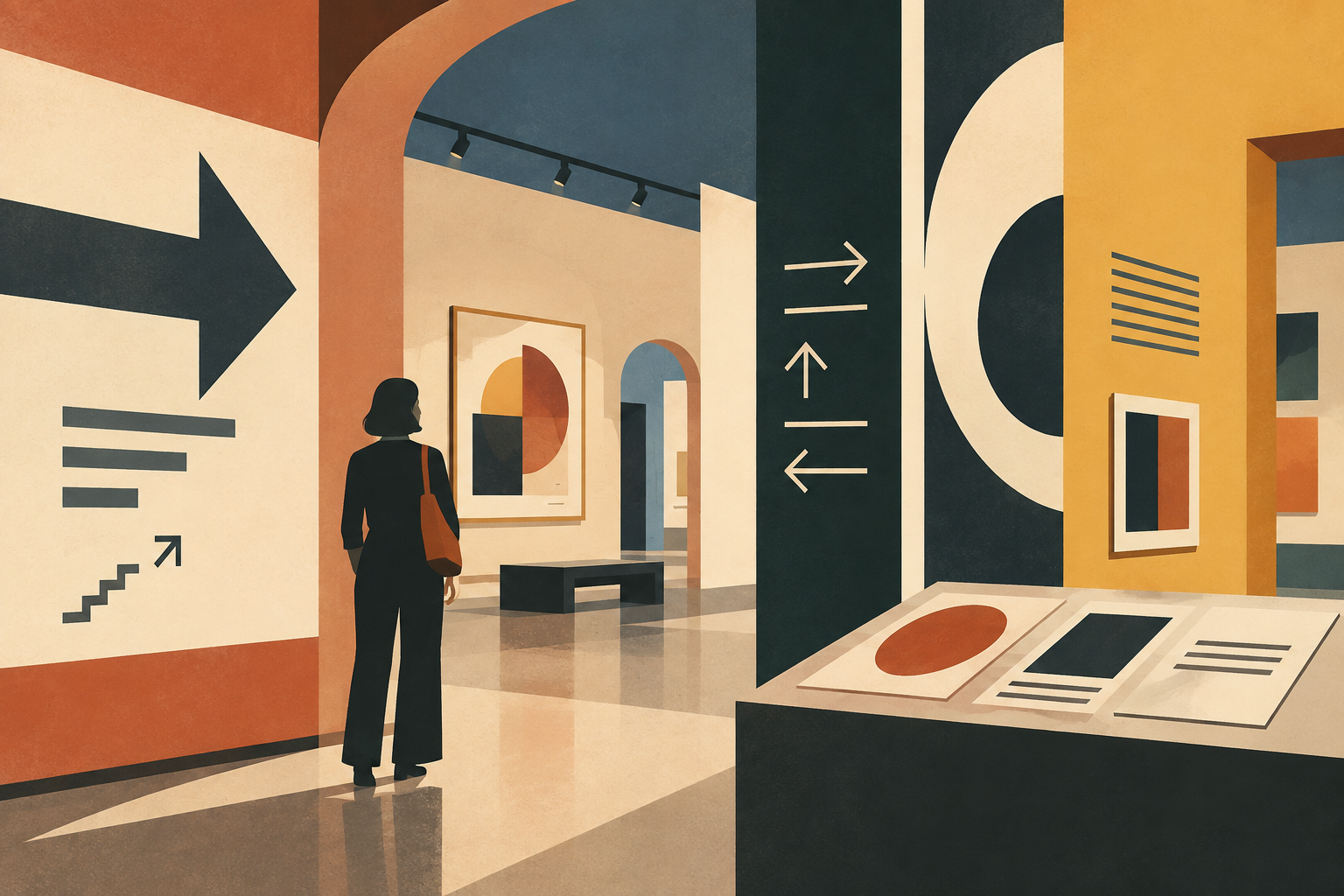
Entering an exhibition means encountering objects, text, colours, labels and signs. These elements do not all serve the same purpose, but together they shape how visitors move through and understand a space. Museum graphic design should therefore not automatically be treated as decoration added after a collection has been arranged. It can be part of an institution’s communication and of the visitor’s learning experience.
A 2023 study examines the graphic design of several museums in Valencia and considers its relationship to visual culture, promotion and heritage education. Its abstract says that graphic choices affect a museum’s image and the impact of the graphic message on the public. This provides a specific basis for discussing museum design. On its own, however, it is neither a complete history of museum advertising nor proof that every visitor responds in the same way.
The visit as an act of reading
Graphic elements can help visitors find their way, signal hierarchies or establish a tone. These functions differ, even when they overlap: a recognisable visual identity does not necessarily explain an artwork, and an informative label cannot by itself create the museum’s overall image. The Valencia study proposes viewing design as a stimulus involved in a process of learning. That idea encourages us to consider how graphic resources and space work together, rather than judging each sign in isolation.
It is also important to distinguish intention from outcome. The presence of a particular visual language lets us describe a design decision; demonstrating its effect on understanding would require appropriate evidence about the public’s experience. The available study summary discusses the educational and communicative interest of design, but does not provide detailed audience measurements. A responsible account preserves that distinction.
From promotion to heritage
Museum design appears both in public-facing communication and within the building. The 2023 article connects the graphic language of museum spaces with promotion and advertising, while considering permanent galleries and temporary exhibitions. This breadth is useful: an institution’s identity is expressed not only through an external campaign, but also through the visual resources used to organise a visit.
Still, the existence of a graphic item is not enough to establish that it should be considered heritage. A more useful question is whether the material could help reconstruct how an institution communicated, presented its collections or changed an exhibition. The answer depends on the particular object and its documentary context. A bibliographic record for research on the design and advertising of variety shows and the conservation of the Balder and Sanz ventriloquism collection provides a relevant example of scholarship connecting design, advertising and conservation. The supplied record does not detail the article’s full contents, so it cannot support claims about specific findings beyond its stated subject.
Preserve relationships, not just objects
Guidance on managing museum archives stresses identifying the documents an institution produces, describing them and setting preservation criteria. Applied to graphic design, this approach suggests questions to ask before keeping or discarding material: who produced it, what activity it relates to, which version it represents and how it connects to other documents. Navarra’s cited instructions refer to document types, classification schemes, metadata and appraisal and retention schedules.
Documentation also matters when interpreting cultural objects. Zubiaur Carreño’s text emphasises recording an object’s context of origin and notes that some media may merit preservation depending on their value. This is general guidance, not a ruling on every poster, leaflet or sign. Decisions require information about the specific object and the institution’s circumstances.
What we still cannot know
The sources support a measured conclusion: graphic design can be part of a museum’s public identity and educational work, while archival methods can help document its context. The supplied evidence does not identify individual campaigns, particular designers, budgets, audience outcomes or a detailed historical chronology. It also does not establish that any one visual style is universally effective.
That caution does not diminish the subject. It points to useful work for researchers and conservators: read graphic elements as situated decisions, connect them to the institution that produced them, and record what is known alongside what remains unverified. In a museum, walls do more than surround artworks. They can communicate messages and become part of a history worth documenting.
- Decade
- Contemporary
- Region
- Spain
- Level
- Enthusiast
- Entities
- Museum
Sources and references
- Clip de SEDIC, Revista de la Sociedad Española de Documentación eedicionsedic.es · 2026-09-27
- instrucciones para la gestión y organización de archivos ...www.navarra.es · 2026-09-27
- Archivos de Museo: Funcionamiento - EVE Museos + Innovaciónevemuseografia.com · 2026-09-27
- Capítulo 10 - El museo como centro de investigación. La necesidad de documentar las piezas en el museo. Tendencias documentales actuales. Normalización y gestión integral del museo. - Fco Javier Zubiaur Carreñowww.zubiaurcarreno.com · 2026-09-27
- Diseño gráfico del museo como estímulo creativo en educación patrimonial | i2 Investigación e Innovación en Arquitectura y Territorioi2.ua.es · 2026-09-27
- El diseño y la publicidad de los espectáculos de variedades: la conservación de la colección de ventriloquía de Balder y Sanzdoi.org · 2026-09-27