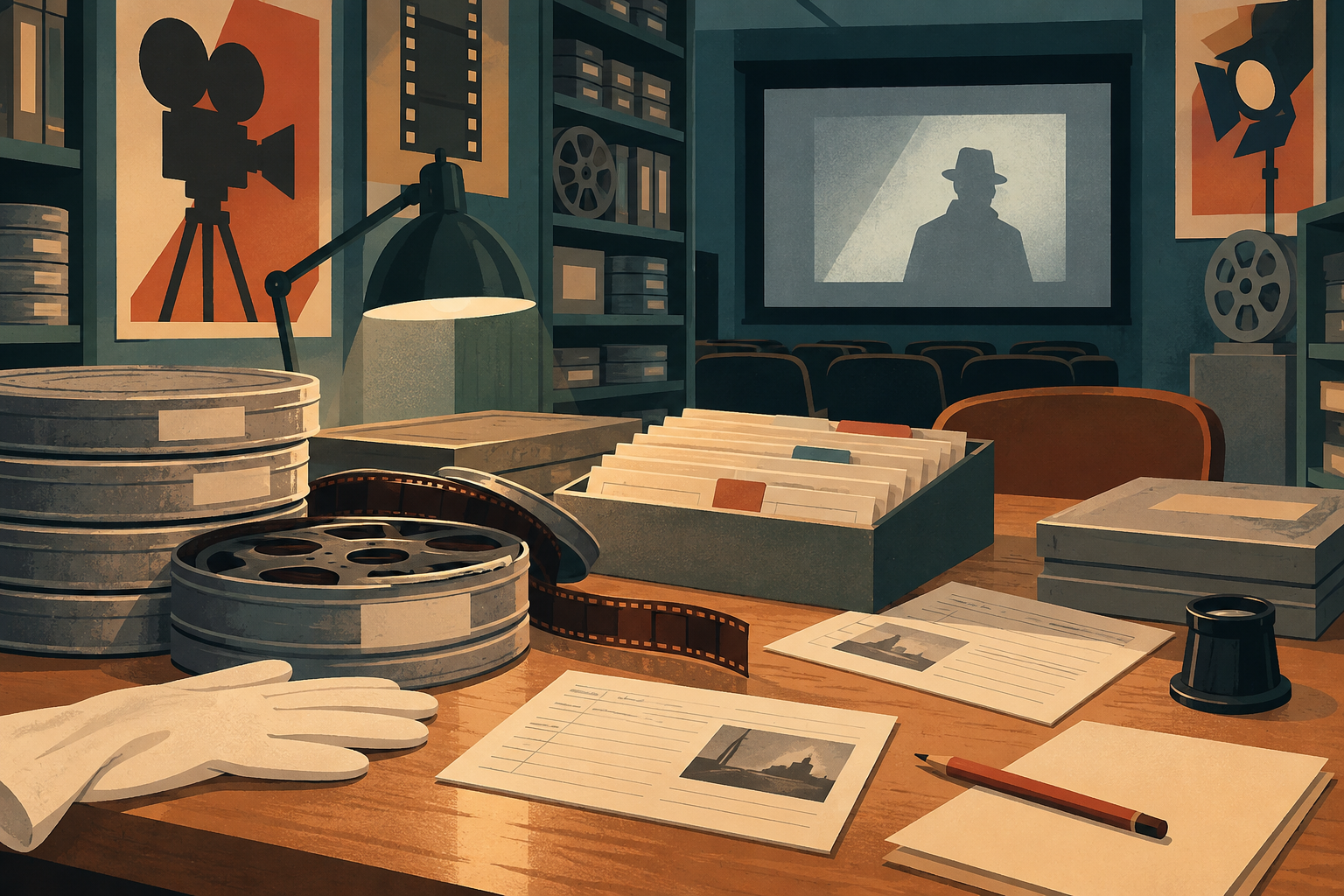
Cinema is often remembered as an experience in front of a screen. Yet a film also exists as carriers, prints, documents and equipment; its history does not end with what we see during a screening. This perspective lies at the heart of debates about film heritage and gives meaning to the project announced for the former NO-DO building: a place of memory and interpretation, alongside a heritage archive.
A film is not the only thing that matters
A study on cinema heritage and museums describes two ways of understanding cinema: as an artistic work linked to authors and cultural movements, and as a body of materials with documentary and historical value. These approaches are not mutually exclusive. A film can be an artwork and, at the same time, testimony shaped by its era, its techniques and the processes that made its production and preservation possible.
Research published in Inter-Ação on film archives describes these institutions as combining custodial, research and dissemination functions. From this perspective, cinema is not preserved simply so that a copy survives. It also matters that people can access it and understand it in context.
The archive has a material dimension
An academic analysis of the Cineteca Nacional de México distinguishes preservation, conservation and restoration—terms that are not always used in exactly the same way. The article notes that a film institution’s heritage may include film prints and other materials, among them photographs, posters and projection equipment. Such objects help researchers study cinema’s technical and material history.
This range of material challenges the idea of an archive as merely a film storehouse. Items associated with a work can help investigate how it was made, how it circulated or what traces its preservation left, provided that the evidence is documented. The point is not to assign an unknown history to every object, but to recognize that collections can offer different kinds of evidence.
Conservation is not the same as restoration
The PH journal article on film restoration suggests, in its very title, that this can be a field of complex boundaries and criteria. Filmoteca Española’s film conservation department likewise describes its work as safeguarding heritage and maintaining access to audiovisual works that exist on different carriers and in different formats.
It is therefore worth avoiding “restoration” as a catch-all word for every archival task. Conservation, preservation and restoration are related, but the sources show that their meanings can vary among institutions and specialists. Without specific information about an intervention, it is not possible to say which procedures were used or assess their results. Caution is part of a rigorous account of heritage.
A museum to interpret, not merely display
In April 2025, Spain’s Ministry of Culture announced that the future Cinema Museum would be located in the former NO-DO building, which housed the organization from 1942. According to the announcement, around 70,000 NO-DO negatives are held at Filmoteca Española’s Centre for Conservation and Restoration. The project envisages rehabilitating the building for its new use and creating a place of memory and interpretation there, while facilitating access to the NO-DO archive and to the history of Spanish audiovisual media during the Franco era.
These details describe an announced project; they do not establish that the rehabilitation is complete or determine what the eventual exhibition will contain. They do, however, point to an opportunity: connecting a specific place with documentary materials and with the history of audiovisual production. In an institution of this kind, context matters as much as display. An isolated object may attract attention; its relationship to documents, processes and historical accounts helps people understand it.
Access is part of the legacy
The study of film archives places dissemination alongside preservation. Filmoteca Española’s page on the conservation of video and digital materials likewise states the need to safeguard works and ensure access to their contents over time. Preservation and sharing are not identical tasks, but the sources connect them in the mission of these institutions.
A cinema museum can make that connection visible by showing that the cinematic experience depends on works, techniques, carriers, people and archives. The project in the former NO-DO building invites visitors to trace that history from a site identified with Spanish audiovisual media. Its actual scope will have to be assessed when information is available about the completed museum and its contents. For now, the evidence supports a more limited but important conclusion: cinema heritage is not just a collection of films; it also consists of preserving the materials that explain their history and making that history accessible to the public.
Documentary gallery


- Decade
- Contemporary
- Region
- Spain
- Level
- Enthusiast
- Entities
- Museum
Sources and references
- Concepto | Estudios El Patrimonio cinematográfico en el Museodigibug.ugr.es · 2026-09-26
- El nuevo Museo del Cine se ubicará en el antiguo edificio del NO-DO | Ministerio de Culturawww.cultura.gob.es · 2026-09-26
- 1 Dossiê El cine como patrimonio culturaldialnet.unirioja.es · 2026-09-26
- Acerca de los conceptos de preservación, conservación y restauración fílmica en el caso de la Cineteca Nacional de México desde los planteamientos de Paolo Cherchi Usaiwww.scielo.org.mx · 2026-09-26
- Investigación Restauración cinematográfica. Tierra de nadiewww.iaph.es · 2026-09-26