Digitising a collection can make its records available to more people and may reduce the need to handle certain originals. But an online image or catalogue entry cannot, by itself, explain what an object is, how it entered an institution or which documents help reconstruct its history. Technology can expand the possibilities for preservation and access; it cannot replace the documentary work that makes a collection intelligible.
The record is not an add-on
According to Spain’s Ministry of Culture, the archives of state museums hold documentation about the objects in their care from the moment of deposit. For some items connected with the Civil War and the Franco period, that documentation may include records of deposits made after 1939 in connection with the work of the National Service for the Defence of the Artistic Heritage. The example is a reminder that an object’s history is not always straightforward: sometimes what can be said depends on the surviving documents and on their limits.
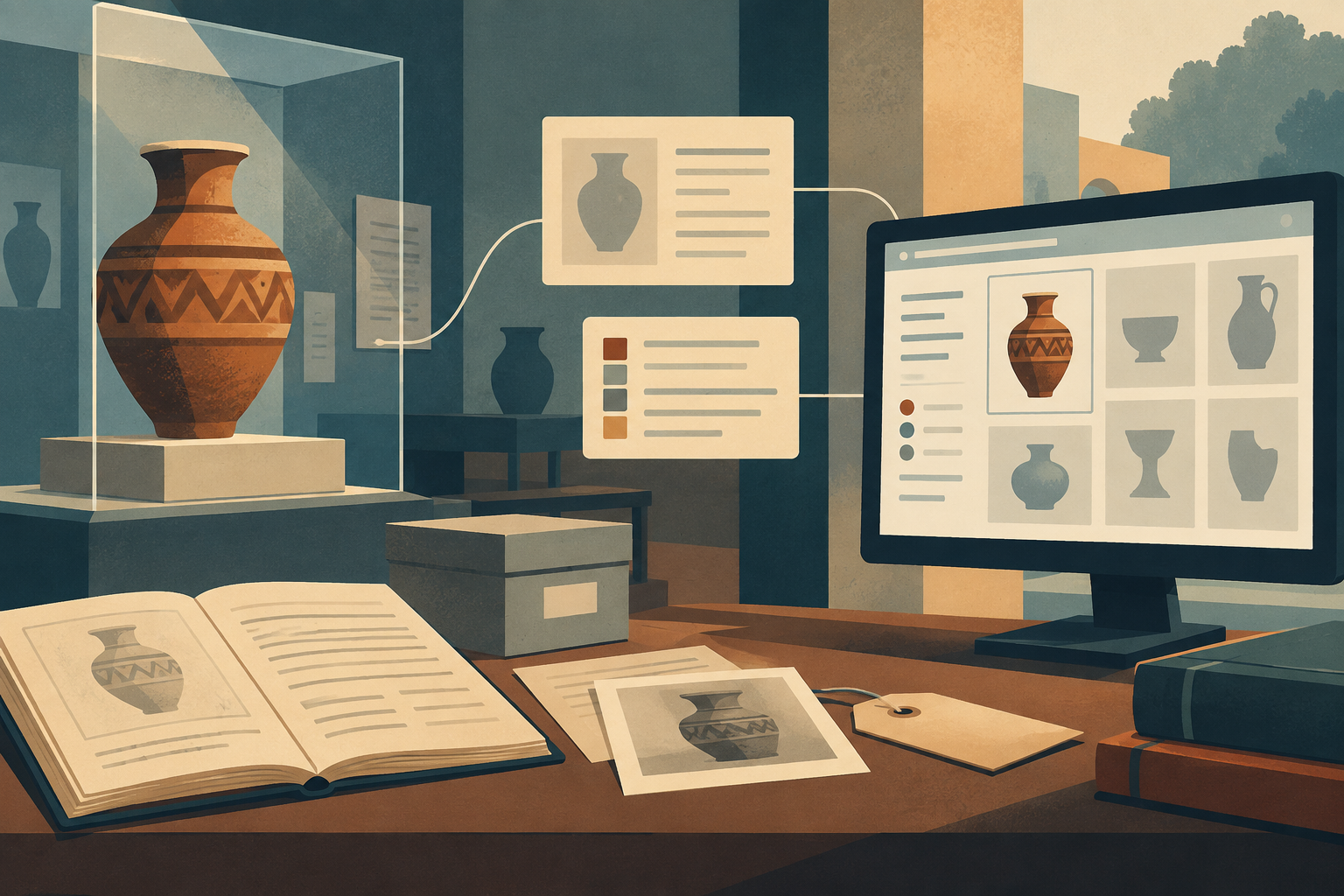
A digital representation can bring those records closer to researchers and the public, but only if it preserves the link between an object and its accompanying documentation. Information should not be reduced to an isolated photograph or a description with no clear provenance.
Digitisation also means organisation
An article in the SEDIC journal Clip stresses the importance of assigning unique identifiers to documents and preserving contextual metadata that makes them findable. Navarra’s instructions for managing museum archives likewise treat documentation about objects as part of their context, to be kept connected to them. In practical terms, a digital collection cannot be sustained by images alone: it needs findable records, intelligible relationships and consistent organisational principles.
Nor does a museum’s digital transformation mean simply publishing content online. EVE Museos + Innovación describes it as a gradual process that can include internal management, collection digitisation, communication with audiences and the integration of digital tools into museum functions. This range matters: an attractive website does not, by itself, show that documentation systems are connected or sustainable.
Access and preservation are not the same
A digital copy can make consultation easier and, in some circumstances, reduce handling of an original. But creating one does not automatically guarantee long-term preservation or better understanding. Records still need to be maintained, their contents explained and the limits of what they can establish made clear. EVE’s article on cultural heritage conservation and digital narratives presents interactive technologies as tools for interpretation and dissemination; the editorial challenge is to make those tools help explain an object or site rather than displace its history.
A screen also changes the experience: it may make information available beyond the museum, but it does not reproduce every condition of a visit or the material nature of an object. A study of new-generation museums available through the University of Granada notes that screen-based technologies have limitations as well as possibilities. That is best understood as a reason to assess each tool, not as a rejection of digital media.
What should accompany the image?
At a minimum, a record should make it possible to identify an object and connect its representation to documentation held by the institution. Where known, provenance and documented circumstances of acquisition are essential parts of that explanation. Where gaps remain, a presentation should make them visible rather than fill them with a confident but unsupported account. The available sources support the importance of context and organisation, but do not establish one technical standard for every collection.
It also matters who can access records and with which tools. Digitisation can widen access, but public usefulness depends on information being findable and readable, and on institutional archives being maintained. EVE emphasises the need to organise and preserve museum records and facilitate public access to them. Archival documentation is therefore part of cultural infrastructure, not merely internal administration.
A digital collection needs a memory
Technology can make documents easier to consult and create new ways to connect objects, images and texts. Its strongest contribution comes when it supports reliable documentation, preserves connections between records and communicates clearly what remains unknown. Without that care, the result may be accessible but stripped of context.
Digitising is not just turning an object into an image. It also means deciding what information stays with that image, how it can be found and what account the available sources can support. A digital archive becomes more valuable when it helps people understand a collection without pretending that the screen contains everything the objects and their records mean.
- Decade
- Contemporary
- Region
- Spain
- Level
- Enthusiast
- Entities
- Museum
Sources and references
- ARCHIVOS DE LOS MUSEOS ESTATALES - | Ministerio de Culturawww.cultura.gob.es · 2026-09-26
- Breve Historia de la Transformación Digital en Museos - EVE Museos + Innovaciónevemuseografia.com · 2026-09-26
- Clip de SEDIC, Revista de la Sociedad Española de Documentación eedicionsedic.es · 2026-09-26
- instrucciones para la gestión y organización de archivos ...www.navarra.es · 2026-09-26
- MUSEOS DE NUEVA GENERACIÓN: LA PANTALLA ...www.ugr.es · 2026-09-26
- Archivos de Museo: Funcionamiento - EVE Museos + Innovaciónevemuseografia.com · 2026-09-26