An advertisement is also a visual object
Advertising is often remembered for what it aimed to sell. Yet a poster, magazine page, package or display can also be examined as a piece of visual communication: it arranges words and images, seeks attention and builds a relationship with an audience. That reading does not automatically make every advertisement a work of art, nor can it establish on its own how viewers responded. It does, however, open up another question: what can advertising materials tell us about the ways people designed and communicated in a particular period?
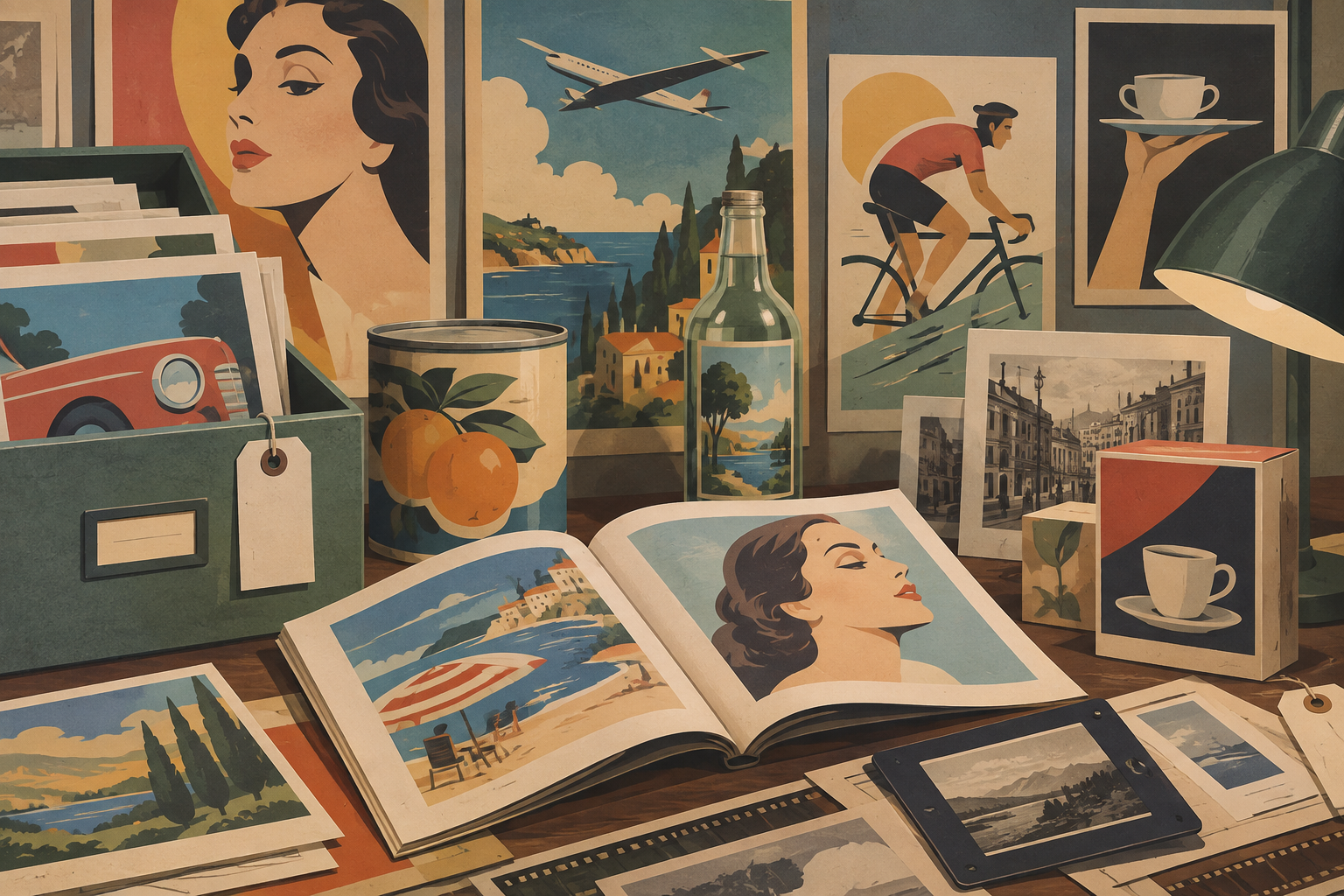
Answering requires looking in more than one direction. Format and medium matter, but so do the circumstances of production, the channels through which an item circulated and the information attached to it. The Museo de la Historia de la Publicidad presents its route as a history of formats and decades, from print to digital media, and mentions advertisements, magazines, packaging, posters, photographs and other period materials. That range suggests a useful idea: the history of advertising cannot be reduced to television commercials or the most striking poster.
From message to context
An advertising design does not speak in a vacuum. Text, image and medium belong to communication intended to inform, circulate or persuade. The encyclopedia entry on advertising places it in relation to campaigns, media and strategies; the entry on outdoor advertising notes that posters, billboards, signs and other formats occupy public spaces. These are broad definitions, not evidence of how a particular campaign worked. Interpreting a specific item requires identifying it and gathering documentation about it.
Context changes what we can claim. A preserved advertisement may allow us to study visible graphic choices, but it cannot by itself prove its reach, sales or audience reception. Nor should an image be attributed to a particular person or agency unless the documentation supports that attribution. Caution does not weaken analysis: it separates what the object shows, what a record states and what we offer as interpretation.
Archives make objects legible
Preservation is not simply storage. The Centro de Documentación Publicitaria describes its project as a way to approach advertising history through names and careers. A Hispanidad report about the Museo de la Historia de la Publicidad says that incoming materials are catalogued and added to the documentation centre’s website. The same report describes enquiries from members of the public and professionals. This is information attributed to a journalistic source, not an independent audit of the archive or a complete account of its holdings.
Cataloguing turns a collection of objects into material that can be consulted and compared. A record can connect an item to its format or context, provided those details are documented. For a visitor, that mediation matters as much as the display case: without references, a poster may be attractive but opaque; with them, it becomes a starting point for asking who produced it, whom it addressed and under what circumstances it circulated.
The exhibition communicates too
Exhibition design helps shape interpretation. The academic article on cultural marketing in museums argues for integrating the communication and mediation of heritage into an institution’s communications; it also discusses elements such as visitor routes, information and places to rest. It does not offer a single formula for exhibiting advertising, but it suggests a useful principle: objects displayed without context can become decoration, while clear interpretation helps visitors understand them as documents.
Bizkaia’s Manual de marketing y comunicación cultural addresses, among other subjects, the importance of character design in brand communication and the presence of brands across different media. This is a reminder that advertising language can extend beyond one format: characters, images and messages may form part of a wider communication strategy. It does not, however, justify assigning such a strategy to any particular object without evidence.
Compare without forcing an evolution
Putting items side by side can reveal changes in format, style or medium. The Museo de la Historia de la Publicidad website proposes a route through decades and media; Reason Why describes collections and museums associated with posters, packaging, displays and other graphic materials. These references make it possible to think of an exhibition as a comparison between objects, rather than as an inevitable march from “old” design to “modern” design.
Visible differences do not explain themselves. A chronology can order objects, but it should not turn sequence into an automatic story of progress. A causal explanation would require further evidence about production, circulation and reception. Where that evidence is absent, a good exhibition can identify the question instead of filling the gap with conjecture.
What can be preserved, and what remains open
Historical advertising has documentary value because it brings together graphic decisions and messages designed to circulate. But an archive preserves what has survived and reached it, not necessarily a complete sample of what was produced or seen. Selection, condition, cataloguing and rights all affect what can be shown and how. The sources consulted support the existence of documentation projects and advertising collections; they do not provide a comprehensive inventory or justify generalisations about every Spanish campaign.
Seeing these materials as graphic heritage does not require celebrating them. It allows us to study them with distance: recognise their design, ask about their purpose and acknowledge the limits of the record. An advertisement preserves more than a commercial promise, but it cannot tell the whole story by itself. Its memory becomes useful when object, context and caution are presented together.
- Decade
- Contemporary
- Region
- Spain
- Level
- Introduction
- Entities
- No linked entities
Sources and references
- Museo de la Historia de la Publicidad — Descubriendo la huella de la Publicidadmuseohistoriapublicidad.org · 2026-09-27
- Centro de Documentación Publicitariawww.lahistoriadelapublicidad.com · 2026-09-27
- Los museos de Publicidad que hay que visitarwww.reasonwhy.es · 2026-09-27
- Evolución y aplicación del marketing cultural en los museosbid.ub.edu · 2026-09-27
- Manual de marketing y comunicación culturalwww.bizkaia.eus · 2026-09-27
- Museo de la Historia de la Publicidad, referente de un sector que está buscando su pasado - Hispanidadwww.hispanidad.com · 2026-09-27