A publication, not just a sequence of stories
A comics magazine can be read in two ways at once. There is the story on each page, but there is also the editorial object that arranges those pages, brings them together and presents them under one masthead. That second reading matters because format shapes which works appear together and how they reach readers. Rubén Varillas’s study of magazines, fanzines, minicomic books, albums and graphic novels considers precisely how comics take different publishing forms; there is no need to rank them as more or less important. The magazine is one form among others, with its own possibilities and limits.
The distinction becomes visible when we move from a work considered on its own to a serial publication. A story may be preserved as a narrative unit, while a magazine makes it possible to study the coexistence of materials and editorial decisions in one medium. We should not assume that every magazine combines the same kinds of material or addresses the same audience: the available sources do not support such a broad claim. They do support a useful question: what do we learn when we catalogue the complete publication rather than only one story or creator?
Form also creates context
Jot Down’s article on the past and present of comics magazines describes this kind of magazine as a specialisation within publishing, whose form and content have adapted over time. This is a general observation, not a detailed chronology of every market. Its value here is to remind us that a magazine is not a neutral container. Selection, sequence and periodicity—where they can be documented—belong to the history of reading as much as the panels do.
It is important, however, to distinguish evidence from interpretation. Several works appearing in one issue may suggest an editorial programme; that fact alone does not prove what its editors intended. Establishing intention would require further materials, such as editorial statements or production documents, which are not among the sources consulted here. Reading the complete magazine allows us to observe relationships; attributing a purpose to them requires different evidence.
From publication to archive
The Reina Sofía Museum Library’s comics and fanzines collection is described as the result of research, analysis and documentation of its holdings. That description points to an important change: publications that may have been treated as ephemeral materials become part of an organised, researchable collection. The National Library of Spain’s bibliographical guide, in turn, offers a route into the history and bibliography of comics. These are different resources, but both make finding copies and references part of historical work.
An archive does not automatically restore lost context. A collection can preserve items and make them discoverable, but that does not guarantee that every detail of their circulation, reception or everyday use has been recorded. It is therefore useful to distinguish three things: the preserved object, the information describing it and the conclusions drawn from both. If one layer is missing, we should say so rather than fill the gap with an imagined scene at a newsstand or in a reader’s home.
Eightball as a specific case
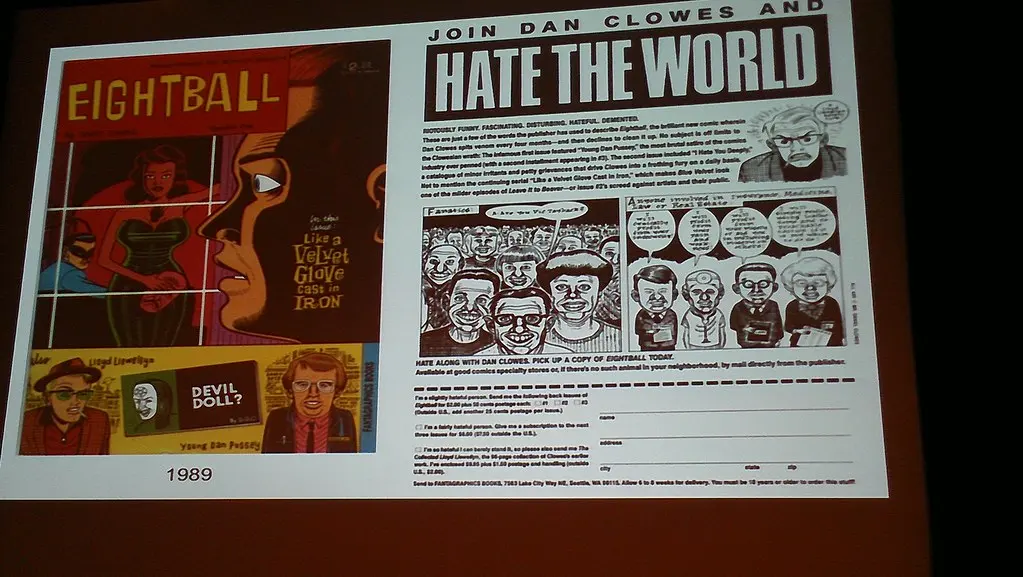
The Reina Sofía Museum video on Daniel Clowes states that he became known through Eightball, a serial publication on which he worked alone from 1989 to 2004. This provides a bounded case for thinking about the relationship between a creator and a magazine: the source identifies it as a series and gives a period of work, but the available description does not detail the contents of individual issues, their design or readers’ responses. Respecting that limit does not make the example less interesting; it prevents a biographical fact from becoming, without support, a complete history of the publication.
The value of a case like this lies in the questions it raises about what a serial collection can reveal that is not apparent when a work is isolated. Answering them rigorously would require examining the issues and documenting their differences, something that cannot be replaced by a brief institutional description. The existence of the publication and the stated period are supported; more detailed formal readings require direct consultation of the issues.
Humour, seriality and caution
The supplied entry on MAD describes it as an American humour magazine created by William M. Gaines in October 1952, focused on satire of popular culture and consumer products. It also reports that the magazine published 550 regular issues between 1952 and 2018 and that, by the end of 2019, it had stopped newsstand distribution; in 2020 it moved to a format consisting almost entirely of reprints. These details show that a magazine’s history can include editorial and distribution changes. They do not justify treating MAD as a model for every comics magazine.
The source is also an encyclopaedia entry, not a complete issue catalogue or a specialised study of every period. It can orient questions and point to facts worth investigating, but an article analysing covers, contents or reception would need more specific references. Caution does not mean avoiding examples; it means making clear what the evidence can support.
Reading the whole magazine
Studies of format, institutional collections and specific cases point towards the same practice: preserve and study the publication as a whole, while ensuring that each claim has an appropriate source. An issue can be a carrier of stories, a publishing product and an archival object at the same time. These layers are distinct, even when they complement one another.
A comics magazine should not be valued only as a precursor to the album or as a disposable container for stories. Its serial form deserves its own questions, but the answers depend on accessible issues, reliable descriptions and contextual documentation. Once those limits are acknowledged, the edges—the masthead, organisation and continuity of the publication—stop being noise around the panels. They become part of what comics history can study.
- Decade
- 1990s
- Region
- Global
- Level
- Enthusiast
- Entities
- Museum, Museo Reina Sofía, MAD, Rubén Varillas
Sources and references
- El cómic, una cuestión de formatos (2): revistas de cómics, fanzines, mini-cómics, álbumes y novelas gráficasdoi.org · 2026-09-29
- Si quieres profundizar en la historia y bibliografía sobre ...www.facebook.com · 2026-09-29
- Documentos 30. Daniel Cloweswww.museoreinasofia.es · 2026-09-29
- Cómics y fanzineswww.museoreinasofia.es · 2026-09-29
- Pasado y presente de las revistas de cómiccomics.jotdown.es · 2026-09-29
- Mad (revista)es.wikipedia.org · 2026-09-29