A new route into the home
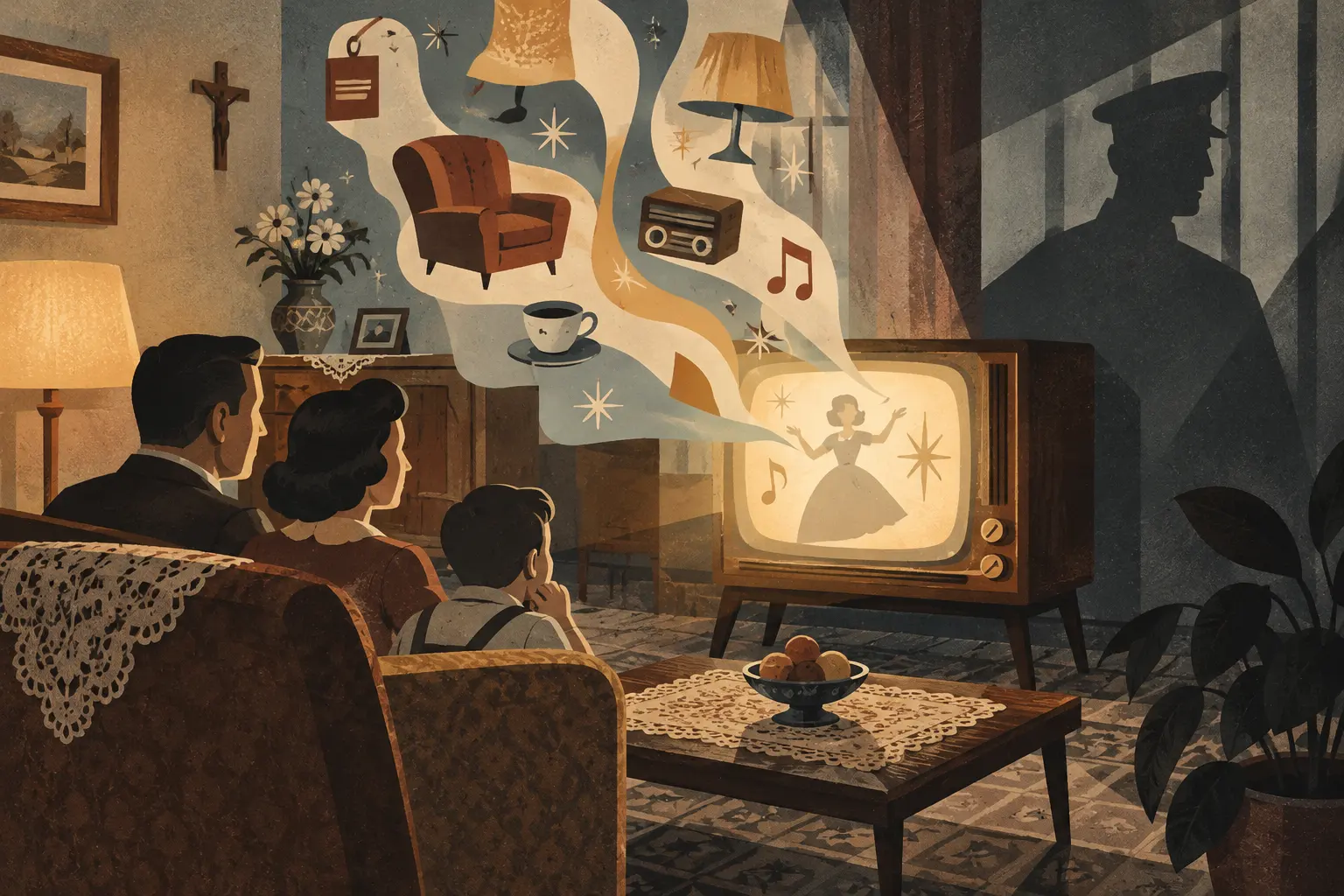
When Televisión Española began broadcasting in 1956, audiovisual advertising already had a history in cinemas. Television, however, offered brands a new way to reach people at home. The first broadcasts had limited coverage: they came from Madrid, and Spain had only about 600 television sets. Yet the cost of a set did not prevent interest in the medium. Many were bought on instalment plans, while people without one could watch at a neighbour’s home, in shop windows or in bars.
Advertising became part of this experience from the start. Commercials did more than present goods: they helped establish what television could look and sound like. In a medium still developing its language, animation, music and repeated brand names made it possible to create short messages that were easy to recognise and remember.
Animation, songs and brands
Journalist Raquel C. Pico identifies the Moro brothers and Belgian creative Jo Linten among the pioneers of Spanish television advertising. The Moros helped advance animated commercials, but faced a material constraint: suitable animation cel was difficult to obtain. According to Pico’s account, they went so far as to draw and animate on used X-rays.
The scarcity of materials went hand in hand with a clear communication formula. Animated images were paired with catchy songs, written to emphasise key moments in a story and leave the product in the audience’s memory. The jingle was not an ornament: within a few seconds of airtime it could make a name, phrase or brand-product association stick.
Those commercials also tended to explain products directly. Pico contrasts this more rational, informative approach with later advertising, in which emotional messages would take on greater importance. Music and repetition made the spots appealing and memorable; explicit explanations made the qualities attributed to each product easy to grasp.
From food to household appliances
The advertised goods reflected the priorities of consumption in Spain at the time. In the 1950s, food held a central place. Pico notes that it accounted for half of household spending in a country still carrying the legacy of postwar hunger. Television advertising thus addressed a market shaped by everyday needs and the importance of the household budget.
Household appliances became more prominent in the 1960s. Commercials presented them as goods that could transform life at home and as markers of status. Like television sets, some were bought on instalment plans. Campaigns featured celebrities and repeated brand names insistently, bringing these products into television’s images of comfort and modernity.
This was more than a shift from one product category to another. The screen showed which objects were beginning to stand for a different way of life, and which desires consumption could attach to the home. Advertising did not simply accompany the medium’s expansion: it made everyday goods part of television’s stories about the future and social standing.
Social roles and stereotypes on screen
Commercials also reveal the social assumptions that shaped the market. According to Pico, women appeared frequently because they were considered responsible for many household spending decisions. But their presence was framed by the period’s gender stereotypes and by expectations about the role women should play under the dictatorship.
National identity, too, was represented through familiar formulas. Some commercials drew on clichés about Spain and Spanishness—bullfighting, flamenco and wine—to make their messages immediately legible. These images did not offer a neutral description of society: they selected roles and symbols that advertising could repeat and turn into visual conventions.
Looking at the commercials today therefore means studying more than selling techniques. It also invites questions about who appeared as a consumer, which aspirations were linked to the modern home, and which social roles were presented as natural. Commercial images helped circulate social norms and models.
Censorship reached commercials too
Francoist censorship affected both programmes and advertising. Drawing on a documentary about early television commercials, Pico recounts the memory of an advertisement withdrawn because dancing chairs were considered too sensual. The anecdote points to a form of scrutiny that could extend to gestures, images and the tone of a commercial message—not only to what programmes said.
This control formed part of a wider television environment in which programming could also serve as propaganda for the regime. Advertising, in turn, operated within restrictions on what could be shown. Its history reveals how the growth of a new medium coexisted with political and moral limits on representation.
An archive of everyday life
TVE’s early commercials bring several histories together on one screen: television’s arrival in homes, changing consumer goods, and the formation of an advertising language built on songs, animation and repetition. They also preserve traces of a society shaped by postwar hardship and dictatorship, from the prominence of food to gender stereotypes and censorship.
They were not merely pauses between programmes. Their visual and sonic techniques helped define how brands could speak through television, while their products and representations showed which objects, aspirations and social roles found a place on screen.
- Decade
- 1950s
- Region
- Spain
- Level
- Introduction
- Entities
- Televisión, Televisión Española
Sources and references 5
- Modelo multidimensional de los factores que afectan la interacción entre marketing y ventas en el lanzamiento de nuevos productos en Latino Américadoi.org · 2026-11-18
- 10 estrategias para un lanzamiento de producto exitosoblog.hubspot.es · 2026-11-18
- Televisión - Wikipedia, la enciclopedia librees.wikipedia.org · 2026-11-18
- Cuando la televisión llegó a España: así eran los primeros anuncioswww.puromarketing.com · 2026-11-18
- Descubre las últimas tendencias en Televisoreswww.mediamarkt.es · 2026-11-18