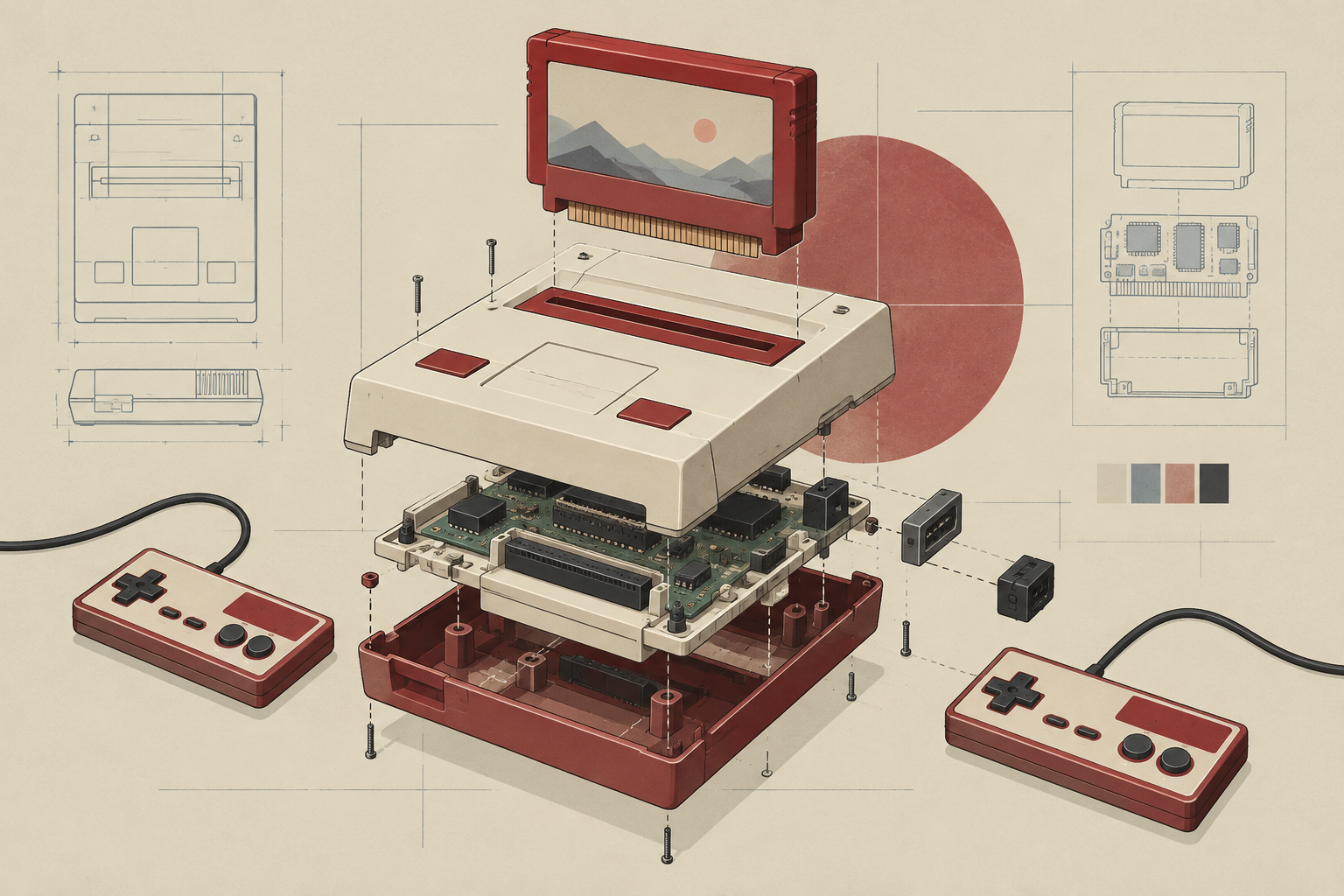
The common perception of the Nintendo Entertainment System, or Famicom in its home market, tends to reduce it to a list of technical specifications. However, available evidence suggests that this machine should be understood as an integrated system where industrial design, software architecture, and sound culture converge. It is not just an object that executes instructions, but an interface that mediated the domestic leisure experience during the 1980s. This perspective forces us to look beyond the chip to understand how manufacturing decisions and preservation policies have shaped our memory of this technology.
The Context of Production and Use
Academic and preservation sources, including Nintendo's policies, indicate that studying these machines requires considering their production and use context. The Famicom did not emerge in a vacuum; it was part of a commercial strategy that helped Nintendo consolidate its position in the entertainment market. By 1986, the company had established important commercial policies and strategies that defined how the product was presented to the public. This strategic approach implies that the console is not just hardware, but also a cultural positioning tool that interacted with the expectations of consumers of the time.
The Processor Architecture
Technical documentation mentions the use of processors like the MOS 6502 in several consoles and computers of the era, including the NES/Famicom and the Super NES/Super Famicom. This component was not exclusive but part of a family of architectures that also equipped devices like the Commodore 64 or the Apple II. The choice of this processor underscores the importance of technical architecture in defining hardware capabilities. By sharing components with other systems, the Famicom inserted itself into a network of compatibilities and limitations that developers had to navigate. This technical reality conditioned the type of games that could be created, establishing a common programming language that transcended brands.
The Percussive Aesthetics of Sound
Between 1983 and 1987, the Famicom and the NES developed a distinct sonic identity. Studies on the percussive aesthetics of these systems offer a cultural perspective on how sound and interaction defined the user experience. Sound was not an accessory but a central element of narrative and gameplay. This characteristic influenced how players perceived the machine, creating an emotional association between the device and the feeling of play. Research in this field reveals that the user experience was deeply linked to the limitations and possibilities of the audio hardware, making sound a key aspect for understanding console culture.
Storage Media and Game Library
A video console is an electronic entertainment system that executes video games contained in various media, such as cartridges, optical discs, or memory cards. In the case of the Famicom, the plastic cartridge that protected a board with chips was the main medium for storing software. This physical format was not only a technical solution but also a cultural object that users collected and shared. The game library associated with the console became an essential component of the system, defining its long-term value. The relationship between the machine and its games was symbiotic; without a robust library, the console would lack relevance, and vice versa.
Preservation Policies and Memory
Nintendo's preservation policies and other academic institutions highlight the need to document and preserve these elements. Preservation is not limited to storing machines but to understanding their relationship with the cultural environment. Avoiding the creation of unverified facts is crucial to maintaining the integrity of technological history. Documentation must prioritize the relationship between the machine and its context, recognizing that technology is not static but evolves through its use and reinterpretation. This approach allows for a more nuanced understanding of how the Famicom has been remembered and valued in the decades following its release.
Limits of Verification
It is important to recognize the limits of what can be verified through available sources. While the existence of preservation policies and the use of the MOS 6502 processor are documented, other aspects of the user experience may be more difficult to quantify. Percussive aesthetics, for example, is a subjective concept that varies according to cultural interpretation. Therefore, any analysis must stay within the margins of available evidence, avoiding speculation not supported by concrete data. This caution is essential to maintain the rigor of the report and the reader's trust.
Conclusion
The Famicom and the NES are not just relics of the video game era, but complex systems that integrate technology, culture, and design. By analyzing them as sets of interconnected decisions, we can better appreciate their impact on the entertainment industry. The lesson they offer is that the value of a machine does not reside solely in its specifications, but in the network of relationships it establishes with its users and its environment. This perspective invites a deeper reflection on how we build and preserve the memory of the technologies that have defined our daily lives.
- Decade
- 1980s
- Region
- Global
- Level
- Enthusiast
- Entities
- Commodore 64, Nintendo, Nintendo Entertainment System
Sources and references
- Punto de control: estado de las políticas de conservación ...www.academia.edu · 2026-10-16
- Afterword: Famicom Remixdoi.org · 2026-10-16
- L’esthétique percussive de la Famicom et de la Nintendo Entertainment System de 1983 à 1987doi.org · 2026-10-16
- Super Nintendo - Wikipedia, la enciclopedia librees.wikipedia.org · 2026-10-16
- ¿Por qué muchos ordenadores domésticos y consolas de ...translate.google.com · 2026-10-16
- Videoconsolaes.wikipedia.org · 2026-10-16