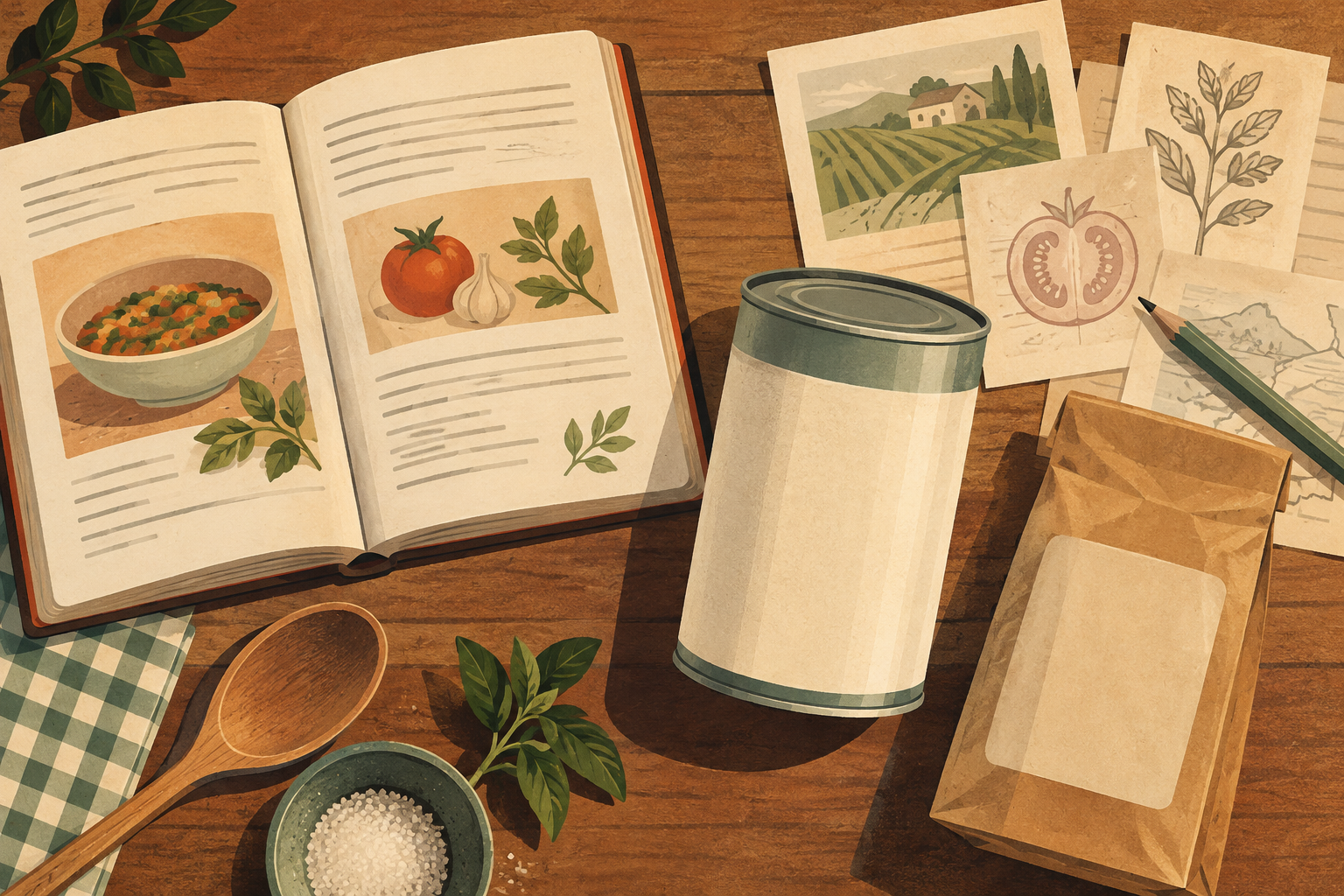
One food, several kinds of trace
A package can describe a product and its presentation; a cookbook can preserve culinary instructions; an archival document can provide institutional context or provenance. Taken alone, none of these objects reconstructs everything a person bought, cooked or ate. That distinction matters to a history of food that wants to discuss both promotion and habit without conflating them.
The sources available here point to a field of inquiry, not to a specific collection of dated advertisements or packages. FoodCultura’s archive is described as a bibliographic collection devoted to food culture, containing books, cookbooks, magazines, fanzines, CDs and memorabilia. The breadth of the collection invites questions; its description alone does not tell us what people usually cooked or how many followed a recipe.
Advertising speaks from the position of promotion
An advertisement is made to present something to an audience. Its language and imagery should therefore be read as commercial communication, not as a transparent survey of domestic practice. It can be valuable evidence for studying how a food was meant to be represented, but it does not automatically prove that an audience bought it, preferred it or consumed it as shown.
A sound interpretation would require identifying the document, its date, medium and context of circulation, then comparing it with other material. The evidence supplied here includes no specific advertisements and no circulation or sales data. It therefore cannot support claims about particular campaigns, brands, quantities or effects. This limitation does not make an advertisement useless; it sets boundaries on the questions it can answer.
A recipe is not a diary either
Cookbooks preserve instructions and ways of organizing culinary knowledge. The FoodCultura archive description confirms that such material is part of its holdings, but it provides no individual recipes or enough information to establish authorship, audience or frequency of use. A printed recipe may suggest a possible or desired practice; it does not prove that people prepared it regularly.
To approach habits, researchers need to compare sources: look at different versions, examine changes in instructions and seek independent testimony or documents that situate the text. Even then, it is important to distinguish what a recipe prescribes from what someone actually did in a kitchen. Domestic practice leaves uneven traces and is rarely preserved in full in a single document.
Archives, collections and provenance
The Spanish Ministry of Culture’s information on state museum archives says they preserve documentation concerning objects from the moment they are deposited. That observation highlights an essential task: connect an object to its records and documentary history rather than presenting it as if it spoke for itself. Castilla y León’s Archives and Gastronomy resource, meanwhile, presents documentary and bibliographic sources for learning about gastronomy.
In a specific investigation, provenance helps establish where an object came from and what documentation accompanies it. But the material supplied for this query identifies no particular tin, label, advertisement or cookbook, and describes no object’s journey. It would not be rigorous to fill that gap with an invented history. The first editorial task is to locate and describe verifiable items.
A museum does not turn one source into another
The Tenerife Museum of History and Anthropology page records the project “Food and Culture” at Casa de Carta, Valle de Guerra, for the period 1997–2000. A study of food heritage and museums is also listed in the Universitat Politècnica de València repository. These references show that food can be approached as a museum and heritage subject; the supplied information, however, does not detail the objects displayed or allow us to reconstruct a visit.
An exhibition can bring materials together and propose relationships between them, but it does not erase the differences between an advertising item, an archival document and a recipe. Responsible interpretation makes those distinctions visible: it identifies what is preserved, what is interpreted and what remains unknown. Without the relevant catalogue or records, specific objects or messages should not be attributed to the exhibition.
A reading that keeps its limits in view
Separating advertising from habits does not mean discarding either dimension. It means recognizing that they require different evidence. Packaging tells us about the presentation intended for a product; a cookbook offers prescriptive text; archives and heritage studies provide ways to locate, describe and interpret material. Multiple sources can strengthen a conclusion, provided each is cited for what it actually documents.
The evidence available supports a method, not a detailed history of a food or brand: identify the items, establish provenance, distinguish representation from practice and state what is missing. A package then stops being a nostalgic illustration and becomes a bounded source. What it cannot tell us by itself can become meaningful alongside independent documents, without confusing possibility, promotion and everyday experience.
- Decade
- 1990s
- Region
- Spain
- Level
- Introduction
- Entities
- Museum, Archivo de FoodCultura
Sources and references
- ARCHIVOS DE LOS MUSEOS ESTATALESwww.cultura.gob.es · 2026-10-09
- Cuando la comida entra en el museo: recetas, envases y ...www.retropause.com · 2026-10-09
- Archivowww.foodcultura.org · 2026-10-09
- Lo inmaterial en el museo. Museos y patrimonio alimentarioriunet.upv.es · 2026-10-09
- Archivos y Gastronomía | Archivos | Junta de Castilla y Leónarchivoscastillayleon.jcyl.es · 2026-10-09
- Alimentación y cultura. Museo de Antropología ...www.museosdetenerife.org · 2026-10-09