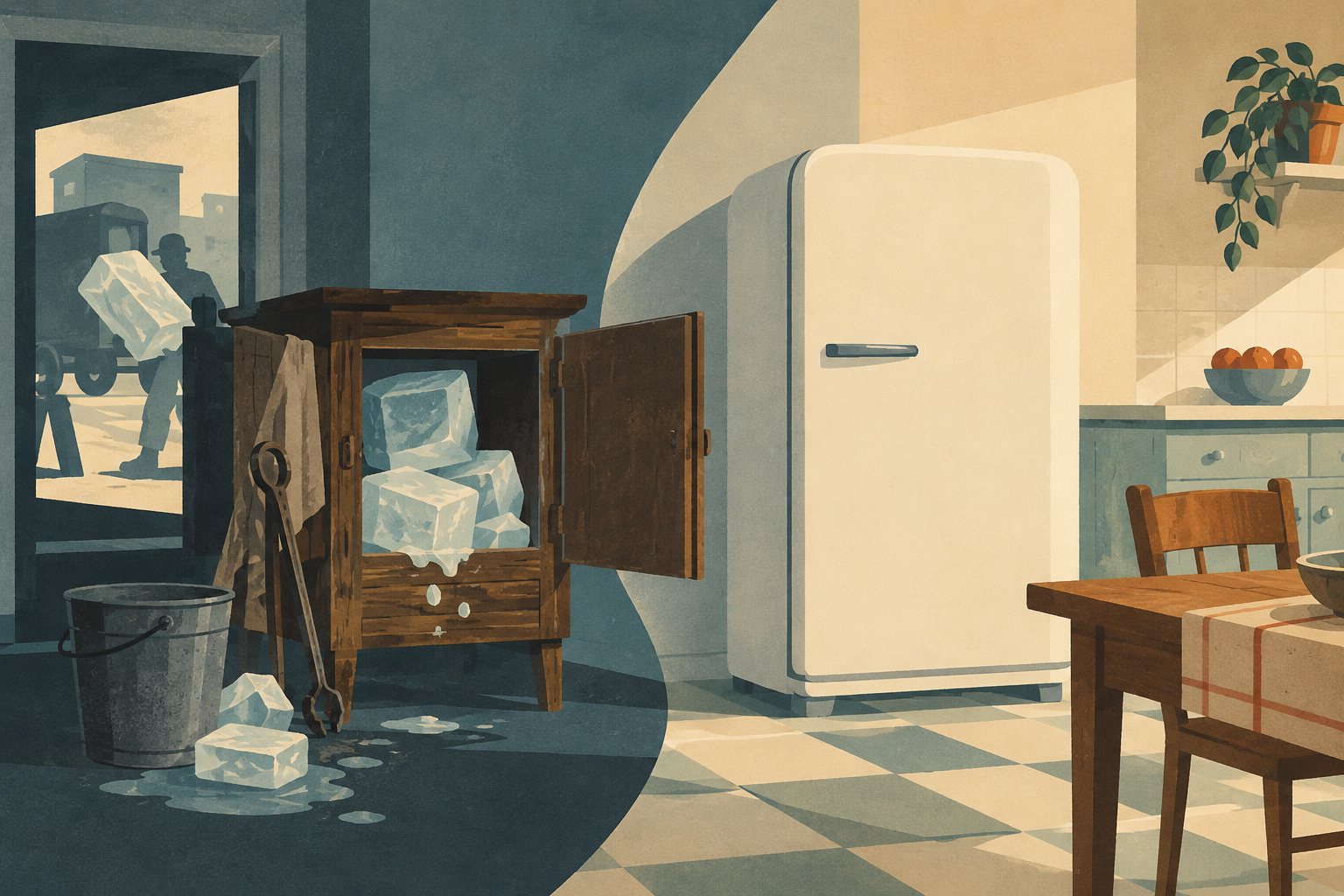
The adoption of the electric refrigerator in Argentina was not a linear process of technological substitution, but a prolonged negotiation between industrial supply and household capabilities. For decades, food preservation depended on manual methods and ice, establishing a baseline of comparison that the electric industry had to overcome. This article examines the trajectory of this change, from early promotional efforts to its numerical consolidation, highlighting the gap between sales statistics and documented domestic reality.
The origin of the 'cold battle'
In the 1930s, the industry began actively promoting the advantages of electric refrigeration. Studies on durable goods describe this period as a 'battle of cold,' a campaign aimed at convincing consumers that the electric appliance offered superiority over existing alternatives. It was not just about selling a product, but about modifying an entrenched practice. The ice refrigerator remained a viable and known option, so the new device had to demonstrate its practical utility beyond its technological novelty.
The persistence of ice refrigeration
The arrival of electricity did not immediately eliminate dependence on ice. Historical sources indicate that the ice refrigerator remained a reference point for years. This coexistence reveals that the transition was gradual and uneven. For many households, the change did not happen overnight but involved economic and logistical adaptation. The simultaneous presence of both systems in the market suggests that the adoption of the electric refrigerator depended on factors such as access to the power grid and purchasing power, rather than the immediate technical obsolescence of ice.
The role of promotion and advertising
Promotion played a central role in the diffusion of the electric refrigerator. Advertisements and marketing campaigns sought to associate the appliance with modernity and hygiene. However, available sources do not allow for a precise reconstruction of how these messages impacted the purchasing decisions of specific families. It is known that there was a clear commercial strategy, but the reception of these messages by consumers is an area where evidence is more limited. Advertising promised convenience, but the reality of installation and maintenance remained a challenge for many.
Access to electricity as a barrier
A critical factor in the adoption of the refrigerator was access to electricity. Research on electrical regulation and cooperativism in Argentina points out that the expansion of the power grid was a complex process. Not all households had reliable access to energy, which limited the utility of an appliance that depended on it. The relationship between electrical infrastructure and appliance purchases is direct: without stable electricity, the electric refrigerator was an impractical luxury. This technical dependency conditioned the pace of adoption in different regions and social strata.
Consolidation in the 1960s
The 1960s marked a turning point. According to bibliographic data, the popularization of the electric refrigerator was finally consolidated in this period. By 1970, the number of appliances in Argentina exceeded 1,300,000. This figure represents a significant scale of change, indicating that the refrigerator had ceased to be a rarity and had become a common good. The numerical consolidation reflects greater economic stability and a broader expansion of electrical infrastructure, allowing more households to incorporate the device into their daily routine.
Limitations of evidence on daily life
Despite aggregate figures, available sources have significant limitations. Studies on durable goods provide macroeconomic trends but do not detail individual experiences. It is not possible to precisely determine which models were purchased, how uses varied among households of different incomes, or how the refrigerator was integrated into family dynamics. The absence of verifiable testimonies or specific user manuals prevents a fine-grained reconstruction of daily life. The article must, therefore, distinguish between documented trends and domestic practices that remain in the shadows of history.
Conclusion: Between statistics and experience
The history of the electric refrigerator in Argentina illustrates the complexity of domestic modernization. It was a process driven by industry, conditioned by infrastructure, and adopted unevenly by the population. The 'battle of cold' was resolved in favor of electricity, but not without a long and conflictual transition. The 1970 figures mark the end of an era, but they do not explain the totality of the human experience behind each appliance. Understanding this change requires recognizing both the power of industrial promotion and the limitations of sources in capturing the diversity of Argentine domestic life.
- Decade
- 1960s
- Region
- Latin America
- Level
- Introduction
- Entities
- Heladera eléctrica
Sources and references
- la evolución de los bienes durables en Argentina, 1920-1970revistas.uniandes.edu.co · 2026-10-17
- asociacion argentina de historia economicaxxijhe.fahce.unlp.edu.ar · 2026-10-17
- la evolución de los bienes durables en Argentina, 1920-1970journals.openedition.org · 2026-10-17
- la evolución de los bienes durables en Argentina, 1920-1970www.researchgate.net · 2026-10-17
- La regulación de la electricidad en la ciudad ...www.aacademica.org · 2026-10-17
- Estado peronista y cooperativismo eléctrico: el caso de la ...www.scielo.org.ar · 2026-10-17


