An image does not arrive alone
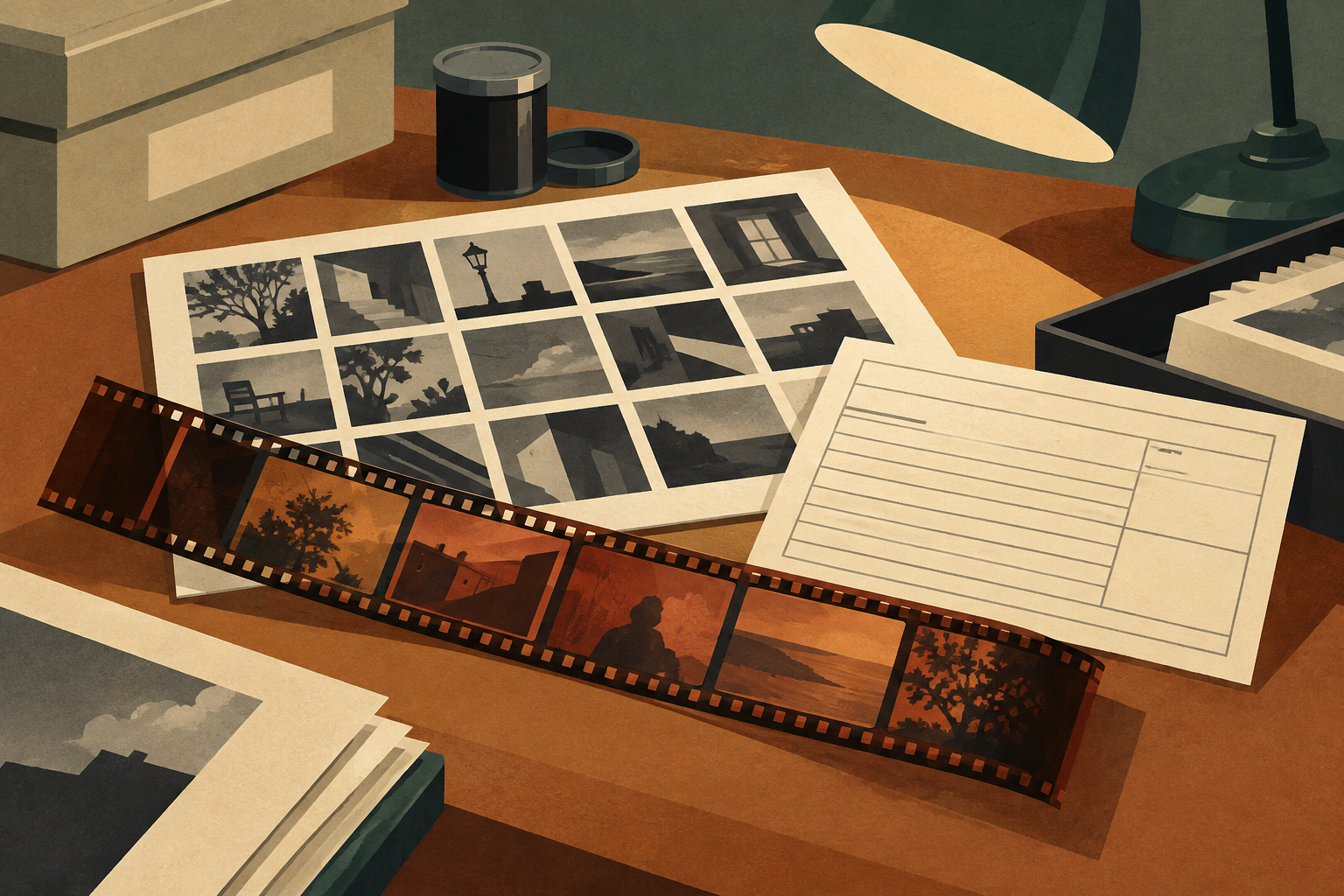
A photograph may survive as a print, a negative or a digital file. In any of these forms, looking at the image is not enough to establish every circumstance of its production. Photographic documentation helps organise information about the object, its process and its subject while keeping those aspects distinct.
That distinction matters. A visible scene may suggest an interpretation, but it does not automatically prove who made the photograph, when it was taken or what material was used. Such claims require documented evidence. A careful account also makes clear whether a description comes from an external source, an inscription on the object or an inference.
The support changes the questions
Specialist documentation considers characteristics of photographic materials, including whether the material is negative or positive film and its sensitivity. These details help describe an object and the technical information associated with its image. On their own, they do not fully explain the visual result or the circumstances in which it was made.
Distinguishing image from support prevents us from treating objects as interchangeable just because they depict the same scene. It also reminds us that a photograph is more than its visible subject: it is an object, the outcome of a production process and, sometimes, part of a chain of reproduction that needs to be described carefully.
Recording without overclaiming
A useful record can include referential information such as authorship, date, film type and format, alongside subject descriptors. Research on photographic reproduction also shows that private photographs can be studied and exhibited. In such cases, a record helps identify the material and explain why it is preserved or examined; it does not automatically turn every entry into certainty.
Caution begins with provenance. If a date is associated with an image in a catalogue, it is important to distinguish whether it is inscribed on the object, supplied by the archive that assembled it or assigned later. When the available evidence cannot settle the question, a description should preserve the uncertainty rather than fill the gap.
Description does not replace interpretation
A descriptor makes an image searchable by subject, but does not exhaust its meaning. Documentation can support searches and comparisons; interpretation requires attention to what the image shows and to verifiable conditions of its production and preservation. A record that is too brief may erase technical distinctions. One that is too conclusive may turn a hypothesis into an assumed fact.
It is therefore useful to separate fields: object identification, support characteristics, description of visible content and context backed by sources. If information is unverified, it can be marked unknown or disputed. That does not weaken an archive: it tells users what is known and what remains to be investigated.
Copying, reproducing, documenting
Reproducing a photograph creates another means of access to the image, but should not automatically be confused with the source object. A record can describe the copy being consulted and, where known, relate it to the material from which it derives. The available sources also support considering photography as a social document and research material, but they do not justify assigning an undocumented history to a particular image.
Preservation and access become more precise when a record makes the distinctions explicit: which object is described, which reproduction is being viewed and which information has been inherited from earlier descriptions. Without that separation, details belonging to a copy or its catalogue may be mistakenly presented as properties of the original.
What a record can and cannot prove
A rigorous description makes a photograph easier to find and understand, but does not replace examination of the object or research into its provenance. The support offers material evidence; metadata organises information; visual content raises questions. None of these elements, on its own, answers them all.
The record forms part of an image’s history of access because it preserves choices of description and classification. Reading it alongside the photograph helps identify both what is documented and the limits of that documentation. The aim is not to force a complete story, but to provide a record that supports research without claiming more than the evidence allows.
- Decade
- 1990s
- Region
- Global
- Level
- Enthusiast
- Entities
- No linked entities
Sources and references
- La fotografía como herramienta de documentación social aplicada en América Latinadoi.org · 2026-10-02
- Fuentes iconográficas y audiovisuales: La iconotecafvalle.wordpress.com · 2026-10-02
- Documento fotográfico como fuente histórica - bernardoriegobernardoriego.wordpress.com · 2026-10-02
- La documentación fotográficarevistas.ucm.es · 2026-10-02
- LA REPRODUCCIÓN FOTOGRÁFICA COMO FUENTE ...e-archivo.uc3m.es · 2026-10-02
- ESTUDIO DE LA NORMATIVA INTERNACIONAL ...riunet.upv.es · 2026-10-02