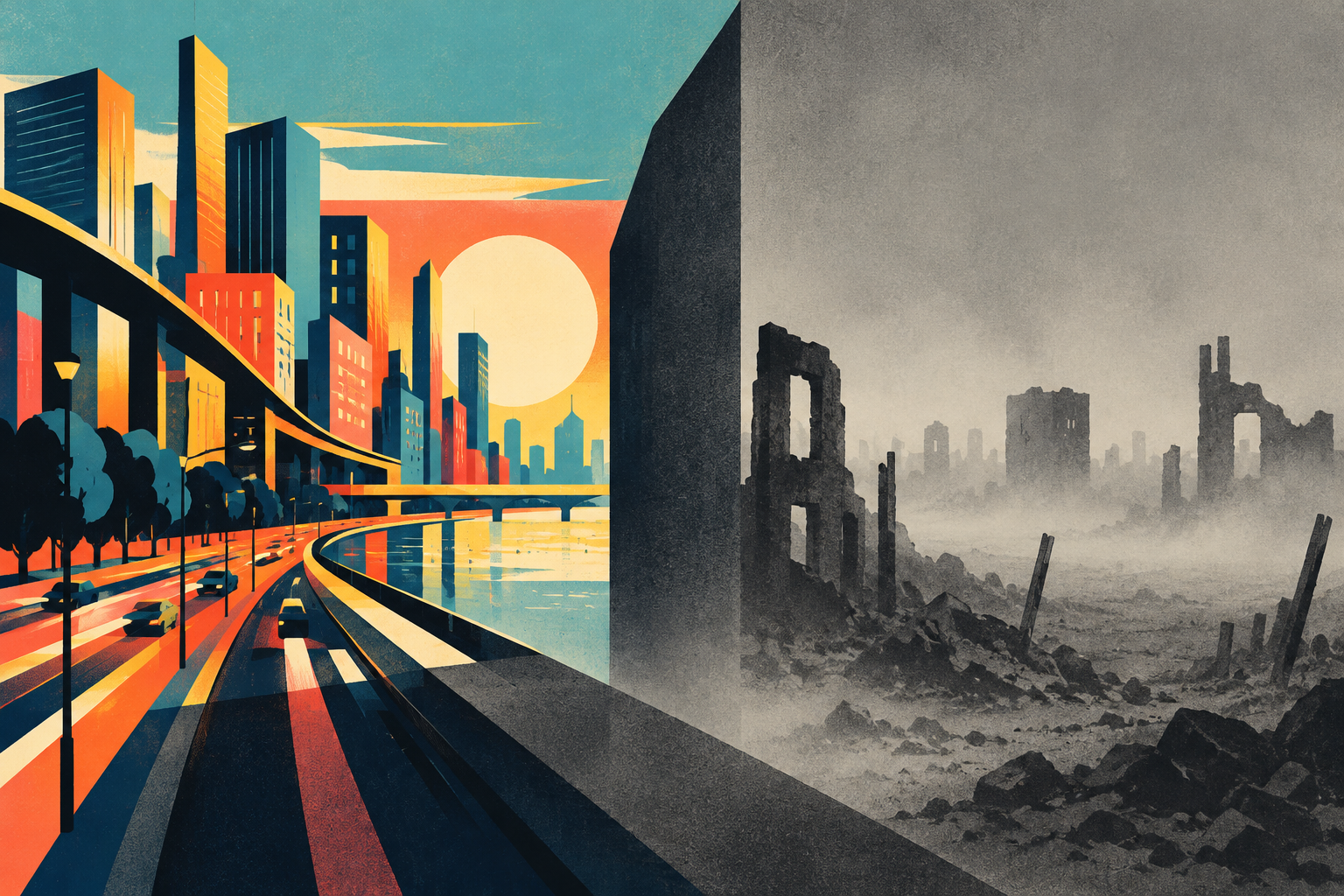
The film Night and Fog (1955), directed by Alain Resnais, does not present itself as a linear account of events, but as a reflection on the impossibility of representing catastrophe. Its relevance lies in the aesthetic decision to avoid the conventional propagandistic rhetoric of the time, opting for a structure that contrasts the vitality of everyday life with the stillness of archival images from concentration camps. This approach marked a shift in how documentary cinema addressed historical memory, particularly regarding the Holocaust.
Breaking with Traditional Rhetoric
In the post-war context, documentary films about the Holocaust often relied on an explicitly accusatory or educational tone. Resnais, along with screenwriter Jean Cayrol, chose a different path. Cayrol's text has a marked poetic and literary tone, moving away from propaganda. This choice was not minor; it sought to provoke deep reflection in the viewer rather than an immediate emotional reaction. The combination of a lyrical voice-over with static images created a unique narrative tension that has been the subject of study in multiple critical sources.
The Contrast Between Life and Death
One of the film's central strategies is editing. Resnais alternates scenes of current life, full of movement and implied color in the narrative, with black-and-white images of the camps. This contrast does not seek to compare, but to highlight the gap between the present and the past. The stillness of the archival images, which show empty landscapes or remnants of destruction, acts as a reminder of absence. Academic evidence indicates that this technique generates a tension that forces the viewer to confront the reality of the catastrophe without the mediation of explicit violence.
Absence as a Narrative Element
The film does not focus on showing direct violence, but on evoking the void it left behind. The fog in the title is not just an atmospheric element, but a metaphor for the opacity of memory and the difficulty of understanding what happened. By avoiding graphic explicitness, Resnais allows the viewer's imagination to complete the image, which can be more disturbing than direct representation. This aesthetic decision has been analyzed in studies on the evolution of documentary and its relationship with literature, highlighting its ability to address traumatic themes from an introspective perspective.
Context of the Nouvelle Vague
Although Night and Fog is produced before the full rise of the Nouvelle Vague, Resnais is considered a key figure in this movement. Along with other filmmakers, he explored new forms of cinematic narration that broke with classical conventions. The film is part of a series of Resnais's works that address history and memory, such as Les Statues meurent aussi (1953) or Guernica (1950). This thematic and formal continuity places the film within a broader search to renew audiovisual language in Europe.
Reception and Educational Legacy
The reception of the work has been analyzed in educational and cultural contexts, where its contribution to the understanding of antisemitism and the Shoah is valued. Over the decades, the film has been used as a tool for education and collective memory. Its influence extends beyond its premiere, being cited in studies on the evolution of documentary. The persistence of its relevance is partly due to its ability to remain pertinent in contemporary debates on historical memory and the ethics of representation.
Limits of Verification
It is important to note that, while the cultural impact of the film is widely documented, specific interpretations of its visual language may vary depending on the source. The provided evidence confirms the poetic tone of the text and the visual contrast, but does not detail all technical production decisions. Furthermore, the exact relationship between this film and other works of the Nouvelle Vague is often described in general terms of influence, without specifying direct causal mechanisms. The production date is generally cited as 1955, although some academic sources mention 1956 in relation to its distribution or later recognition.
Conclusion
Night and Fog remains a reference in documentary cinema for its ability to transform Holocaust memory into an aesthetic and philosophical experience. By prioritizing absence over presence and poetry over propaganda, Resnais and Cayrol created a work that continues to challenge the viewer to reflect on the limits of representation. Its legacy lies not only in its historical content, but in the way it expanded the possibilities of cinematic language to address trauma.
- Decade
- 1950s
- Region
- Europe
- Level
- Enthusiast
- Entities
- No linked entities
Sources and references
- En busca de lo real. 50 documentales esencialesopenaccess.uoc.edu · 2026-10-19
- (DOC) Vcinewww.academia.edu · 2026-10-19
- marzo 2014 – 39escalones39escalones.wordpress.com · 2026-10-19
- Recursos para el estudio del antisemitismo y el Holocaustotranslate.google.com · 2026-10-19
- el caso de Night Will Fall (André Singer, 2014)*1www.raco.cat · 2026-10-19
- Bruno Hachero Hernándezwww.tdx.cat · 2026-10-19
- La Nouvelle Vague: Revolución Cinematográfica | PDFes.scribd.com · 2026-10-19
- del cine al videoclip. de el año pasado en marienbad a toru.dgb.unam.mx · 2026-10-19